


cPanel SMTP & POP3 Settings and Outlook Setup: Step-by-Step Guide

To set up cPanel email in Outlook, copy your mail server name from cPanel's Connect Devices page and add the account manually: IMAP port 993 (or POP3 port 995) for incoming mail and SMTP port 465 for outgoing mail, both with SSL/TLS. Your username is always your full email address, and the password is that mailbox's own password, not your cPanel login.
Using Outlook instead of browser-based webmail gives you one tidy inbox, desktop notifications, calendar integration and fast search. This guide covers which SMTP, POP3 and IMAP settings to use, where cPanel shows them, the exact steps for both the new and the classic Outlook for Windows, and a quick test to run once the account is added.
The steps follow cPanel's official documentation and Microsoft Support; menu labels may vary slightly by version and language, but the logic stays the same.
What You Need Before You Start
Have these details ready before you start:
- Your full email address: for example [email protected]. cPanel uses the complete address as the username, not just the part before the @ sign.
- The mailbox password: the password set for that email account, not your cPanel login. If you have forgotten it, you can reset it on the Email Accounts page in cPanel.
- Incoming and outgoing server name: usually mail.yourdomain.com on most hosting plans, but confirm it on the Connect Devices page described below.
- Your protocol choice: decide between IMAP and POP3 up front. Outlook cannot switch an existing account from one type to the other; you would have to add the account again.
IMAP vs POP3: Which Should You Choose?
The difference between the two comes down to where your messages live. IMAP keeps them on the server and Outlook shows a synchronised view: read a message on your phone and it shows as read on your laptop; file it in a folder and it sits in that folder on every device. POP3 downloads messages to the computer. According to cPanel's documentation, a POP3 client downloads the messages and then removes them from the server, so other devices can no longer see them; Outlook's option to leave a copy on the server changes that behaviour.
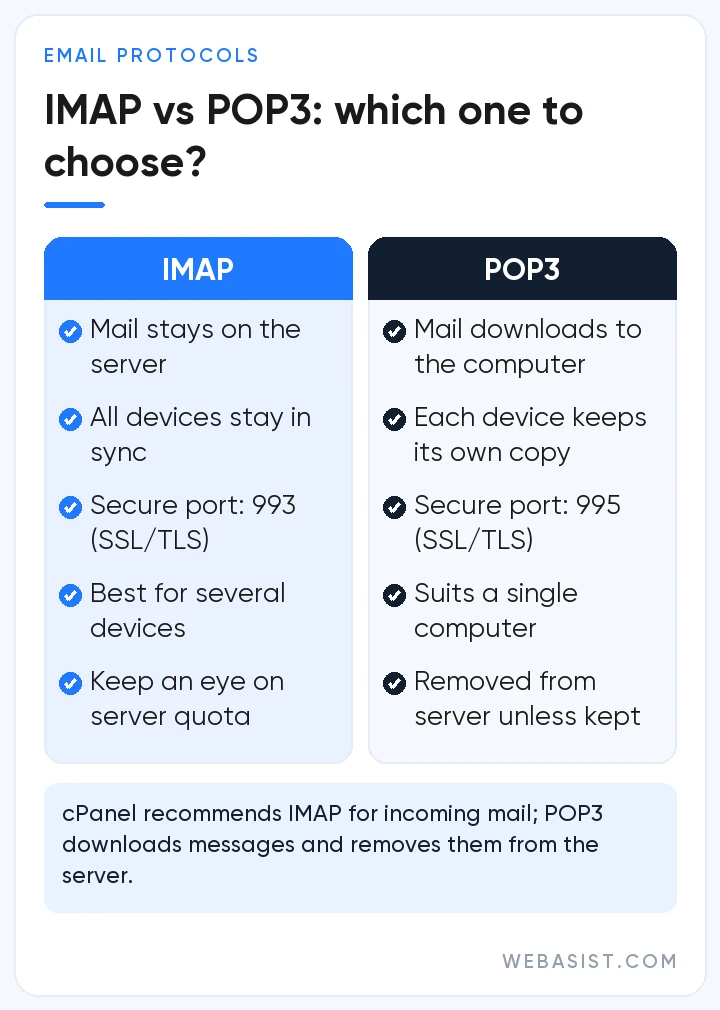
| Criterion | IMAP | POP3 |
|---|---|---|
| Where messages are stored | On the server | On the computer (after download) |
| Multiple devices | Same folders and read status everywhere | Each device keeps its own copy, no sync |
| If you replace your computer | Nothing is lost, mail stays on the server | Mail can be lost without a local backup |
| Server quota | Fills up as the mailbox grows, so archive regularly | Uses little server space if no copy is kept |
| Secure port (SSL/TLS) | 993 | 995 |
For most businesses today, IMAP is the right choice, and cPanel itself recommends IMAP with SMTP on its manual settings screen. POP3 only makes sense if you work from a single computer, have a very tight server quota or need to keep your archive locally.
Where does SMTP fit in?
IMAP and POP3 only handle incoming mail. Every message you send goes out through SMTP. Whichever incoming protocol you pick, you still need to define the outgoing server and switch on authentication for it. Skipping this step is one of the most common reasons behind the "I can receive but not send" problem.
Finding Your Email Settings in cPanel (Connect Devices)
cPanel shows the correct server name and ports for every email account, so there is no need to guess.
- Log in to cPanel. The standard address in cPanel's documentation is https://yourdomain.com:2083, and many hosting providers also let you open cPanel straight from their client area.
- In the Email section, open Email Accounts.
- Find the address you want to set up and click Connect Devices on that row. This opens the Set Up Mail Client interface.
- Scroll to Mail Client Manual Settings and note the username, incoming server, outgoing server and ports in the Secure SSL/TLS Settings box.
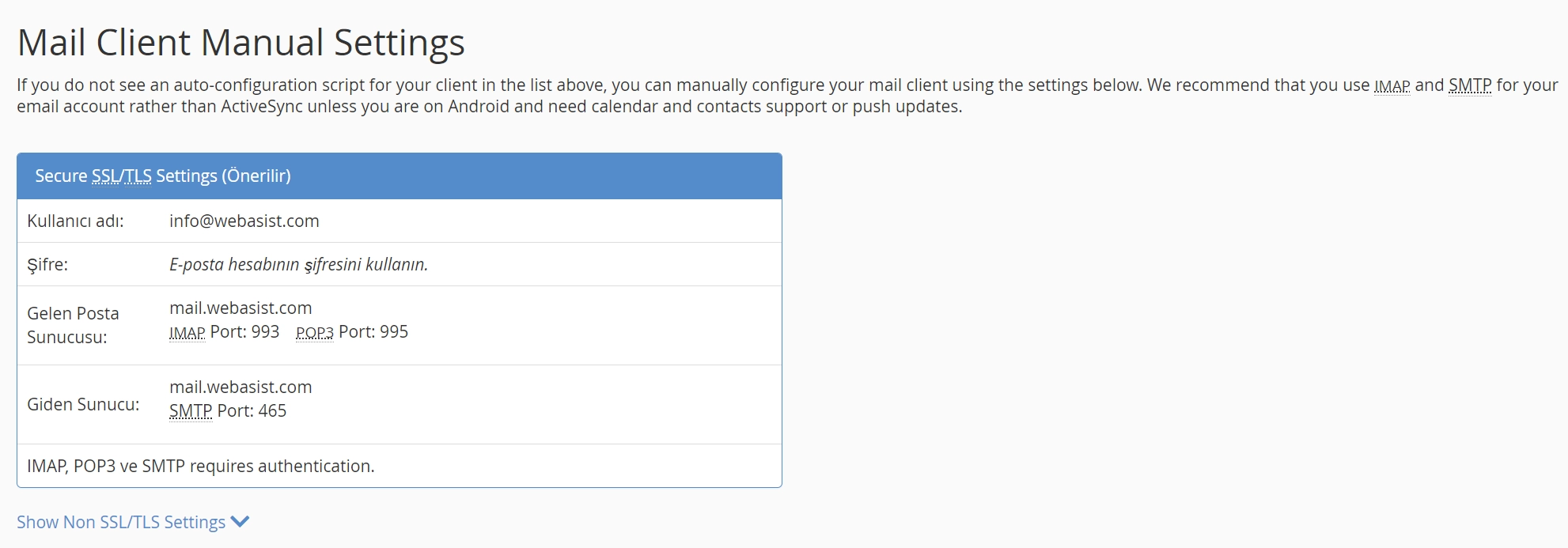
The Email Instructions field on the same page emails these settings to any address, which is handy when a colleague will do the setup without cPanel access. According to cPanel's documentation, the automatic configuration scripts at the top are offered only for specific clients such as Windows Live Mail, iOS (iPhone, iPad) and macOS Mail. Outlook is not among them, so if Outlook's own auto-detection fails you enter the settings by hand. cPanel's Set Up Mail Client documentation explains every field.
Which server name should you use?
In most cases the incoming and outgoing server is mail.yourdomain.com. However, cPanel's documentation notes that if your domain does not have a valid SSL certificate, this page shows the server's own hostname instead. Enter whatever name appears on the page. A mismatch between the name on the certificate and the server name typed into Outlook is one of the main causes of certificate warnings.
cPanel Email Ports: IMAP, POP3 and SMTP
These are the values cPanel recommends for a secure connection. Replace "yourdomain.com" with your own domain, or with the server name shown on the Connect Devices page.
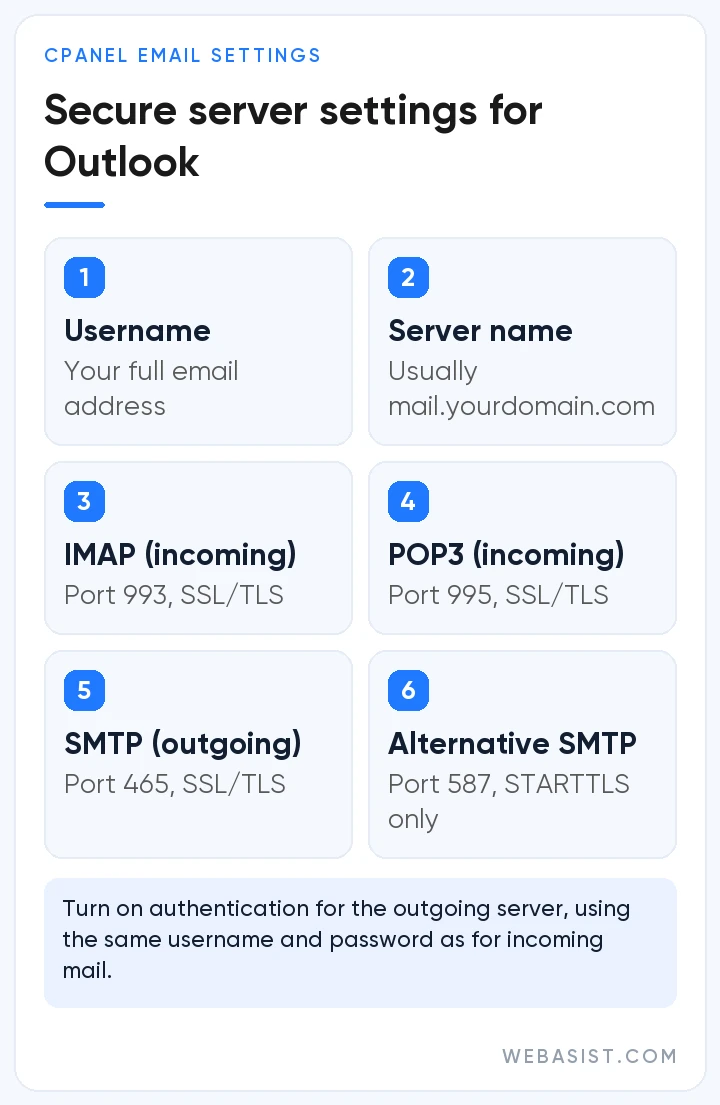
| Setting | Value | Encryption |
|---|---|---|
| Username | Full email address ([email protected]) | - |
| Incoming server (IMAP) | mail.yourdomain.com, port 993 | SSL/TLS |
| Incoming server (POP3) | mail.yourdomain.com, port 995 | SSL/TLS |
| Outgoing server (SMTP) | mail.yourdomain.com, port 465 | SSL/TLS |
| Alternative SMTP port | 587 | STARTTLS |
| Authentication | Required for IMAP, POP3 and SMTP | Same credentials as incoming |
cPanel lists unencrypted settings (IMAP 143, POP3 110, SMTP 587) separately and advises against them, since your password and messages would travel across the network unprotected. If you use port 587, always choose STARTTLS. WHM's Exim configuration has an option, on by default, that requires clients to connect with SSL or issue the STARTTLS command before authenticating, so an unencrypted attempt on port 587 will most likely fail to log in.
Adding a cPanel Account in the New Outlook for Windows
According to Microsoft's list of supported account types, the new Outlook for Windows works with accounts that connect over IMAP and POP. Here is how to add yours:
- Open Outlook and, on the View tab, select View settings. The gear icon at the top right opens the same Settings window.
- Go to Accounts > Your accounts and, under Email accounts, select Add account.
- Type your full email address and continue.
- If Outlook cannot recognise your provider automatically, it asks you to choose an account type. Pick IMAP, or POP if you really need it.
- On the form that opens, enter mail.yourdomain.com, port 993 (995 if you chose POP) and SSL/TLS for the incoming server. If the outgoing (SMTP) fields are hidden, expand the extra settings on the form (labelled Show more), then enter the same server name, port 465 and SSL/TLS for the outgoing server. Use your full email address and password for the SMTP username and password as well.
- Select Continue. Outlook tests the connection and, once the account is added, starts syncing your folders.
If you entered a wrong server detail in the new Outlook, the quickest fix is often to remove the account from the same Accounts screen and add it again with the correct values.
Adding an IMAP or POP3 Account in Classic Outlook
Classic Outlook, the desktop app that comes with Microsoft 365 subscriptions and perpetual Office licences, uses a slightly different flow:
- Select File > Add Account.
- Enter your email address, open Advanced options, tick Let me set up my account manually and select Connect.
- Choose IMAP or POP as the account type.
- In the account settings window, enter the incoming server name and port (IMAP 993 or POP3 995). For an IMAP account, choose SSL/TLS as the Encryption method; for a POP account, tick This server requires an encrypted connection (SSL/TLS).
- For outgoing mail, enter the same server name, port 465 and SSL/TLS. If you use port 587, the encryption method must be STARTTLS.
- Leave Require logon using Secure Password Authentication (SPA) unticked. Microsoft's Outlook email setup troubleshooting page also advises keeping this box unticked in IMAP settings.
- Select Next, enter your password and select Connect to finish.
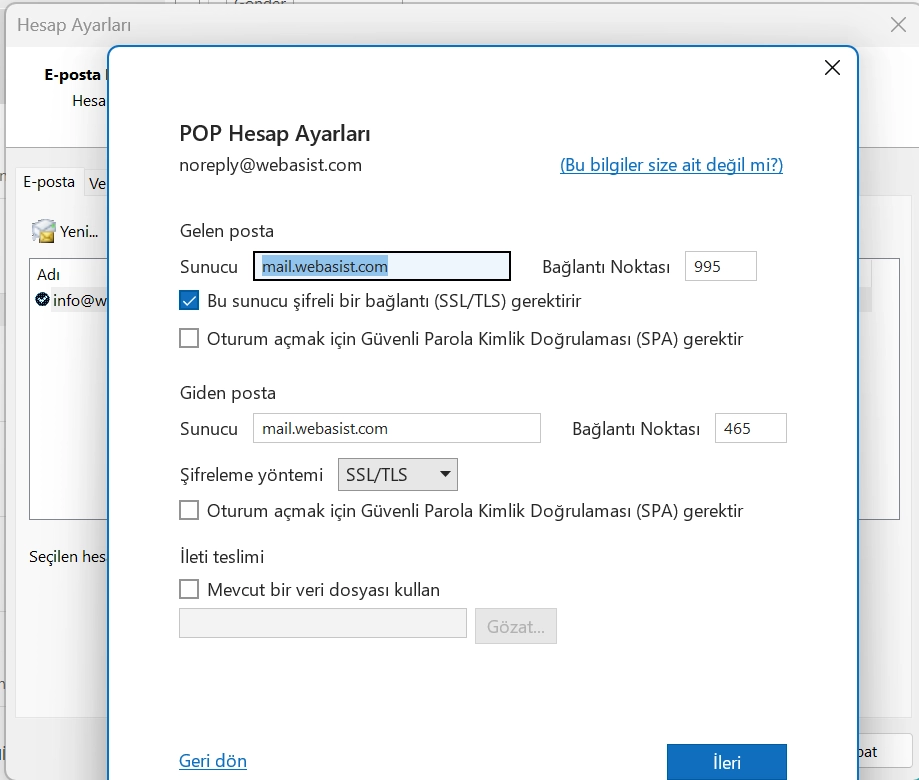
You can also find the latest version of these steps on Microsoft Support.
Changing settings on an existing account
If the account is already in Outlook, go to File > Account Settings > Account Settings, select the account and click Change. Under More Settings, open the Outgoing Server tab, tick My outgoing server (SMTP) requires authentication and choose to use the same settings as the incoming server. Then correct the port numbers and encryption type on the Advanced tab. Recent builds also offer Server Settings in the same menu, where you can change the password, server name, port and authentication on a single screen.
Using POP3? Leave a copy on the server
For POP3 accounts, the Advanced tab under More Settings includes Leave a copy of messages on the server. With this option on, Outlook downloads your mail without deleting the server copies, and you can also have them removed after a set number of days. Keep it switched on if you also check the same address on your phone; otherwise messages downloaded by Outlook may never reach the phone. Bear in mind that the copies will count towards your server quota.
Run a Quick Test After Setup
Outlook may report that the account was added, but a few minutes of testing confirms the settings really work and catches problems on day one:
- Sending test: send a test message to an address with a different provider, such as your personal email. If it arrives, your SMTP settings are correct.
- Receiving test: reply from that address and check that the reply lands in Outlook. This confirms the incoming server settings too.
- Sync test (IMAP): create a test folder in Outlook and check that it also appears in webmail. If it does, the account is syncing with the server.
- Spam folder check: if the test message landed in the recipient's junk folder, the cause is most likely your domain's email authentication records rather than Outlook, so talk to your hosting provider.
Common Errors and How to Fix Them
Outlook keeps asking for the password
Check that the username is your full email address and that the password is typed correctly, since passwords are case-sensitive. If you recently changed the password in cPanel, update the one saved in Outlook too. A quick test is to log in to webmail with the same details: if webmail works, the problem is in Outlook's settings; if it does not, the issue is with the account or the password.
You can receive email but cannot send
This usually points to the outgoing server settings. Make sure SMTP authentication is on, the port is 465 (SSL/TLS) or 587 (STARTTLS), and the encryption type matches the port. Mismatches such as port 465 with STARTTLS or port 587 with SSL/TLS stop the connection from being established. Many internet providers block outgoing port 25, so use 465 or 587 in your client settings instead.
You see a certificate warning
Outlook shows a security warning when it cannot verify the certificate of the server it connects to. View the certificate, check which name it was issued to, and change the incoming and outgoing server names to match it. If your domain has no valid certificate, ask your hosting provider to issue one through cPanel's AutoSSL feature. Clicking through the warning every time is not a real fix.
The connection times out
If the settings are right but Outlook still cannot connect, look at the network. Corporate firewalls, some guest networks and security software that scans email traffic can block ports 993, 995, 465 or 587. Trying the same settings on another network, such as your phone's hotspot, quickly shows whether the problem is the network or the configuration.
You are locked out after several failed attempts
cPHulk, a brute-force protection service that can be enabled on cPanel servers, may temporarily block IP addresses with many failed logins in a short time, and it covers mail services too. An Outlook client that keeps retrying a wrong password can trigger this block. If that happens, ask your hosting provider to check whether your IP address is blocked.
Mailbox full warnings
In cPanel, each email account can have its own storage quota. Once the quota is reached, new messages may not be delivered to the mailbox. If you use IMAP, archive older mail or raise the quota on the Email Accounts page in cPanel.
Frequently Asked Questions
What SMTP port should I use for cPanel email?
cPanel's secure settings recommend SMTP port 465 with SSL/TLS encryption. If your network blocks 465, you can use port 587 with STARTTLS instead. In both cases, authentication must be enabled for the outgoing server.
Should I choose IMAP or POP3 in Outlook?
Choose IMAP if you read your email on more than one device, because folders and read status stay in sync everywhere. POP3 is only suitable for limited cases where you want to download messages to a single computer and keep them there.
What username do I use for cPanel email in Outlook?
The username is your full email address, for example [email protected]. The password is the one set for that email account, not your cPanel login password.
How do I switch a POP3 account to IMAP in Outlook?
Outlook cannot change the type of an existing account, so you need to add the account again as IMAP. If some messages exist only on your computer because of POP3, move them into folders of the new IMAP account before removing the old one; this uploads them to the server.
Does the new Outlook for Windows support POP3?
Yes. Microsoft's list of supported account types for the new Outlook includes accounts that connect via IMAP and POP. That said, IMAP gives a smoother experience if you use several devices.
Can I use the same settings on my phone?
Yes. The same server name, ports and credentials work in mobile email apps. With IMAP, your phone and computer see the same mailbox, and cPanel also provides automatic configuration files for iPhone, iPad and macOS Mail.
Conclusion
Connecting cPanel email to Outlook comes down to three correct details: the server name from Connect Devices, SSL/TLS-secured ports, and SMTP authentication switched on. With those in place, both the new and the classic Outlook are up and running quickly, and if something goes wrong, working through the error list above usually leads to the fix.
If you would like to handle your business email, domain and hosting together with your website, take a look at WebAsist's website design service and our web design packages, which include SSL and hosting. To plan the technical side of a project, you can talk to our project consulting and management team or send us your questions through the contact page.