


Digital Marketing Trends for 2026: 8 Shifts Backed by Data
Digital marketing trends for 2026 come down to a handful of verified shifts: AI is now part of search and ad placements, privacy rules have pushed first-party data to the center, short vertical video has become the default format, shopping is moving closer to social apps and chat interfaces, and reviews carry more weight than ever in local search.
Most trend lists lean on predictions. We took a stricter route: every shift below is backed by dated data or announcements from named sources such as Google, YouTube, OpenAI, Pew Research Center, DataReportal and BrightLocal, followed by what it means in practice. We also flag the topics we think are overhyped.
1. AI-Powered Search Has Gone Mainstream
At Google I/O on May 19, 2026, CEO Sundar Pichai said AI Mode had passed 1 billion monthly active users in about a year and that AI Overviews now has more than 2.5 billion monthly active users; Google's I/O 2026 keynote recap has the details. The rollout keeps widening: on February 18, 2026, Google began bringing AI Mode and AI Overviews to users in Türkiye, in Turkish.
For many queries, people now get a synthesized answer on a single results page. What that means for brands:
- Keep content direct, clearly structured and current, answering the question in the first lines.
- Add original data, examples and first-hand experience; being different is how you get cited.
- Measure success through visibility, branded search and conversions, not clicks alone.
2. Zero-Click Search Changes How You Measure, Not Whether Search Matters
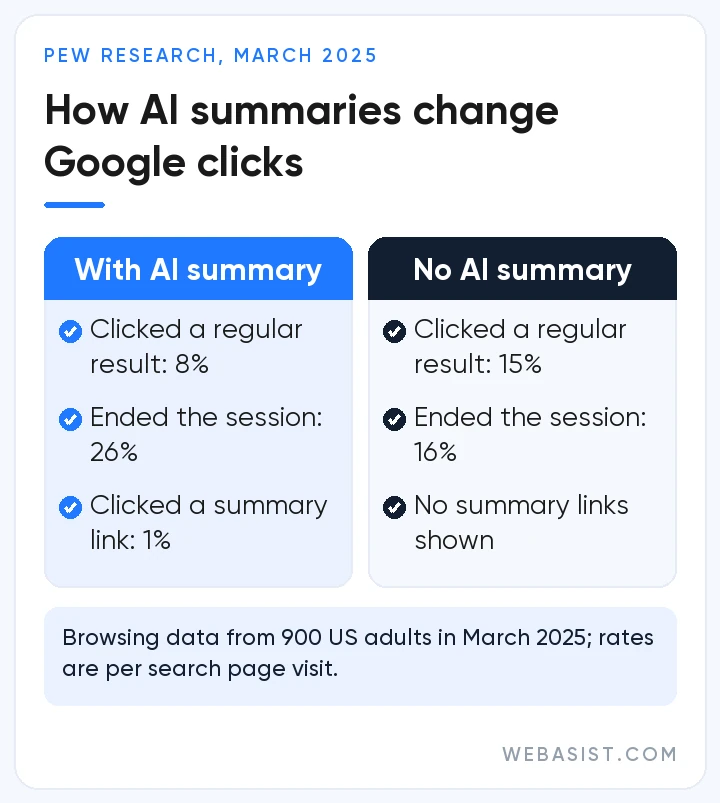
Pew Research Center, in a study published in July 2025, analyzed the March 2025 browsing of 900 US adults. When a Google results page included an AI summary, users clicked a traditional result in 8% of visits, compared with 15% when there was no summary. Clicks on links inside the summary happened in just 1% of visits, and people ended their browsing session on 26% of pages with a summary versus 16% without one. About 18% of the searches studied produced an AI summary.
Yet search is still where discovery happens. GWI data in DataReportal's Digital 2026 Global Overview, published in October 2025, shows that nearly one in three internet users aged 16 and over learn about new products and services through search engines, still the top discovery channel, even as the share of online adults who used a search engine in the past month slipped to 80.3%, the lowest level GWI has recorded for that question.
The takeaway: SEO isn't dead, but organic traffic alone is too narrow a goal. Growing branded search, strengthening owned channels like email and community, and measuring conversions across channels are core jobs for 2026.
3. Ads Are Moving Into AI Surfaces
According to Google Ads Help, ads can appear above or below AI Overviews in the 200-plus markets where AI Overviews is available, while ads inside the overview are currently limited to English in 12 countries, and Türkiye isn't on that list yet. Showing inside the overview requires AI-driven matching such as broad match, AI Max for Search, Performance Max, Shopping or Dynamic Search Ads. At Google Marketing Live on May 20, 2026, Google also announced new ad formats built with Gemini for AI-powered search and further updates to AI Max, which had just turned one.
AI assistants beyond search are becoming ad channels too. On January 16, 2026, OpenAI announced ad tests in ChatGPT's Free and Go tiers, and testing began in the US on February 9, 2026. OpenAI says ads are clearly labeled, don't influence answers and that conversations stay private from advertisers. ChatGPT ads reached 31 European countries in August 2026, and by OpenAI's September 2026 count they're available in more than 60 countries, with the self-serve Ads Manager opening market by market.
The common thread: the stronger the algorithms get, the more their inputs matter. Accurate conversion tracking, rich product feeds and quality creative assets are the price of entry. We cover this in our guide to AI-powered ad optimization, and the setup basics in our Google Ads guide.
4. Cookies Stay, but First-Party Data Matters More
The long-predicted cookieless world played out differently. On April 22, 2025, Google said Chrome would keep its current approach to user choice on third-party cookies and would not roll out a new standalone cookie prompt. On October 17, 2025, it retired most Privacy Sandbox technologies, including Topics, Protected Audience and the Attribution Reporting API, citing low adoption.
Measurement problems haven't gone away, though. Consent requirements, browser restrictions and laws such as the GDPR in Europe and KVKK (Law No. 6698) in Türkiye still limit the signals ad platforms receive. KVKK's 2024 amendment, Law No. 7499, rewrote the rules for transferring personal data abroad, so if you send server-side data to ad platforms based outside Türkiye, review that with your legal advisor too. For 2026, focus on:
- Email, CRM and membership data collected with clear consent
- Server-side connections such as Meta's Conversions API and Google's enhanced conversions
- Keeping cookie banners and privacy notices current with legal advice
You'll find the Meta side of server-side measurement in our Facebook ads guide.
5. Short Vertical Video Is the Default Format
In his annual letter of January 21, 2026, YouTube CEO Neal Mohan said Shorts now averages 200 billion daily views. Individual markets are large too: DataReportal's Digital 2026 Türkiye report, drawing on the platforms' ad tools, puts late-2025 ad reach at 57.9 million for YouTube and 62.3 million for Instagram, with TikTok reaching 44.9 million adults aged 18 and over.
Vertical video is no longer a TikTok-only habit; Shorts, Reels and X's vertical video ads all speak the same language. In practice that means 9:16 shoots, a clear hook in the first seconds, captions and formats you can turn into a series. We cover the paid side in our YouTube ads strategy guide.
6. Video Is Moving Back to the Big Screen
While short video grows, long-form viewing is shifting to the living room. In June 2025, YouTube said viewers watch more than a billion hours of YouTube on TV screens every day. DataReportal's global report, using GWI data, notes that streaming services now account for 50.4% of internet users' total TV viewing time. Even LinkedIn now offers connected TV (CTV) ads in the US and Canada, a sign that the big screen isn't just for consumer brands.
TV-screen creative needs different thinking: assume the sound is on, make logos and messages readable from across the room, and pair vertical mobile edits with horizontal versions.
7. Shopping Is Moving Closer to Social and Chat
Purchases are getting closer to where discovery happens, though not in a straight line. YouTube says more than 500,000 creators are in YouTube Shopping and that viewers will soon be able to buy recommended products without leaving the app. In September 2025, OpenAI launched Instant Checkout for buying directly in ChatGPT in the US, along with the open Agentic Commerce Protocol built with Stripe. In March 2026 it changed course: people now discover and compare products in ChatGPT and finish the purchase on the merchant's own site or app, with the protocol serving as the pipe for merchants' product feeds. At Marketing Live 2026, Google expanded its Universal Commerce Protocol to new verticals and introduced Universal Cart.
Most of these features launch in the US first. The right preparation elsewhere is clean product data: accurate prices and stock, clear titles and descriptions, strong images and structured data. Those basics drive visibility in Google Merchant Center, social catalogs and AI assistants alike.
8. Local Search Runs on Reviews
BrightLocal's Local Consumer Review Survey, published on February 11, 2026 and based on 1,002 US consumers, found that 97% read reviews when choosing local businesses. The bigger change is where they look: the share using ChatGPT and other generative AI tools for local recommendations jumped from 6% to 45% in a year, while the share using Google as a review source fell from 83% to 71%, though Google still leads.
The data is from the US, but the direction applies widely, and AI answers such as Google's AI Overviews draw on and link to sources across the web. Keeping your Google Business Profile complete, using consistent name, address and phone details everywhere and replying to reviews regularly are the basics of local visibility in 2026.
What's Overhyped: Where to Be Cautious
Every year some topics get more attention than behavior justifies. In DataReportal's global report, analyst Simon Kemp argues that ideas like agentic marketing, where AI agents do the shopping, aren't yet shaping consumer behavior at scale. OpenAI's decision to step back from in-chat checkout and send buyers to merchant sites points the same way: the bridge from AI discovery to AI payment isn't settled yet. Our advice is similar:
- Treat AI as a tool that speeds up production and analysis, not a replacement for strategy, and keep human review in the loop.
- Don't buy the “SEO is dead” line; search engines remain the biggest discovery channel.
- Go deep on the two or three channels where your audience actually is instead of joining every new platform at once.
A 2026 Action Plan
You don't need to invest in every shift at once. The table below pairs each trend with a first step you can take this quarter and the metric that shows whether it's working.
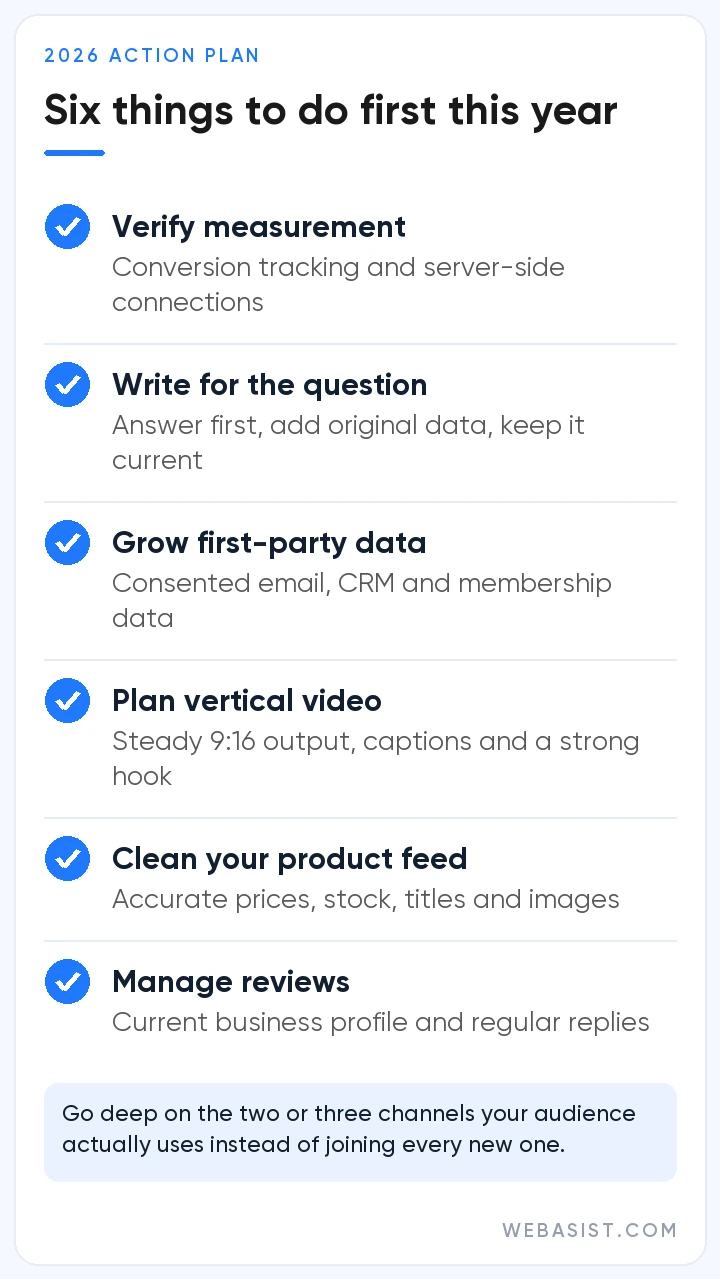
| Trend | First step | Metric to watch |
|---|---|---|
| AI-powered search | Rework your top-traffic pages so they answer questions clearly | Visibility, branded search |
| Ads in AI surfaces | Verify conversion tracking, then test broad match and AI Max in a controlled way | Cost per conversion, conversion value |
| First-party data | Set up consent management and server-side conversion connections | Number of measured conversions |
| Short vertical video | Build a steady monthly 9:16 production calendar | View rate, video-assisted conversions |
| Big-screen video | Track TV-screen performance separately in YouTube campaigns | Reach, brand lift |
| Social and chat commerce | Clean up your product feed and catalog | Feed errors, catalog sales |
| Local search | Update your business profile and define a review-response routine | Review count and rating, profile actions |
Frequently Asked Questions
What is the biggest digital marketing trend in 2026?
The widest-reaching change is AI becoming part of search and ad placements. Google says AI Overviews has more than 2.5 billion monthly active users and AI Mode more than 1 billion, which affects both SEO and search advertising.
Is Google AI Mode available in Turkish?
Yes. Google began rolling out AI Mode and AI Overviews in Türkiye, in Turkish, on February 18, 2026, across search results and the Google app for Android and iOS.
Can you advertise on ChatGPT?
Yes, though access varies by country. OpenAI began testing ads in the US in February 2026 and said in September 2026 that ChatGPT ads were available in more than 60 countries. The self-serve Ads Manager is rolling out market by market, so check OpenAI's Ads Manager availability page for your country.
Will AI search kill SEO?
No, but it changes how SEO is measured. Click-through rates can fall on queries with AI summaries, yet search engines are still the main way people discover brands. Clear, original and current content improves your chances in both classic results and AI answers.
Are third-party cookies going away in 2026?
Not in Chrome. In April 2025, Google said it would keep its current approach to third-party cookies. Consent rules, browser limits and privacy laws still restrict tracking, so first-party data and server-side measurement remain essential.
Where should a small business start?
Reliable conversion tracking and an up-to-date Google Business Profile usually deliver the fastest return. Then add content that answers customers' most common questions and a steady rhythm of short videos. On a tight budget, consistency in one or two channels beats spreading thin.
Conclusion
The winners in 2026 won't be the brands that chase every headline, but those that read verified shifts and strengthen the fundamentals: solid measurement, owned data, steady video production and a brand people trust, including in AI answers. We can help you decide which of these trends matter most for your sector and budget. Explore our project consulting and management service or contact us for a roadmap built around your brand.