


Google Ads Advertising Models: 2026 Campaign Types Compared
Google Ads campaign types decide where your ads can appear, which formats you can use (text, image, video or product listings) and which bidding goals make sense. In 2026 the main options are Search, Performance Max, Demand Gen, Display, Video, Shopping and App campaigns, and the right choice depends on your goal, your account data and your creative assets.
The lineup has changed a lot in two years. Conversion-focused Video action campaigns were folded into Demand Gen, Google announced in May 2026 that Display campaigns will follow, and AI Max added a new automation layer to Search and Shopping. Many "types of Google Ads" lists online still describe map ads, smart ads or remarketing as separate products, which no longer matches what you see in the campaign builder.
This guide walks through each Google Ads advertising model, then gives you a comparison table and a goal-to-campaign map so you can decide quickly. If you are new to the platform, our Google Ads guide covers account structure and budgeting basics first.
Why the campaign type matters so much
When you create a campaign in Google Ads, you start by picking an objective such as sales, leads, website traffic, app promotion, local store visits or YouTube reach. Google then suggests the campaign types that fit that objective; if you want to see every option, choose to create a campaign without a goal's guidance. The type you pick locks in five things at once:
- Inventory: whether your ads run on Google Search, YouTube, Gmail or partner websites and apps.
- Targeting logic: keywords, audience signals or a product feed.
- Ad formats: text, image, video, carousel or product cards.
- Bidding options: strategies built around clicks, views, conversions or conversion value.
- Reporting depth: how much visibility you get, from search terms to channel-level breakdowns.
Picking the wrong type usually shows up as "the ads are live but nothing happens". Two classic examples are buying cheap visual reach when you actually need people who are ready to buy, and launching a fully automated campaign in an account with no conversion tracking.
Google Ads campaign types in 2026
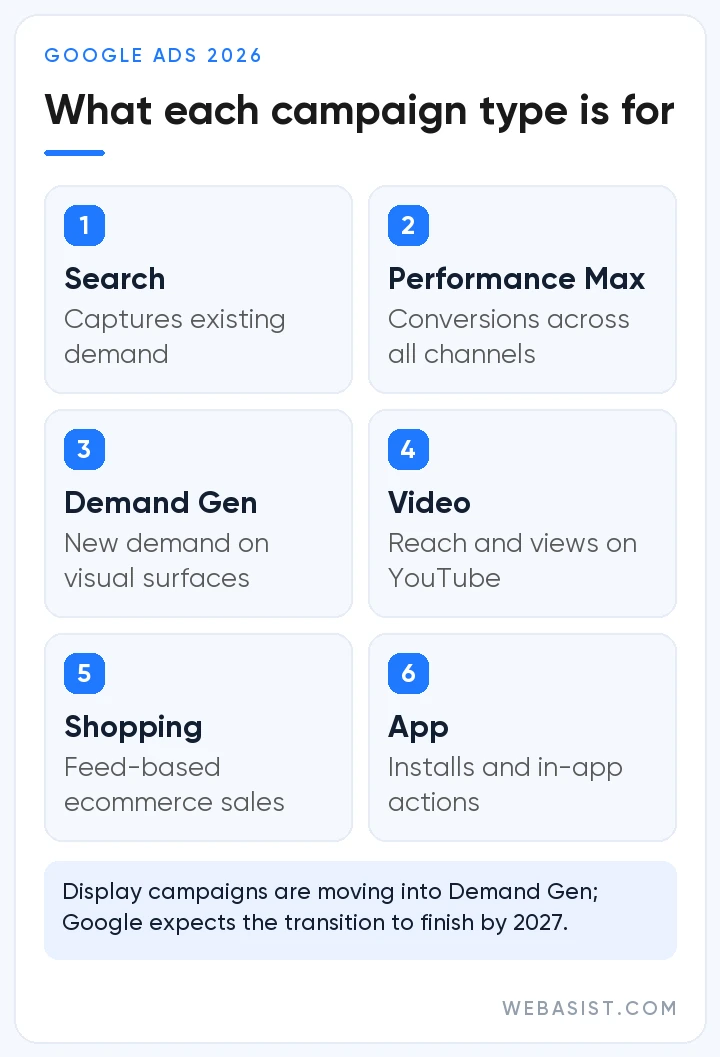
Below, each campaign type is covered by where it shows, which goal it serves and what it needs from you. First, a quick summary:
1. Search campaigns
Search campaigns show text ads above or below Google search results when someone types a relevant query. Their strength is capturing demand that already exists: a person searching for "emergency plumber near me" has a clear and often urgent need. Keywords, responsive search ads and a focused landing page are the three core building blocks. The optional AI Max suite adds search term matching, text customization and final URL expansion, helping you reach relevant queries your keyword list misses. Google has also announced that campaigns using Dynamic Search Ads will be upgraded to AI Max automatically starting in February 2027.
For service businesses, B2B companies and local providers, Search is usually the first campaign to build. We explain the auction, Quality Score and match types in detail in our guide to Google Search ads.
2. Performance Max
Performance Max is built around your conversion goals and buys across every Google Ads channel from one campaign: Search, YouTube, Display, Discover, Gmail and Maps. You provide conversion goals, a budget, asset groups (headlines, descriptions, images, logos, videos) and audience signals; Google AI decides bids, placements and asset combinations. Ecommerce brands can attach a Merchant Center feed to serve product ads, and businesses with physical locations can run it with store goals.
You still have levers to pull: brand exclusions, negative keywords, search themes, the final URL expansion setting and channel performance reporting. According to Google's documentation, when a query matches an exact match keyword in one of your Search campaigns, the Search campaign takes priority over Performance Max. Reliable conversion tracking and high-quality creative in several aspect ratios are non-negotiable if you want Performance Max to work well.
3. Demand Gen
Demand Gen is built to reach people who are not searching for you yet but are likely to be interested, using visually rich ads. It serves on YouTube (including Shorts, in-stream and feeds), Discover, Gmail, the Google Display Network and, in beta, Maps. Single image, carousel (2 to 10 cards), video and product feed ads are all supported. Compared with Performance Max, you keep more control: you can use lookalike segments and restrict delivery to specific channels, for example YouTube Shorts only.
Demand Gen is also absorbing two older campaign types. Video action campaigns have been upgraded into it: new ones could no longer be created from April 2025, and Google says the last remaining campaigns were migrated automatically in April 2026. The Display transition is still under way.
4. Display campaigns and the move to Demand Gen
Display ads appear as banners or responsive ads across millions of partner websites and apps in the Google Display Network (GDN). Advertisers use them for awareness through audience, topic and placement targeting, and above all to re-engage people who have already visited their site.
On May 26, 2026, Google announced that Display campaigns are moving into Demand Gen as "Google Display Network (GDN) on Demand Gen". A migration tool began a phased rollout to eligible accounts in June 2026. At a later stage, new display campaigns can only be created inside Demand Gen, and remaining eligible campaigns will be migrated automatically without any action from the advertiser. Google has not given firm dates for these steps yet; it says it expects the transition to be complete by 2027. GDN inventory stays available, and what changes is the campaign type you use to reach it: if you want display-only delivery, Demand Gen channel controls let you keep it.
There are practical differences to plan for. Manual CPC bidding is not supported in Demand Gen (target CPC is the suggested alternative), custom promo text and price prefixes must be removed before migrating, and uploaded HTML5 ads are planned for late 2026. You can follow the current timeline on the Google Ads Help Center migration page, and check image dimensions and file rules in our display ad sizes guide.
5. Video campaigns (YouTube)
Video campaigns now focus mainly on reach, views and engagement; in the campaign builder this objective is called "YouTube reach, views, and engagements". Subtypes include efficient reach, non-skippable reach, target frequency, video views, ad sequence and subscriptions and engagements. Skippable and non-skippable in-stream ads, short bumper ads, in-feed ads and Shorts ads all run here.
If your goal is direct sales or leads, conversion-focused YouTube ads now run through Demand Gen (or Performance Max, which covers every channel). We cover the step-by-step setup of each format in our YouTube ads setup guide.
6. Shopping campaigns
Shopping ads are product cards with an image, price and store name that appear in search results and on the Google Shopping tab. You need a Google Merchant Center account with a product feed; instead of choosing keywords, you let Google match queries to the titles, descriptions and categories in your feed. In practice, your product titles and descriptions do the job a keyword list does in Search, so the more carefully the feed is written, the better the matching. Retailers with physical stores can also promote in-store stock with local inventory ads.
On April 30, 2026 Google introduced AI Max for Shopping campaigns: existing campaigns can be upgraded in one click to add ad text generated for the shopper's query, landing pages matched to intent and automatic selection between text and Shopping ad formats, while product targeting and bidding settings stay in place.
7. App campaigns
App campaigns are designed for mobile app owners. Google builds the ads automatically from your app store listing and the text, images and videos you provide, then serves them across Search, Google Play, YouTube, Discover and sites and apps in the Google Display Network. Eligible accounts can choose between three subtypes: app installs, app engagement and pre-registration for Google Play. The real success factor is in-app conversion tracking for valuable post-install actions such as sign-ups, purchases or subscriptions; without it, the system simply learns to find cheap installs.
Things you will not find as separate campaign types anymore
- Remarketing: an audience method, not a campaign type. "Your data" segments built from site visitors or customer lists can be used in Search, Demand Gen, Display and Video campaigns, and act as audience signals in Performance Max.
- Map and local ads: Local campaigns were upgraded to Performance Max in 2022. Store visit goals now run through Performance Max for store goals, and Maps inventory is also available in Demand Gen (beta).
- Smart campaigns: the simplified option for small businesses can only be created in Smart Mode. In Expert Mode, the closest equivalents are Search or Performance Max.
- Video action campaigns: upgraded to Demand Gen and no longer offered as a separate option.
Comparison table: Google Ads campaign types at a glance
| Campaign type | Where it shows | Main format | Best for | Must-have preparation |
|---|---|---|---|---|
| Search | Google search results (optionally search partners) | Text (responsive search ads) | Capturing existing demand: sales, leads, calls | Keyword research, a focused landing page |
| Performance Max | Search, YouTube, Display, Discover, Gmail, Maps | Ads assembled automatically from asset groups | Scaling conversions or conversion value across all channels | Reliable conversion tracking, a rich creative set |
| Demand Gen | YouTube (incl. Shorts), Discover, Gmail, GDN, Maps (beta) | Image, carousel, video, product | Creating new demand, mid-funnel conversions | Strong images and video, an audience strategy |
| Display | Partner sites and apps in the GDN | Responsive display ads, banners | Awareness and remarketing | Correctly sized images, a Demand Gen migration plan |
| Video | YouTube and Google video partners | In-stream, bumper, in-feed, Shorts | Reach, views, brand awareness | Videos uploaded to YouTube, a frequency plan |
| Shopping | Search results, Google Shopping tab | Product cards (image, price, store name) | Ecommerce sales | Merchant Center account and a clean product feed |
| App | Search, Google Play, YouTube, Discover, partner apps | Automatically generated text, image and video ads | Installs, in-app actions, pre-registration | Store listing, in-app conversion tracking |
Which campaign type fits which goal?
Don't ask which campaign type is the newest; ask where your customer is in their buying journey right now. The mapping below is a sensible starting point for most businesses:
| Your goal | Start with | Add next |
|---|---|---|
| Get calls or form leads from people searching for your service | Search | Test AI Max or Performance Max once conversions build up |
| Sell products online | Shopping or feed-based Performance Max | Demand Gen with a product feed to reach new audiences |
| Launch a new brand or product | Video (reach) or Demand Gen | Remarketing to people who engaged |
| Win back visitors who didn't convert | Demand Gen or Display with your data segments | Use the same segments as Performance Max audience signals |
| Drive visits to a physical store | Performance Max for store goals | Search for local queries |
| Grow app installs and usage | App (installs) | App (engagement) |
Combining campaign types: a five-step roadmap
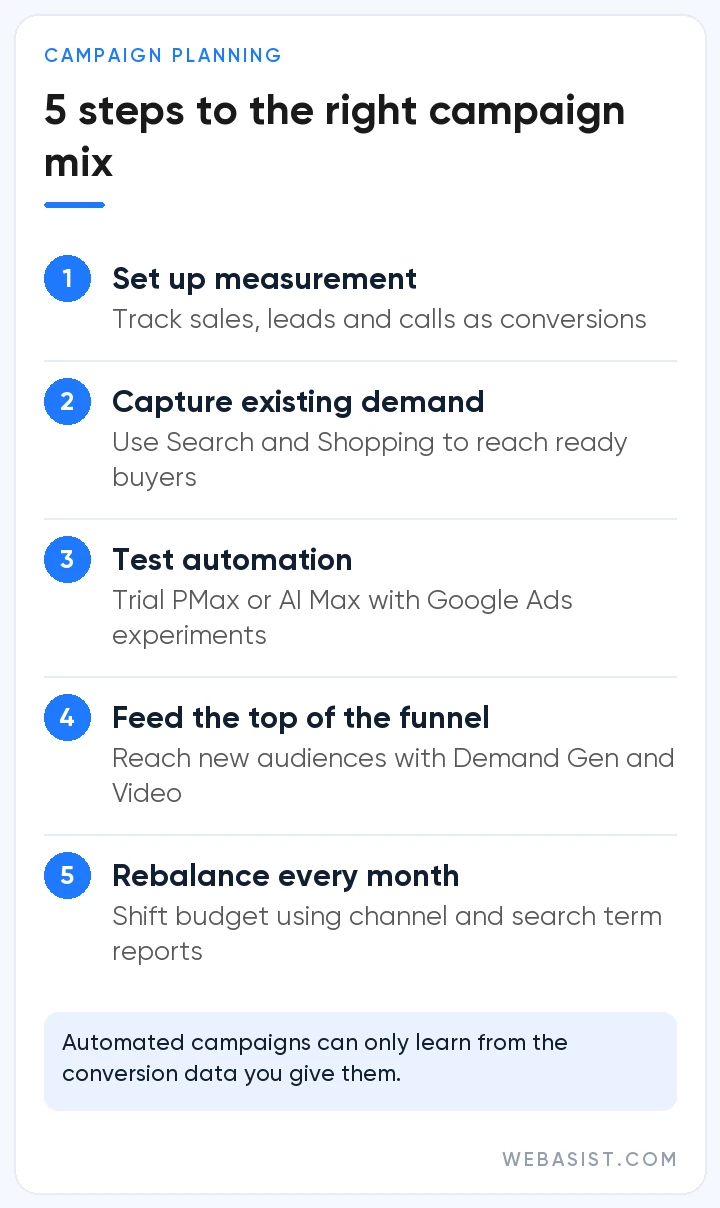
- Set up measurement first. Define your conversion actions (purchases, forms, calls) correctly and turn on enhanced conversions where possible. Automated campaigns can only learn from the data you give them.
- Capture existing demand. Start with Search and/or Shopping. They deliver results quickly and show you which queries actually convert.
- Add automation in a controlled way. Once you have conversion volume, test Performance Max or AI Max with Google Ads experiments, and keep a close eye on brand queries and budget split.
- Feed the top of the funnel. Use Demand Gen and Video to reach new audiences, and judge them not only by last-click conversions but also by growth in branded searches and remarketing lists.
- Rebalance regularly. Review budget allocation monthly using channel reports, search terms and cost-to-value ratios.
Frequently Asked Questions
How many campaign types does Google Ads have?
In Expert Mode the main types are Search, Performance Max, Demand Gen, Display, Video, Shopping and App. Smart campaigns for small businesses are only available in Smart Mode. As Display campaigns move into Demand Gen, the list will get shorter over time.
Which Google Ads campaign type is best for beginners?
If people search for your product or service on Google, a Search campaign is the safest starting point, and online stores can add a Shopping campaign. Once the account has steady conversion data, testing more automated types such as Performance Max or Demand Gen reduces the risk of wasting budget during the learning period.
What is the difference between Performance Max and Demand Gen?
Performance Max looks for conversions across every Google channel, including Search and Shopping, and hands most decisions to Google AI. Demand Gen is designed to create new demand on visual surfaces such as YouTube, Discover, Gmail and the Display Network, and gives you more control over audiences, channels and creative testing.
Are Google Display campaigns going away?
The Display Network is staying; what changes is where you buy it. Google has announced that display campaigns will be managed inside Demand Gen as "Google Display Network". A migration tool started rolling out in June 2026, and at a later stage new display campaigns can only be created in Demand Gen while remaining ones are migrated automatically. Google expects the transition to be complete by 2027.
Which campaign type should I use for remarketing?
Remarketing is not a separate campaign type. You can use your data segments, built from site visitors, app users or customer lists, in Demand Gen, Display, Video and Search campaigns, and add them to Performance Max as audience signals.
Can Performance Max and Search campaigns run at the same time?
Yes, they can run side by side in the same account. According to Google, when a search query is identical to an exact match keyword in your Search campaign, the Search campaign takes priority over Performance Max. To limit unwanted overlap, use brand exclusions and negative keywords in Performance Max and compare the search terms of both campaigns regularly.
Conclusion
The right Google Ads campaign type depends on where your customers are in their journey and how much data your account has. In 2026 the picture is getting simpler: Search and Shopping capture active intent, visual surfaces are consolidating under Demand Gen, and Performance Max brings every channel together in one campaign. If you are unsure which combination fits your business, our Google Partner team can review your account as part of our Google Ads management service and recommend a structure built around your goals. Contact us to request an initial review.