

Google Ads Display Network Ad Sizes and Specs: 2026 Guide

Google display ad sizes depend on the type of ad you run. For responsive display ads you upload landscape 1.91:1 images (1200×628 pixels recommended) and square 1:1 images (1200×1200 pixels recommended), and Google resizes the ad for each placement. If you upload your own banners instead, fixed dimensions such as 300×250 or 728×90 and a 150 KB file limit apply.
Getting this wrong has real consequences: an image in the wrong size or a heavy file either fails at upload or quietly limits where your ad can serve. In 2026 there is an extra reason to get it right, because Google is moving display campaigns into Demand Gen, which also uses vertical image formats.
The tables below reflect the specifications published in the Google Ads Help Center as of September 2026. Google updates these values from time to time, so it's worth checking the official pages before you start a large creative production.
First decide: responsive or uploaded display ads?
The Google Display Network has two main ad types, and the assets you need to prepare depend entirely on which one you choose:
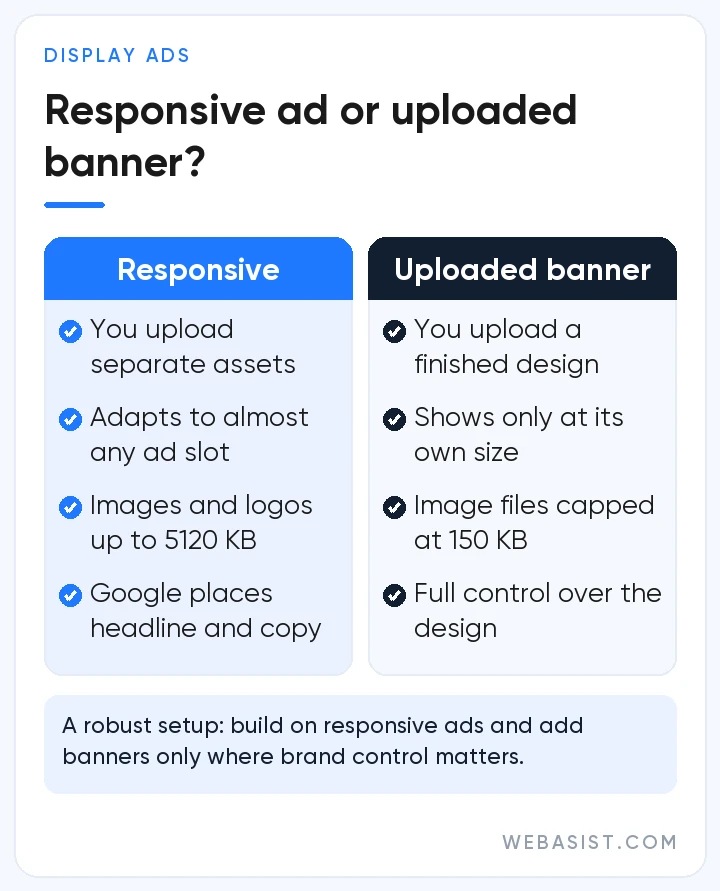
- Responsive display ads: you upload images, logos, headlines and descriptions separately, and Google AI combines them for each ad slot. It is the Display Network's default format, and a single set of assets can be reshaped to fit nearly every slot. Google can also enrich the ad with its own enhancements, stock imagery or AI-generated backgrounds.
- Uploaded display ads: you design the banner yourself in a tool such as Google Web Designer, at specific pixel dimensions, and upload it. You get full creative control, but every size has to be produced separately and the ad will not adapt to other slots.
In practice, the most robust setup is to build on responsive display ads and add uploaded banners only for the handful of standard sizes where brand control really matters. Google's own documentation suggests pairing custom banners with responsive assets, so the slots your banners can't fill are still covered.
Responsive display ad image and logo specs
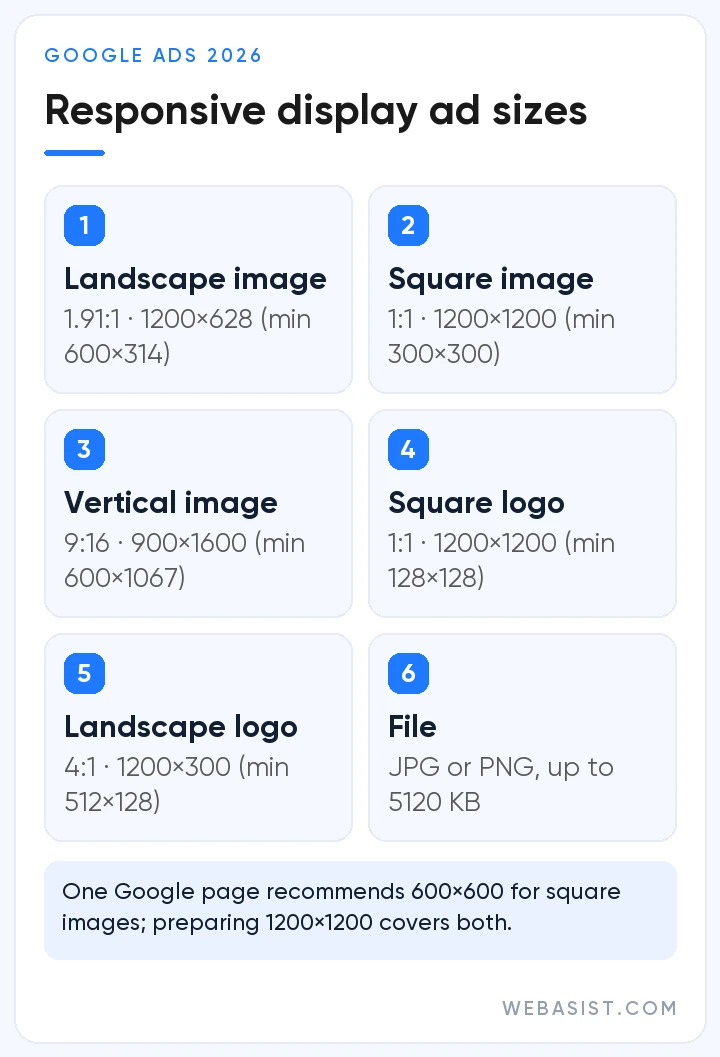
With responsive display ads you don't hand Google a finished banner; you supply separate assets. The table below summarises the aspect ratios, recommended sizes and minimums the Google Ads Help Center lists for each one.
| Asset | Aspect ratio | Recommended size | Minimum size | Quantity | Required? |
|---|---|---|---|---|---|
| Landscape image | 1.91:1 | 1200×628 | 600×314 | 1–15 | Yes |
| Square image | 1:1 | 1200×1200 | 300×300 | 1–15 | Yes |
| Vertical image | 9:16 | 900×1600 | 600×1067 | 0–15 | No |
| Square logo | 1:1 | 1200×1200 | 128×128 | Up to 5 | No, but recommended |
| Landscape logo | 4:1 | 1200×300 | 512×128 | Up to 5 | No |
The maximum file size for every image and logo is 5120 KB; use JPG or PNG. Google's best practices guide (which is also where the 9:16 vertical sizes in the table come from) suggests uploading 5 to 10 different images per aspect ratio, because more options mean more combinations to test and more ad slots your ad can fill. Google's own pages disagree here: the responsive display ad specs page recommends 600×600 for square images, while the ad creation and best practices pages say 1200×1200. Preparing 1200×1200 satisfies both and looks sharper on high-resolution screens.
The logo is technically optional in responsive display ads, but add one anyway. Demand Gen requires a business logo, and according to Google's migration page, the migration tool adds a placeholder logo to display campaigns that don't have one. Upload your own now so your ads don't end up running with a placeholder.
Text and video assets
Text limits matter as much as image sizes, because Google may use the same headline in a tiny banner and in a large placement:
- Short headline: up to 30 characters, 1–5 headlines.
- Long headline: up to 90 characters, 1 headline.
- Description: up to 90 characters, 1–5 descriptions.
- Business name: up to 25 characters.
- Video: added as a YouTube link; landscape, square and vertical videos can be used. When Google predicts that a video will outperform a still image in a given slot, it serves the video.
Video is optional. If you add one, keep it short and easy to follow with the sound off; professional video production keeps the message and the brand look under your control. For tips on writing persuasive headlines within tight character limits, see our guide to writing Google Ads copy.
Uploaded display ad (banner) sizes
If you upload your own banners, these are the sizes Google supports. The last column highlights a detail most size lists skip: some of these dimensions are defined by Google as regional sizes used only in specific countries.
| Group | Size (pixels) | Google name | Note |
|---|---|---|---|
| Square and rectangle | 200×200 | Small square | Global |
| Square and rectangle | 240×400 | Vertical rectangle | Global |
| Square and rectangle | 250×250 | Square | Global |
| Square and rectangle | 250×360 | Triple widescreen | Regional (Sweden) |
| Square and rectangle | 300×250 | Inline rectangle | Global |
| Square and rectangle | 336×280 | Large rectangle | Global |
| Square and rectangle | 580×400 | Netboard | Regional (Norway) |
| Skyscraper | 120×600 | Skyscraper | Global |
| Skyscraper | 160×600 | Wide skyscraper | Global |
| Skyscraper | 300×600 | Half-page ad | Global |
| Skyscraper | 300×1050 | Portrait | Global |
| Leaderboard | 468×60 | Banner | Global |
| Leaderboard | 728×90 | Leaderboard | Global |
| Leaderboard | 930×180 | Top banner | Regional (Denmark) |
| Leaderboard | 970×90 | Large leaderboard | Global |
| Leaderboard | 970×250 | Billboard | Global |
| Leaderboard | 980×120 | Panorama | Regional (Sweden) |
| Mobile | 300×50 | Mobile banner | Global |
| Mobile | 320×50 | Mobile banner | Global |
| Mobile | 320×100 | Large mobile banner | Global |
Google also lists three Poland-only billboard sizes: 750×100, 750×200 and 750×300. Unless you target those markets, your design time is better spent on the global sizes.
Which sizes should you start with?
You don't need to produce every size. Google's AdSense guide for publishers lists 300×250, 336×280, 728×90, 300×600 and 320×100 among its top-performing ad sizes. On a limited design budget, those five plus 320×50 for mobile make a practical starter set, and responsive display ads can cover the remaining slots.
File types, file size and animation rules
| Ad or asset type | File format | Maximum file size | Additional rules |
|---|---|---|---|
| Responsive display ad images and logos | JPG, PNG | 5120 KB | Must meet recommended and minimum pixel sizes |
| Uploaded image ads (static or animated) | JPG, PNG, GIF | 150 KB | Only supported sizes are accepted |
| Animated GIF | GIF | 150 KB | Animation 30 seconds or shorter; loops must stop within 30 seconds; frame rate slower than 5 FPS |
| HTML5 ads | ZIP (HTML; optionally CSS, JS, GIF, PNG, JPG, JPEG, SVG) | 600 KB | No more than 40 files in the ZIP; account must meet eligibility criteria |
| AMPHTML ads | ZIP (1 HTML file plus up to 39 media assets) | 600 KB | Must follow AMPHTML ad format rules |
Older articles often quote a 600 KB limit for image ads. Today that figure applies to HTML5 and AMPHTML bundles; static and animated image ads are capped at 150 KB. HTML5 access is not automatic either: Google reviews applications based on how long the account has been open, its lifetime spend and its policy history. For the exact rules, see Google's uploaded display ads specifications.
Preparing your images for the move to Demand Gen
On May 26, 2026 Google announced that display campaigns will be managed inside Demand Gen as "Google Display Network", with a migration tool rolling out in phases from June 2026. Google has not set a firm cut-off date and says it expects the transition to be complete by 2027. On the creative side, here is what you need to know:
- Responsive display ads and uploaded static image ads are supported in Demand Gen.
- Uploaded HTML5 ads and third-party ads are planned for late 2026.
- Custom promo text and price prefixes are not supported in Demand Gen; remove them from the affected ads before you migrate.
- Keep new Demand Gen logo files under 150 KB; the 5120 KB limit for responsive display assets does not carry over.
- Demand Gen uses vertical formats in addition to 1.91:1 and 1:1. If you want to appear on vertical surfaces such as YouTube Shorts, start building a vertical image set now.
| Demand Gen image asset | Aspect ratio | Recommended size | Minimum size |
|---|---|---|---|
| Landscape image | 1.91:1 | 1200×628 | 600×314 |
| Square image | 1:1 | 1200×1200 | 300×300 |
| Vertical image | 4:5 | 960×1200 | 480×600 |
| Full-screen vertical image | 9:16 | 1080×1920 | 600×1067 |
| Square logo | 1:1 | 1200×1200 | 128×128 (144×144 in the single image ad section of the same page) |
Google's Demand Gen documentation lists a 5 MB maximum for images and 150 KB for logos, with up to 20 image assets per ad. Because the same page gives two different logo minimums, preparing the square logo at 144×144 or larger, ideally 1200×1200, satisfies both. For the bigger picture on how campaign types differ, read our Google Ads campaign types comparison.
Design tips for compliant, effective display creatives
The right size alone won't get an ad approved; the image also has to meet Google's quality rules. The points below are based on Google's image quality policy and its responsive display ad recommendations, and they cover the most common reasons creatives get rejected or underperform.
Mistakes that lead to disapproval
- Rotated or upside-down images, or images that leave part of the ad frame empty.
- Out-of-focus or hard-to-recognize visuals, and text that is too small or unclear to read.
- Animation that flickers, flashes or pulls attention in a disruptive way.
- Fake buttons such as "Play", "Download" or "Close" that don't actually work, and designs that imitate site warnings or error messages.
Habits that improve performance
- Don't overlay logos or text on responsive display images. Google already adds your headline and logo as separate assets, so overlaid text becomes repetitive and unreadable in small slots.
- Keep the product or service in focus. Empty space should cover no more than 80% of the frame. As Google's image asset guidelines suggest, keep important content in the central 80% of the frame, because cropping starts at the edges.
- Use real photos instead of collages or composite backgrounds. Google prefers real-world shots with natural light and shadows over products cut out onto digital backdrops, even plain white ones.
- Avoid borders, rounded corners and heavy filters. Let the photo run edge to edge.
- Prepare your logo properly. Google often places transparent logos on a white canvas, so a mostly white logo on a transparent background can simply disappear. Google's Demand Gen documentation notes that Gmail can show the logo as a circle, which crops the corners, so keep key details away from them.
- Test banners at their smallest size. On a 320×50 mobile banner, one message, a clear brand mark and a single call to action are enough.
- Label AI-generated images where required. Regulations in the European Union, India and New York require labels or disclosures on certain ads made with AI, and Google offers an AI label setting for this.
Pre-launch checklist
- Choose the ad type: responsive display ads, uploaded banners or both.
- Prepare landscape and square images at the recommended sizes, as JPG or PNG and under 5120 KB; add vertical versions if you can.
- Upload square and landscape logos, and avoid white logos on transparent backgrounds.
- Check that banner files are under 150 KB and that animations stop within 30 seconds.
- Write several headlines and descriptions within the 30/90/90/25 character limits.
- Make sure the offer in the ad appears on the landing page in the same way.
- Use the Google Ads preview to check how the ad looks across sizes and devices.
Frequently Asked Questions
What are the most common Google display ad sizes?
Google's AdSense guide lists 300×250, 336×280, 728×90, 300×600 and 320×100 among its top-performing sizes, and 320×50 is a common mobile choice. If you use responsive display ads, you don't need to produce these sizes one by one, because Google adapts your landscape and square images to the available slots.
What image size do I need for responsive display ads?
At least one landscape (1.91:1) and one square (1:1) image are required. The recommended sizes are 1200×628 and 1200×1200 pixels, and the minimums are 600×314 and 300×300 pixels. You can optionally add 9:16 vertical images and logos; each file can be up to 5120 KB.
What is the file size limit for Google display ads?
Uploaded static or animated image ads (JPG, PNG, GIF) are limited to 150 KB. Each image and logo in a responsive display ad can be up to 5120 KB. HTML5 and AMPHTML ads are uploaded as ZIP bundles of up to 600 KB.
Can I use animated GIF ads in Google Ads?
Yes, GIFs are supported for uploaded image ads. Keep the whole animation, loops included, to 30 seconds at most and the frame rate below 5 FPS. The 150 KB file limit still applies.
Can I put text on display ad images?
You can use text on uploaded banners as long as it's legible. For responsive display ads, Google recommends avoiding overlaid text and logos, since headlines and descriptions are added as separate assets and overlaid text can become unreadable in small placements.
What size should a Google Ads logo be?
For responsive display ads, the square (1:1) logo is recommended at 1200×1200 pixels with a 128×128 minimum, and the landscape (4:1) logo at 1200×300 with a 512×128 minimum. Demand Gen requires a square logo and caps the file at 150 KB. Since Google's own tables give either 128×128 or 144×144 as the minimum, a compressed 1200×1200 file is the safest choice.
Conclusion
Correctly sized, uncluttered and policy-compliant images directly affect both the reach and the efficiency of your display ads. The most robust approach in 2026 is to prepare high-resolution responsive display assets in 1.91:1 and 1:1, add vertical formats, produce a few standard banners where needed and plan your Demand Gen migration early. If you would like help from creative production to campaign setup, take a look at our display advertising services or get in touch with our team.