

TikTok Ads Guide 2026: Ads Manager, Formats and Targeting
TikTok ads are paid placements created in TikTok Ads Manager and shown in the For You feed, in search results and, in some markets, across TikTok's partner apps. Every campaign has three layers: the campaign, where you choose the objective; the ad group, where you set audience, budget and bidding; and the ad, which holds the video or images.
Because they run full screen between organic videos, well-built TikTok ads can serve anything from awareness to sales, app installs or leads. This guide walks through the whole process, from account setup to measurement, based on TikTok Business Help Center rules as they stand in 2026.
TikTok Ads Manager: account and campaign structure
TikTok advertising runs through TikTok Ads Manager, part of TikTok for Business. If you manage several ad accounts, pixels, catalogues or team members, TikTok Business Center keeps those assets in one place.
| Level | What you decide here |
|---|---|
| Campaign | Objective, campaign type (Manual, Smart+ or Search, depending on your account), budget and automatic budget distribution across ad groups |
| Ad group | Placements, targeting, budget and schedule, optimisation goal and bid strategy |
| Ad | Identity (your TikTok account or an authorised post), video or images, ad text, call-to-action and destination URL |
According to a TikTok help page updated in August 2026, accounts with the upgraded Smart+ experience get manual and Smart+ set-up in a single flow, where you choose full automation, partial automation or fully manual control. It is rolling out gradually, so your screens may differ slightly from this description.
How to advertise on TikTok: your first campaign
Building your first campaign in this order keeps you from getting stuck on settings that cannot be changed later.
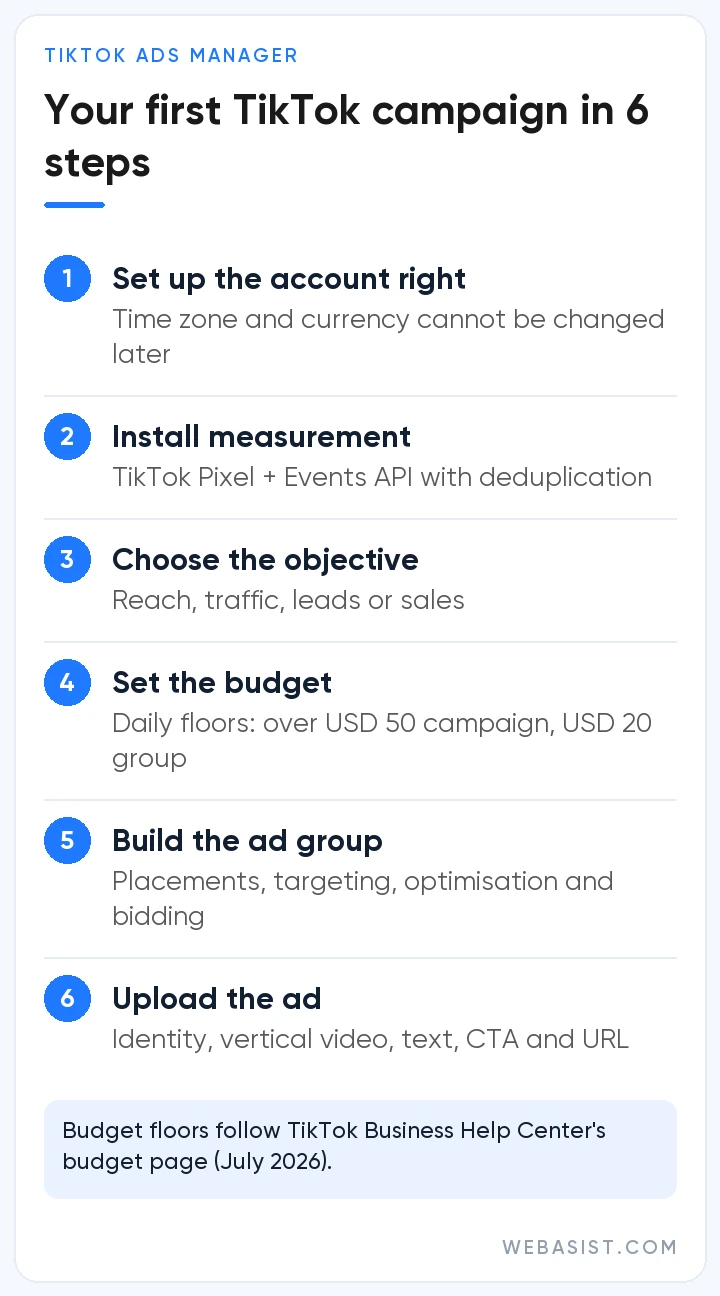
- Create your account: sign up for Ads Manager through TikTok for Business and enter business details, time zone, currency and payment method. Time zone, country or region and currency cannot be changed after the account is created, so a wrong choice means opening a new account.
- Set up measurement: install the TikTok Pixel and, ideally, connect the Events API server-side. TikTok recommends that web conversion advertisers use both together with event deduplication.
- Choose an objective: start a new campaign and pick the objective that matches your goal.
- Pick campaign type and budget: choose the set-up type your account offers, with optional A/B testing and automatic budget distribution across ad groups.
- Build the ad group: placements, audience, budget and schedule, optimisation goal and bid strategy.
- Create the ad: select the identity, upload a video or use an existing post, then add ad text, call-to-action and URL.
- Submit and monitor: ads go live after review; check delivery and Pixel events in the first days.
Know the platform's budget floors before you start. According to TikTok's help centre budget page, updated in July 2026, daily budgets must exceed USD 50 at campaign level and USD 20 at ad group level. For lifetime budgets, the ad group minimum is the number of days multiplied by the daily minimum. You cannot switch between daily and lifetime budgets while a campaign is running, and a campaign budget lower than its ad group budgets can cause delivery issues. Accounts in other currencies should check the equivalent in Ads Manager.
TikTok campaign objectives
TikTok groups objectives into three categories. The objective tells the system who to show your ad to and what result to optimise for, so it is your most important choice.
| Category | Objective | Choose it to |
|---|---|---|
| Awareness | Reach | Show the ad to as many people as possible, e.g. for launches |
| Consideration | Traffic | Send people to your website or app |
| Consideration | Video views | Earn attentive views and engagement |
| Consideration | Community interaction | Grow followers and profile visits, or promote a LIVE |
| Consideration | Branded Mission | Run collaborative campaigns with creators (not in every account) |
| Conversion | App promotion | Drive installs and in-app actions |
| Conversion | Lead generation | Collect leads and enquiries |
| Conversion | Sales | Sell through your website, app or TikTok Shop |
The former Website conversions and Product sales objectives have been merged into a single Sales objective, which is rolling out to accounts in phases. Where TikTok Shop operates, GMV Max has been the default and only supported campaign type for Shop ads since July 2025.
Automation with Smart+
Smart+ is TikTok's AI-driven campaign solution for the Sales, App promotion, Lead generation and Traffic objectives. In the current version you can switch automation on or off module by module, covering targeting and placements, creative combinations, budget distribution and bidding. We discuss when to trust automation in our article on AI-powered ad optimisation.
TikTok ad formats
TikTok formats fall into two buying routes: auction formats anyone can run in Ads Manager, and high-visibility brand formats reserved through TikTok's sales team.
| Format | How it is bought | Best for |
|---|---|---|
| In-Feed ads | Auction (Ads Manager) | Traffic, leads, sales |
| Spark Ads | Auction (Ads Manager) | Scaling organic posts and creator collaborations |
| Carousel (image) ads | Auction (Ads Manager) | Product ranges, step-by-step stories |
| TopView | Reservation (TikTok sales team) | Launches and very broad reach |
| Pulse and Branded Effects | TikTok sales team | Brand-safe context, audience participation |
In-Feed ads
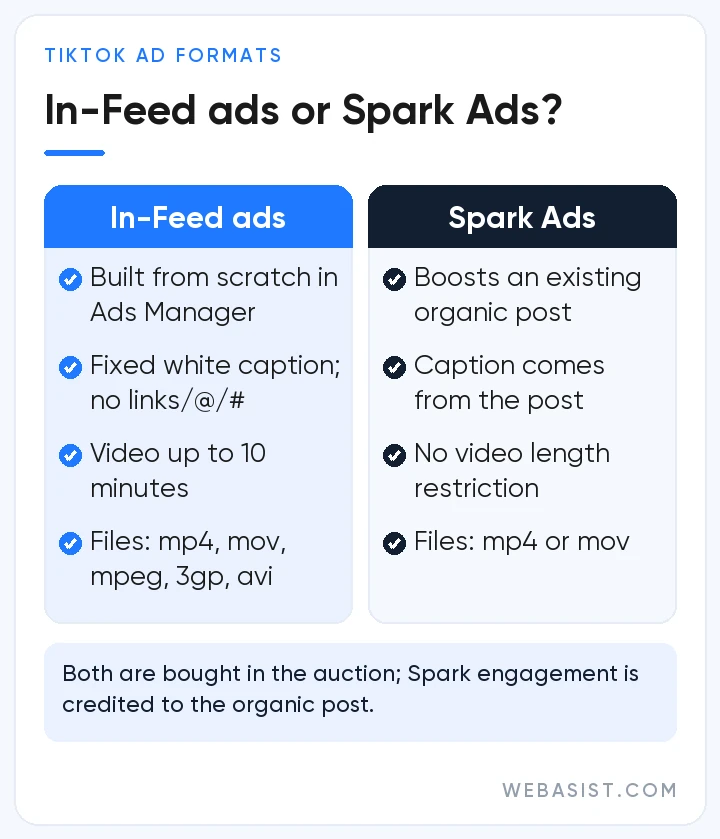
In-Feed ads are the core auction format, shown full screen between organic videos in the For You feed. In standard (non-Spark) ads the caption appears in a fixed white font that cannot be customised and cannot include clickable links, @mentions or hashtags; traffic flows through the call-to-action button.
Spark Ads
Spark Ads promote organic posts from your own account or from a creator who authorises you. Views, likes, comments, shares and follows earned during the promotion are credited to the organic post, so spend also builds social proof. To use a creator's post, the creator generates an authorisation code in the video's ad settings in the TikTok app, choosing how long it stays valid, and you enter it in Ads Manager.
Carousel ads
Carousel ads replace video with a sequence of images that people swipe through before tapping to convert. Available for objectives such as Traffic, App promotion and Lead generation, they are a practical way to show a product range or how-to steps without a video shoot.
TopView and reserved brand formats
TopView is the full-screen, sound-on video people see when they open TikTok, booked on reservation through TikTok's sales team. TikTok allows 5 to 60 seconds and recommends 9 to 15. Reserved options also include Pulse, which places ads next to premium creators (Pulse Core) and publisher content (Pulse Premiere), and Branded Effects, built around branded filters and effects.
TikTok search ads
Automatic Search Placement (formerly the Search Ads Toggle) extends In-Feed campaigns to relevant search results using the same targeting and creative, and is on by default for new campaigns. It is not keyword-based. To target specific search terms, use the keyword-based Search Ads Campaign type in Ads Manager, where TikTok recommends at least 20 keywords per ad group.
TikTok ad specs (In-Feed video)
- Aspect ratio and resolution: 9:16 vertical recommended (at least 540×960 px); 16:9 horizontal (at least 960×540) and 1:1 square (at least 640×640) accepted. TikTok's creative guidance recommends 720p or higher.
- Length: up to 10 minutes for non-Spark In-Feed ads; no restriction for Spark Ads.
- File: .mp4, .mov, .mpeg, .3gp or .avi, up to 500 MB, bitrate at least 516 kbps.
- Profile image and name: 98×98 px JPG or PNG under 50 KB; account name up to 20 characters in languages other than Chinese, Japanese and Korean.
- Safe zone: keep logos, text and products near the centre, clear of captions and buttons.
TikTok ad targeting options
Ad groups use four targeting groups:
- Demographics: location, age, gender and language.
- Audience: custom audiences from your own data and lookalikes modelled on them.
- Interests and behaviours: interest categories plus interactions with videos, creators and hashtags.
- Device: operating system, device type and connection.
Custom and lookalike audiences
Custom audiences can come from customer files, TikTok engagement, app activity, website traffic, lead forms, business account interactions and shop activity. A custom audience needs at least 1,000 matched users before it can be used in an ad group; lookalikes then use it as a seed to find new people.
Broad targeting and Smart Targeting
TikTok advises against over-narrowing. In internal testing TikTok shared in 2023, broadly targeted web conversion ads able to reach more than 80% of potential users in a country achieved a 15% lower cost per acquisition and a 20% higher conversion rate than restrictive targeting. With Smart Targeting on, the system can go beyond your audience and interest selections when it predicts better results, but it does not change your age, gender or location choices.
TikTok ads budget and bidding
Budgets can be set at campaign or ad group level, daily or lifetime. With campaign budget optimisation on, TikTok shifts budget between ad groups by performance. The current interface centres on two bid strategies:
- Maximum Results: leave the target cost blank and the system aims for as many results as possible within your budget; good for new accounts, creative tests and scaling.
- Target Cost per Result: keeps the average cost per result close to your target; best for mature campaigns that need predictable costs.
Costs depend mainly on audience size, season and competition, the objective and optimisation event, the bid strategy and how well the creative holds attention. Frequent changes during learning can restart it, so adjust gradually.
TikTok creative best practices
Once most of the targeting is handed to the algorithm, creative becomes your strongest lever: people judge an ad by the same standard as every other video and swipe on if it does not grab them. Combining TikTok's creative best practices for performance ads with what we see in live campaigns:
- Vertical, sound-on, sharp: 9:16, at least 720p, made to work with sound on.
- Promise in 3 seconds: introduce the product or offer within 3 seconds and land the hook within 6.
- Hook, benefit, CTA: a gripping opening, the product's distinctive benefits and a clear call to action.
- Real people, natural tone: creators, employees or customers in casual, phone-shot videos look at home in the feed.
- Trends, used wisely: study trending hashtags, creative insights and top ads in Creative Center, but skip trends that do not fit your brand.
- Licensed music: use the Commercial Music Library, around 1 million songs pre-cleared for commercial use; the general music library cannot be used commercially.
- Test and refresh: TikTok recommends 3 to 5 creatives per ad group and 3 to 5 distinct ad groups per campaign; add fresh creatives to existing ad groups when performance drops.
TikTok's free AI tool Symphony Creative Studio offers text-to-video, avatars and dubbing, and TikTok One helps you work with creators. For professional shoots and editing, our video production team can help.
Measurement and optimisation
- Event setup: send purchases, form submissions and add-to-cart events accurately, deduplicated through the Pixel and Events API; optimisation depends on it.
- The right metric: reach and frequency for awareness, watch time and click-through rate for consideration, cost per acquisition and ROAS for conversion.
- Lift studies: TikTok's Brand Lift studies survey exposed and control groups to measure brand impact and can only be set up by your TikTok account manager; Conversion Lift studies measure incremental conversions.
- Cross-platform view: judge TikTok with the same framework as Instagram Reels and YouTube Shorts; see our Instagram ads guide for the Instagram side.
Frequently Asked Questions
What is the minimum budget for TikTok ads?
According to TikTok's help centre, daily budgets must exceed USD 50 at campaign level and USD 20 at ad group level, and lifetime ad group minimums scale with the number of days. These are technical floors; a meaningful test needs enough budget to get through learning.
What is the difference between Spark Ads and In-Feed ads?
A standard In-Feed ad is built from scratch in Ads Manager, and its caption cannot contain links, @mentions or hashtags. A Spark Ad promotes an existing organic post from your account or an authorising creator, and the engagement it earns is credited to that post.
How long should a TikTok ad be?
Standard In-Feed videos can run up to 10 minutes, but the opening matters more: TikTok advises introducing your proposition within 3 seconds. For TopView it recommends 9 to 15 seconds. Test short and long versions to find your best length.
How narrow should TikTok targeting be?
TikTok generally recommends broad targeting, because the system is good at finding people who respond to your creative. Set essentials such as location and age, keep interest layers light and narrow further only if a test against a broad setup proves it pays.
Do I need the TikTok Pixel?
For website sales or conversions, in practice yes: the system can only learn who converts from Pixel or Events API data. Reach or video view campaigns can run without it, but measurement and retargeting will be limited.
Will Smart+ replace manual campaigns?
No, Smart+ is an option. In the upgraded experience you choose between full automation, partial automation and fully manual set-up, so you keep control where you need it. With enough conversion data, test Smart+ against a manual campaign.
Conclusion
Lasting results on TikTok come from four pieces working together: the right objective, broad but meaningful targeting, solid measurement and videos that feel like content in the feed. The steps above give your first campaign a sound start; the real learning begins with the data from its first weeks.
If you would rather have setup, creative and optimisation handled in one place, explore our TikTok advertising service and social media advertising packages, or contact us for a tailored quote.