


YouTube Ads Guide: Building a YouTube Advertising Strategy for 2026

An effective YouTube ads strategy sets one measurable business goal, chooses audience segments that fit that goal, uses videos that grab attention and show the brand in the first seconds, sizes the budget around reach and frequency targets, and judges success by brand and conversion lift rather than clicks alone. Opening a campaign takes minutes; whether the spend pays back depends on how well those five decisions are made.
This guide takes the decisions in the order they should be made: what you want to achieve, who you need to reach, how the video should be built, how much to spend and how to tell whether it worked.
For formats, specs and the click-by-click build, see YouTube ads in Google Ads: formats, specs and setup. This article covers the thinking behind that build.
Why advertise on YouTube in 2026?
People watch YouTube on phones for short clips, on laptops for tutorials and on TVs for long sessions, often on the same day. According to figures YouTube CEO Neal Mohan shared at Cannes Lions in June 2025, Shorts averages more than 200 billion daily views, and viewers watch over a billion hours of YouTube on TV screens every day. YouTube's press page adds that the platform has localised versions in more than 100 countries and 80 languages.
For advertisers, that means three things:
- The whole funnel in one place. Introduce the brand with short messages, persuade with product videos and close with conversion-focused ads, all to the same audience.
- Intent signals. People search YouTube for reviews, set-up guides and comparisons, and that behaviour feeds content targeting and custom segments.
- TV-like impact, digital measurement. Ads on connected TVs feel close to broadcast while keeping digital targeting and reporting.
Which businesses is YouTube advertising right for?
Any business that sells better by showing than telling: products that need a demo, mobile apps, education providers, visual sectors such as travel and real estate, and B2B services with long buying cycles. If you only want to capture existing search demand and cannot produce video yet, search ads will usually pay off faster.
Start with the goal: objectives, KPIs and funnel stage
The most common mistake is expecting one campaign to deliver broad reach, cheap views and sales at once. Campaign subtypes optimise for different outcomes, so choose the funnel stage first and build each campaign around that stage's metric.
| Funnel stage | Campaign approach | Success metric |
|---|---|---|
| Awareness | Efficient reach, Non-skippable reach, Target frequency | Unique reach, average frequency, CPM, lift in ad recall |
| Consideration | Video views (skippable, in-feed and Shorts) | View rate, video quartiles, earned actions, lift in brand searches |
| Conversion | Demand Gen | Conversions, CPA or ROAS, engaged-view conversions |
At the conversion stage, the old Video action campaigns are gone: Google finished upgrading them to Demand Gen by April 2026. Give every campaign one primary metric. A low click-through rate is no failure for an awareness campaign; in a conversion campaign it is a red flag.
YouTube ad targeting: the right people at the right moment
Two groups of settings shape who a YouTube ad reaches: audience segments, which describe the viewer, and content targeting, which decides the videos, channels or topics the ad appears alongside. A good plan does not treat them as alternatives; it combines them according to funnel stage.
Audience segments
- Detailed demographics: long-term traits such as being a university student, homeowner or new parent.
- Affinity segments: lifestyles and lasting interests; a broad but meaningful start for awareness.
- In-market segments: people actively researching products like yours, ideal for consideration.
- Life events: moving, marrying or graduating, which gives furniture, finance and education brands a timing edge.
- Custom segments: people who search your chosen keywords, visit certain sites or use certain apps; category and competitor searches work well.
- Your data segments: website visitors, people who engaged with your channel and Customer Match lists.
Content targeting: keywords, topics and placements
Keyword targeting places ads on related videos, topic targeting on content categories and placement targeting on channels and videos you pick. These add context, but layered and narrow they shrink reach fast. Lead with audiences, add content targeting for a niche or brand safety, and handle unwanted channels with exclusion lists.
First-party data and remarketing
Google's ready-made segments give you a broad starting point, but lists of people who already know your brand tend to be sharper. With your channel linked to Google Ads, you can build segments from people who watched, liked or subscribed. Site visitors and CRM lists serve both remarketing and exclusions; removing existing customers from awareness campaigns frees budget for new people.
In Demand Gen, those lists can also seed lookalike segments. During 2026 Google is moving lookalikes by default from a strict targeting constraint to a suggestion that guides its AI, with an opt-out for advertisers who want the original behaviour.
Working with automation
Demand Gen supports optimised targeting, which uses your audiences as a starting signal and expands to people who behave similarly. Google recommends switching it on for prospecting campaigns and pairing it with first-party seed lists. With thin conversion data, start from well-defined segments and compare results. We weigh up automation in our article on AI-powered ad optimisation.
Creative that gets watched: Google's ABCDs
However precise your targeting, a YouTube ad's fate is decided in its first few seconds. Google groups the traits of effective YouTube ads into the ABCDs, with current guidance in the Google Ads Help Center. Google cites an April 2021 Google/Kantar study in which ads following these principles showed up to a 30% lift in short-term sales likelihood and a 17% lift in long-term brand contribution.
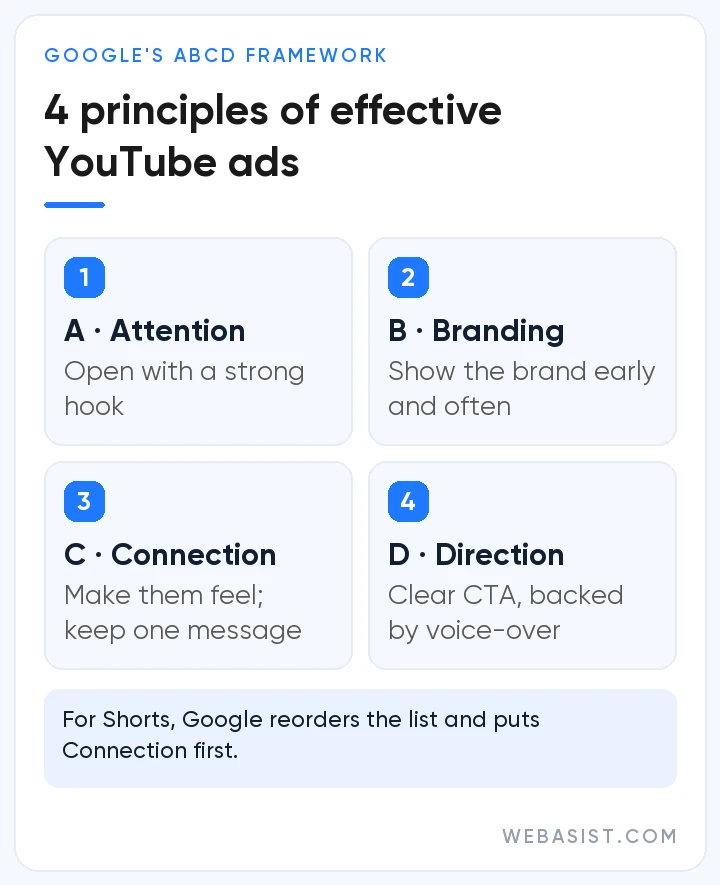
- Attention: open with a hook. Tight framing, fast pacing and strong audio win viewers before the skip button appears.
- Branding: show the brand early, often and in several ways: product, logo and a spoken brand name. If the logo only appears in the closing frame, anyone who skips early leaves without ever seeing it.
- Connection: make people feel or think something with real people, one simple message, humour or surprise.
- Direction: say what you want viewers to do and back the on-screen call-to-action with voice-over.
Matching creative to format
- Bumpers (6 seconds): one idea, one line; a reminder of a longer story.
- Non-skippable (15 seconds): the full message is seen, so show the benefit clearly with a problem, solution and brand arc.
- Skippable in-stream: five seconds of hook, then story, demo and a strong close. Test different openings.
- Shorts: vertical, sound-on and made in a creator's voice. Google reorders the ABCDs for Shorts and puts Connection first.
Partnering with creators
On 23 March 2026 YouTube announced YouTube Creator Partnerships, the new name for its evolved BrandConnect tools. Built into Google Ads and Display & Video 360, it helps brands find suitable creators and turn their videos into Shorts and in-stream ads. Creator-made content often feels more natural on Shorts, so it is worth testing with part of your budget. For your own shoots, our video production team delivers edits in every length and orientation.
YouTube ads budget: how much should you spend?
YouTube has no rate card. Costs are set in the auction by audience size and competition, so what a YouTube ad costs depends on variables you can manage:
- Targeting breadth: narrow, in-demand audiences cost more.
- Season and competition: holidays, Black Friday or your industry's peak raise prices.
- Format and bidding: CPM-bought non-skippable formats and CPV-bought view campaigns have different cost structures.
- Creative quality: videos with high view rates achieve more for the same money.
- Frequency goals: how often you want to reach each person each week drives total spend.
Forecast with Reach Planner
Reach Planner in Google Ads estimates unique reach, average frequency and cost for a given budget, audience, location and format mix. Forecasts are not guarantees, but they show how much of your audience a budget can reach, and how often, before you build anything.
Test budgets and the learning period
For conversion-focused Demand Gen campaigns, Google's "YouTube Performance Four" guidance is specific: with Target CPA, set a daily budget of at least 10 times your target CPA, wait for at least 50 conversions before judging performance, and change bids or budgets by no more than 15% a week. For small budgets the lesson is the same: a few well-funded campaigns learn faster than many thin ones.
A fee note for ads served in Türkiye
Google adds a separate charge on top of ad costs for ads served in Türkiye. According to Google Ads Help's jurisdiction-specific surcharges page, the Türkiye Regulatory Operating Cost was reduced from 7% to 4.5% on 1 January 2026. It appears as a separate line on your invoice or statement, with taxes such as VAT applied on top. Google can change the rate, so check the page for the current figure when you plan budgets.
Measurement: looking beyond views
Read the right metrics
- TrueView views and view rate: Google Ads has used this name for "Views" since October 2025; view rate shows how compelling the ad is.
- Video quartiles: the share of viewers reaching 25%, 50%, 75% and 100%, showing where the creative loses people.
- Unique users and average frequency: the real yardstick for awareness, since impressions alone mislead.
- Earned actions: subscriptions and organic views viewers generate on your channel after seeing an ad.
Brand Lift and other lift studies
Brand Lift shows short YouTube surveys to people who saw your ad and to a control group who did not, then measures the difference in ad recall, awareness and consideration. It works with Video and Demand Gen campaigns, but it is not available without a Google account representative, and a country-specific minimum spend has to be met within 10 days. Google also offers Search Lift for growth in organic searches and Conversion Lift for incremental conversions.
Credit conversions fairly
YouTube viewers often watch, then search for the brand later instead of clicking. Engaged-view conversions capture this: they count people who watched at least 10 seconds of a skippable in-stream ad, or 5 seconds of an in-feed or Shorts ad, and converted without clicking. The default window for web conversions is 3 days and can be changed in the conversion action settings. Last-click reports alone undervalue YouTube. For tracking basics, see our Google Ads guide.
YouTube ads strategy checklist for 2026
Run through these eight points one last time before any campaign goes live:
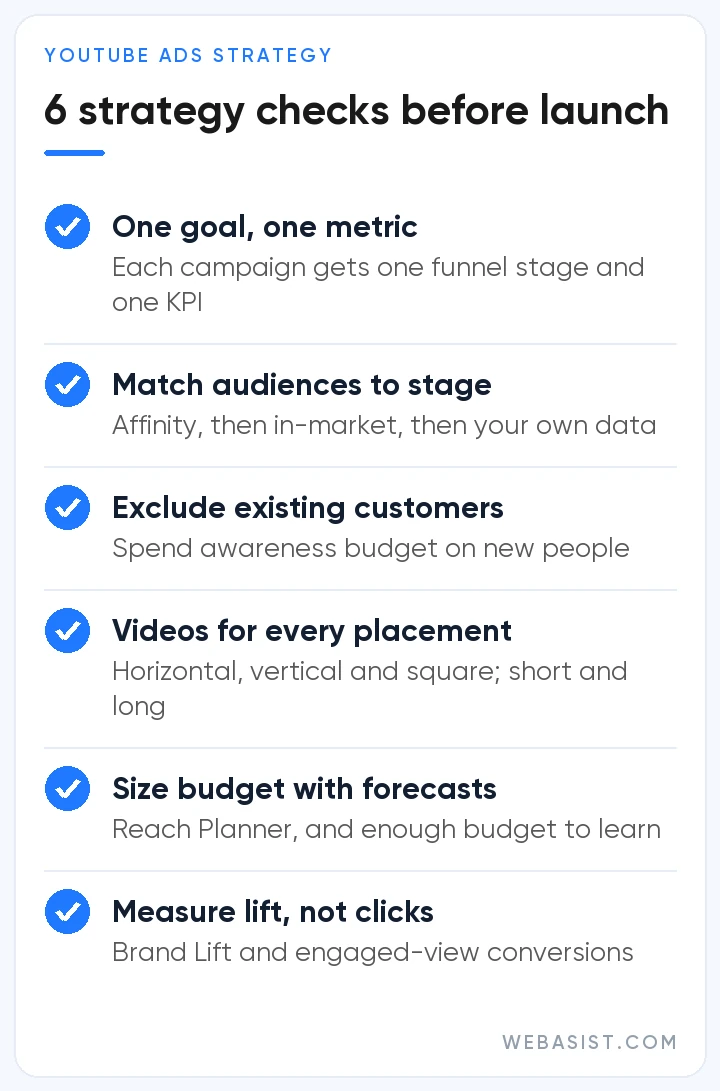
- Give each campaign one funnel stage and one primary metric.
- Match audiences to the stage: broad interests, then in-market and custom segments, then your own data.
- Exclude existing customers from awareness campaigns.
- Prepare horizontal, vertical and square versions in several lengths.
- Show the brand in the first five seconds and voice the call-to-action.
- Size the budget with Reach Planner and keep it big enough for learning.
- Watch frequency to avoid creative fatigue.
- Judge success on reach, viewing quality, brand lift and conversion lift together.
Frequently Asked Questions
Do YouTube ads actually work?
Yes, when goal and measurement are set up properly. Judge awareness campaigns on reach and ad recall, and conversion campaigns on cost per sale or lead. Controlled lift studies such as Brand Lift or Conversion Lift are the most reliable proof.
How much should I budget for YouTube ads?
There is no fixed price or universal minimum; cost depends on audience, season, format and creative. Use Reach Planner to estimate the budget for your target reach and frequency. For conversion-focused Demand Gen campaigns, Google recommends a daily budget of at least 10 times your target CPA.
What is the best way to target YouTube ads?
It depends on the funnel stage. Broad affinity segments protect reach for awareness. In-market and custom segments built from category searches suit consideration, while your own data, such as site visitors and customer lists, usually performs best for conversions.
What is a Brand Lift study and who can use it?
Brand Lift is a Google study that compares survey answers from people who saw your ad with a control group, measuring effects on ad recall, awareness and consideration. It requires a Google account representative and a country-specific minimum spend reached within 10 days.
Should I use Shorts ads or in-stream ads?
They suit different viewing habits. Shorts fits short, native-feeling content in a fast vertical mobile feed, while in-stream is stronger for storytelling in longer sessions and on TVs. Most brands should prepare vertical and horizontal versions and serve both.
Conclusion
What separates strong YouTube campaigns is the thinking behind the settings rather than the settings themselves. Brands that set a clear goal, choose matching audiences, produce videos people watch, plan budgets with realistic forecasts and measure impact properly treat YouTube as a growth channel, not a view counter.
As a Google Partner, WebAsist plans YouTube campaigns end to end, from strategy and creative to measurement. Visit our YouTube advertising service page, or get in touch for a plan built around your brand.