


LinkedIn Advertising: Costs in Turkey and When the Expensive Click Pays Off
LinkedIn advertising is the shortest route to a B2B decision maker, but the clicks are expensive. The floor is clear: a daily budget of at least 10 dollars, roughly 490 TL a day at the central bank rate in October 2026; an ad set that runs every day approaches 15,000 TL a month. Our rule: if a customer's annual contract is worth less than 50,000 TL, stay off LinkedIn, that money does more work on Google. Above that, LinkedIn's job-title and company targeting does something no other channel can.
Below are the maths in lira, the four decisions of a setup, targeting, Lead Gen Forms and the LinkedIn recommendations we do not follow. We wrote this for businesses selling software, consulting, export manufacturing and corporate training; not for retail.
LinkedIn advertising costs in lira
LinkedIn sells ads in an auction; what you pay depends on your bid and on the ad's relevance score. You pay per click, per thousand impressions, per video view or per message sent. The floors: a daily budget of at least 10 dollars for every format, and a lifetime budget of at least 100 dollars for a new campaign that has not run. If your account is in lira, go by the equivalent Campaign Manager shows.
Why are clicks expensive? Because the audience is small and qualified. Target "purchasing manager, manufacturing, more than 200 employees" and you compete with dozens of vendors for the same few thousand people. That is why success on LinkedIn is measured not by click price but by cost per qualified lead.
Example scenario, an ERP software company: 20,000 TL a month, 150 TL per click (an example figure), 133 clicks. Eight in every 100 clicks fill in the Lead Gen Form: 11 forms. The sales team finds a quarter of them qualified: 3 qualified meetings, about 6,700 TL each. If the annual contract is 200,000 TL and one in three meetings closes, the ads pay for themselves; at a 30,000 TL contract the same campaign loses money. The maths is that simple; the numbers are yours.
A daily budget is an average: spend can reach twice the daily budget on one day, and the weekly total never exceeds seven times the daily amount. A lifetime budget is a hard limit; for campaigns with fixed dates we work with lifetime budgets.
How to advertise on LinkedIn: four decisions
You need a LinkedIn Page for your company and a Campaign Manager account tied to it. Since October 2025 the layer names have changed: the old "campaign group" is now the campaign, the old "campaign" is now the ad set. URL tracking parameters changed too (CAMPAIGN_ID replaces CAMPAIGN_GROUP_ID, AD_SET_ID replaces the old CAMPAIGN_ID); use the new names in new ad sets or your Analytics reports get muddled.
- Objective: brand awareness, website visits, engagement, video views, lead generation, website conversions, job applicants. For B2B sales we almost always start with lead generation.
- Setup type: Accelerate (AI builds it and optimises delivery itself) or Classic (targeting, bidding and creative are yours). Classic for anything that needs a target account list or exclusions.
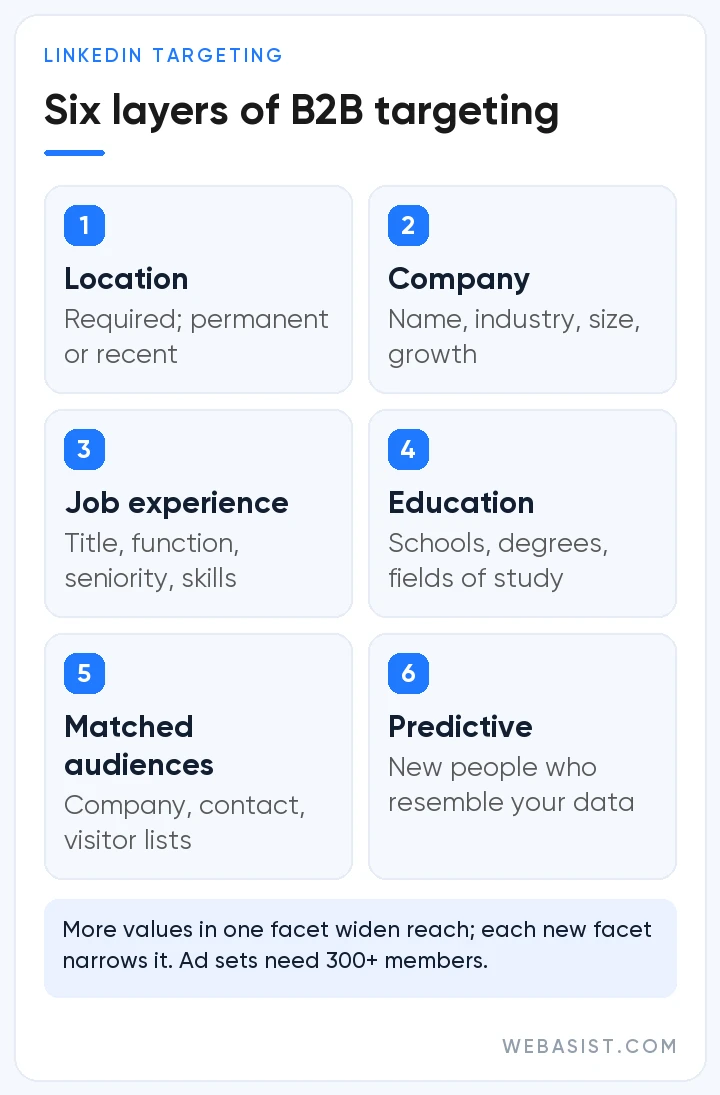
- Ad set: audience, format, budget and bid. Location is mandatory; an ad set needs at least 300 members in the audience to run.
- Ad and form: a single image or document ad with a Lead Gen Form behind it. At least four ads per set; LinkedIn recommends this too and is right, the system shifts delivery to the best performer.
For measurement, add the Insight Tag to your site from the start; it counts website conversions and feeds retargeting audiences. If you send the records that became sales back from your CRM through the Conversions API, LinkedIn can optimise for the ones that turned out qualified rather than every form fill; this "qualified leads" goal works only with maximum delivery. In conversion campaigns landing page speed directly affects results; conversion-focused website design protects the expensive click.
B2B targeting: LinkedIn's real strength
Five layers sit on top of location: company (name, industry, size, growth), job experience (title, function, seniority, skills), education, demographics and interests. Several values in the same category widen the audience, because a member only needs to match one; every new category added under "narrow audience" shrinks it.
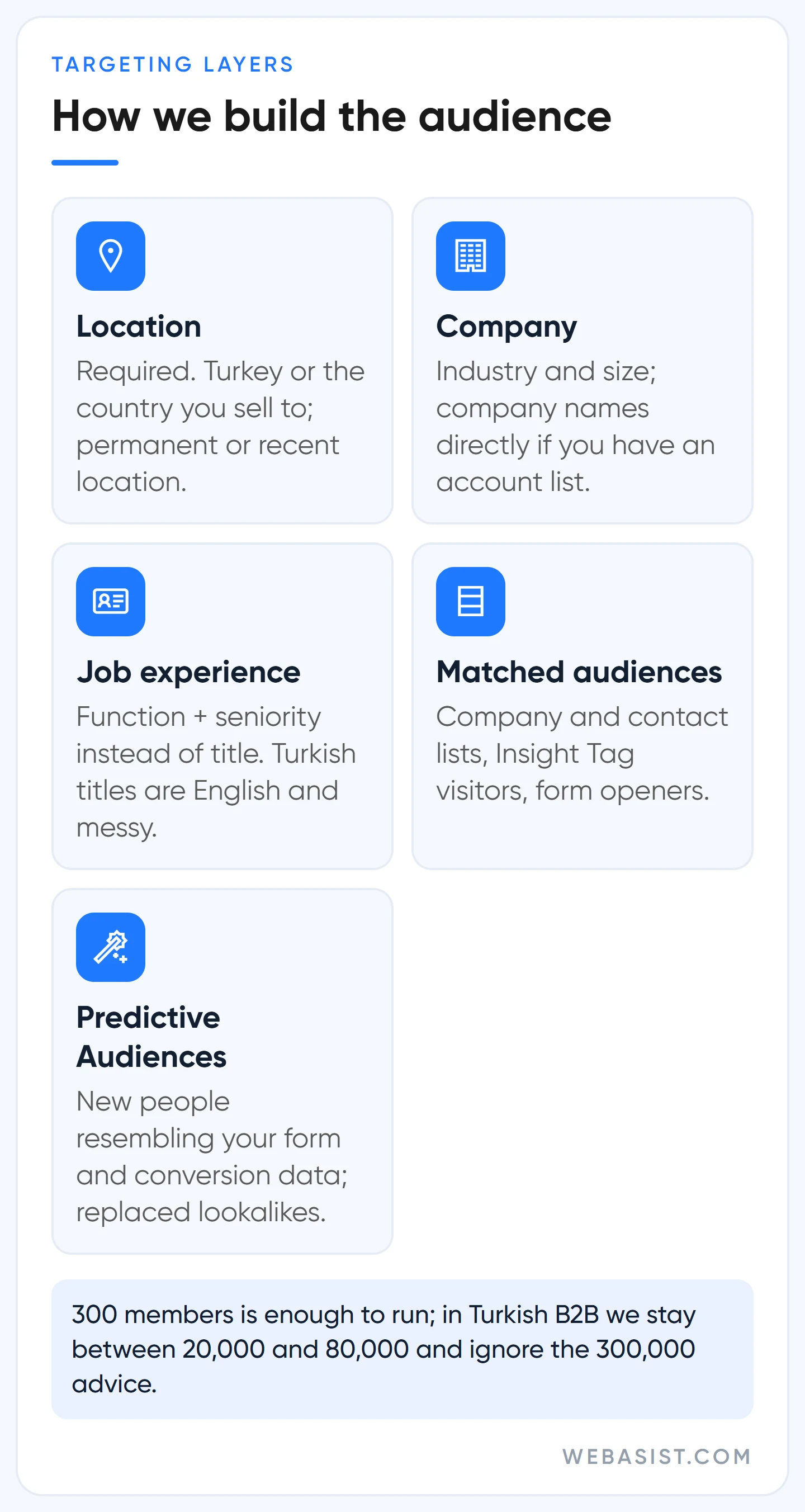
A note specific to Turkey: most professionals write their title in English, and the same job goes by different names from company to company. Do not rely on title alone; combine job function with seniority. "Function: purchasing, seniority: manager and above" is both wider and more accurate than "purchasing manager".
With your own data: upload a company list for an account-based campaign, exclude existing customers with a contact list, and reach site visitors and people who opened a Lead Gen Form again through the Insight Tag. Lookalike audiences closed on 29 February 2024; Predictive Audiences replaced them, taking form responses, conversions or your contact list as the source and finding new people likely to convert. For exporting manufacturers this works alongside international Google Ads: LinkedIn introduces you to the decision maker, Google catches the search that follows.
On audience size LinkedIn generally recommends at least 50,000 people, and 300,000 for sponsored content and messaging. In Turkish B2B we work between 20,000 and 80,000; in most sectors a 300,000-person audience means "everyone working in Turkey" and spends an expensive click on irrelevant people.
Lead Gen Form or landing page?
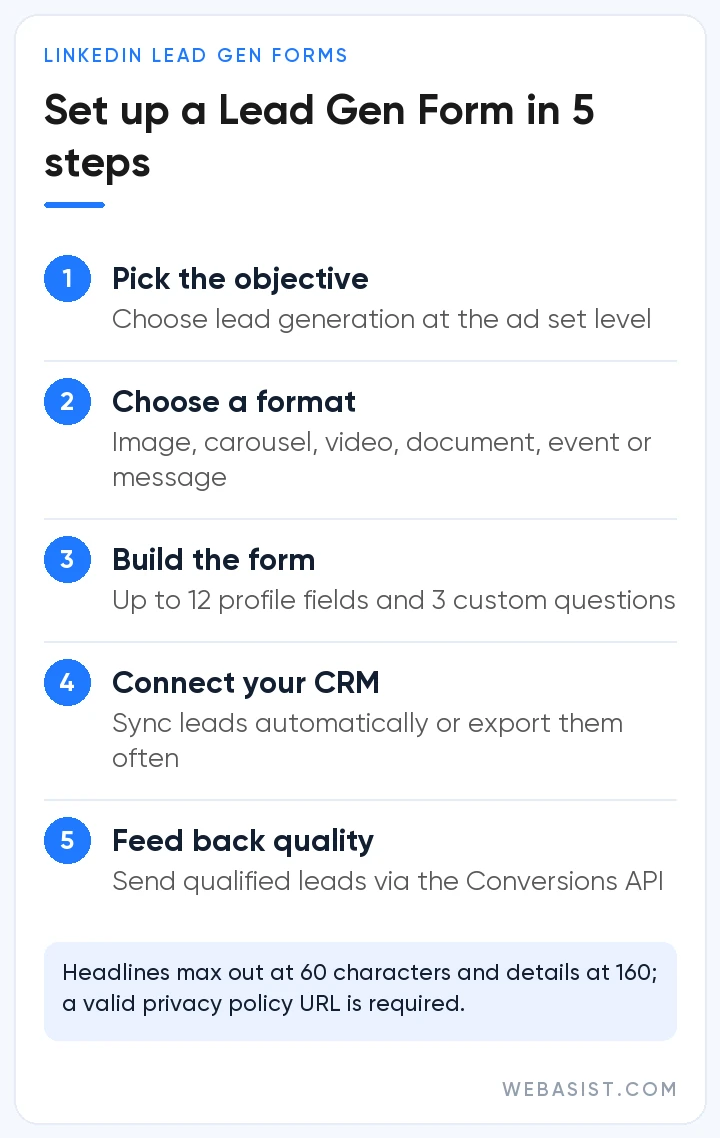
A Lead Gen Form opens a form pre-filled with profile data for whoever clicks the ad; the person applies in two taps without leaving LinkedIn. The limits: up to 12 fields (custom questions count towards this), up to 3 custom questions of 100 characters each, 20 hidden fields, a 60-character headline and 160-character description, a 300-character thank-you message; a valid privacy policy link is required.
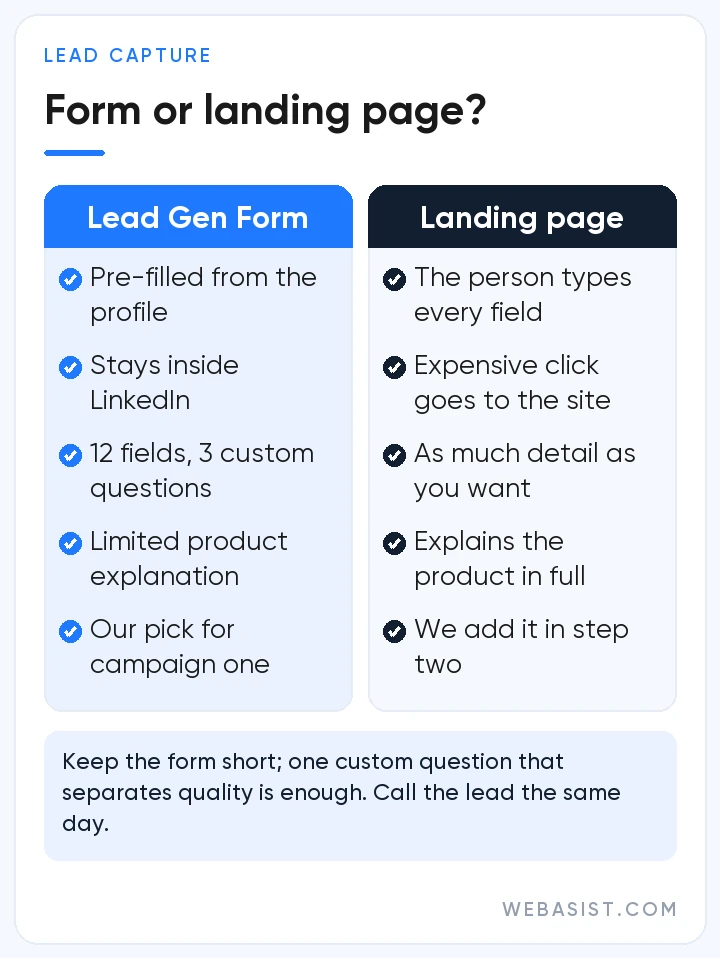
Our preference: the first campaign is always a Lead Gen Form. Some of the expensive clicks sent to a site close before the page loads; in a form they do not. We add a landing page in a second step, when you need to explain the product or track on-site behaviour. Do not make the form long; one custom question that separates quality ("number of employees" or "project timing") is enough. The real difference is not the form but how fast you follow up: a LinkedIn lead that is not called the same day goes cold.
Which format, and when?
Sponsored content that looks like an ordinary post in the feed (single image, video, carousel, document, event) has the widest reach. A document ad lets people read a PDF in the feed, and you can put the full document behind a Lead Gen Form; it is the format that brings us the most B2B results. Thought Leader Ads promote a post by your CEO or an expert instead of the company page, with the author's approval; there is no button, the link goes in the text. For brand awareness we prefer this format to a company post; a human face gets read more in the feed. If you are shooting video, plan the production vertical and captioned for the feed.
Message and conversation ads land in the inbox and are charged per send; in the European Economic Area and Switzerland only members who opted in see them. If you sell into Europe, leave this format out of the plan. Text ads run only on desktop, in the right column; cheap but invisible. Connected TV ads are open only to English-speaking audiences in the US and Canada for now; irrelevant for Turkey.
What LinkedIn recommends, and what we do instead
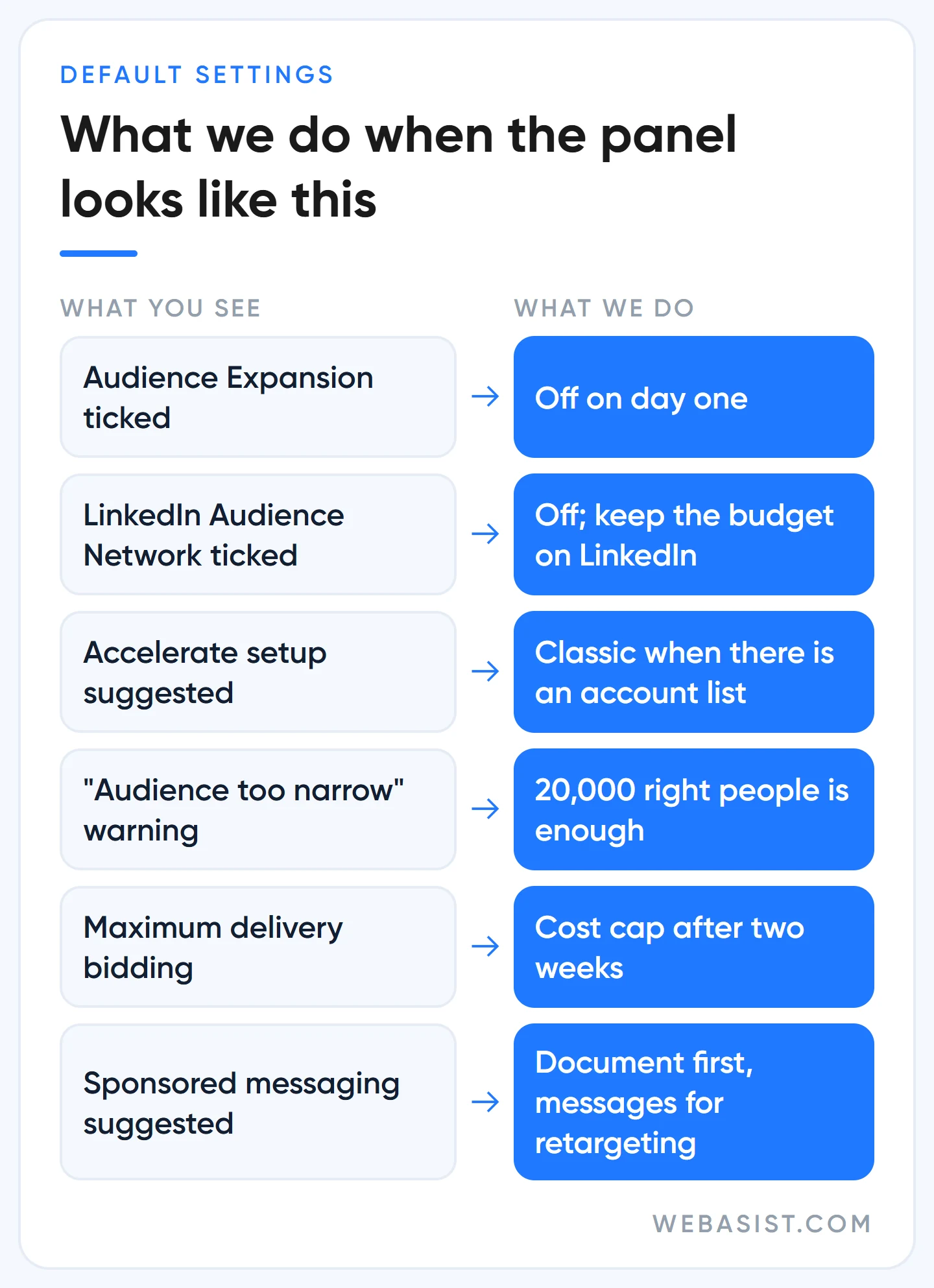
- Audience Expansion and the LinkedIn Audience Network: both usually come ticked when you build an ad set. Audience Network shows your ad in apps and sites outside LinkedIn; it spends the money you paid for an expensive B2B audience inside a game app. We switch both off on day one.
- Accelerate: good for a quick setup, but you do not see which companies you reach or whom you exclude. We never use it in a campaign that runs on a target account list.
- The "your audience is too narrow" warning: it appears often below 300,000. In Turkish B2B a correct audience of 20,000 beats a wrong audience of 300,000.
- Maximum delivery: the default bid. Right for the first two weeks; then we move to cost cap on the lead generation objective. LinkedIn itself recommends at least 15 days of delivery on cost cap.
- Sponsored messaging: LinkedIn wants to sell the inbox; on the receiving end this format usually reads as "another sales message". Start with a document, use messages for retargeting.
Who should not put money into LinkedIn?
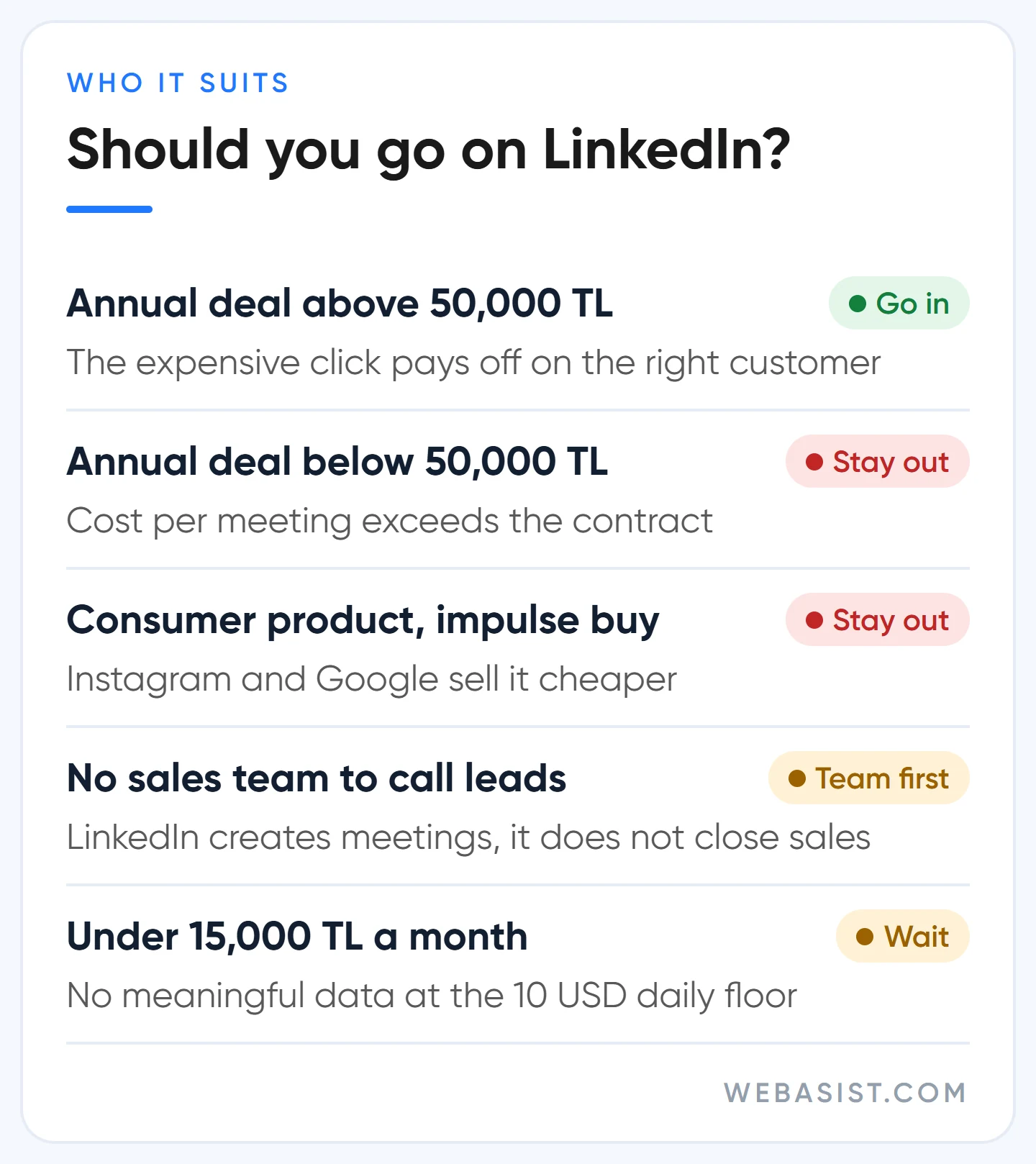
- Low contract value. For a customer worth less than 50,000 TL a year, a LinkedIn click does not pay for itself.
- Consumer products. For low-priced, impulse purchases, Instagram and Google.
- No sales team. LinkedIn does not close sales, it creates meetings; if nobody will call the form, the form is wasted.
- Less than 15,000 TL a month. With a 10-dollar daily floor and expensive clicks, nothing meaningful comes out below that. Collect existing demand with Google Ads first; X can complement it for joining industry conversations.
Frequently Asked Questions
How much do LinkedIn ads cost, and what is the minimum budget?
There is no fixed price; cost forms in the auction from audience, competition, bid and relevance score. The floor is 10 dollars a day and 100 dollars lifetime for a new campaign; about 490 TL a day at the October 2026 rate. Our own floor is 15,000 TL a month.
What should I look for in a LinkedIn ads agency?
Ask three questions: whose name will the Campaign Manager account be in, who prepares the target company list, and will records that become sales be sent back to LinkedIn through the Conversions API? Do not work with an agency that cannot answer all three clearly; ask us the same questions.
What is the ideal audience size on LinkedIn?
At least 300 members are needed to run; LinkedIn recommends 50,000 in general and 300,000 for sponsored content. In Turkey we stay between 20,000 and 80,000; with a target account list you can go narrower, knowing that cost will rise.
What are Thought Leader Ads?
A format that lets you sponsor a post by an employee, an expert or a creator instead of the company page, with the author's approval. It works with the brand awareness, engagement and video views objectives and has no button.
Conclusion
Clicks on LinkedIn are expensive and will stay expensive; the question to ask is not "how much is a click" but "how much is one qualified meeting and how much does one customer leave me". If those two numbers support each other, LinkedIn is unmatched in B2B; if they do not, stay out.
Send us your target company list and the annual value of one customer; we will work out together whether LinkedIn is worth entering and, if so, with which audience and which form. We quote LinkedIn ad management individually.