


International Google Ads: How to Advertise Abroad from Türkiye
International Google Ads does not require a company abroad or a separate account. Add Germany to the location settings of a campaign in the TL account you opened in Türkiye, and your ad can be showing in Germany the next day. The settings are not the hard part; three decisions are: which country, which language and which currency. The last one is chosen once, when the account is opened, and never changes.
Our rule is short: if you have no landing page in the target country's language, or you cannot answer enquiries during that country's working hours, do not launch an international campaign. If both are in place, below you will find a worked TL budget for an exporting manufacturer and a separate section for hotels and tour operators. We showed how to set locations on screen in our campaign setup article; this one only covers decisions specific to selling abroad.
Do you need a separate account to advertise abroad?
For most businesses, no. In a single account you run separate campaigns for Germany, the Netherlands and the Gulf; wherever the ad is shown, you are invoiced in the account currency, which here is TL. Reports, conversion settings and negative lists stay in one place.
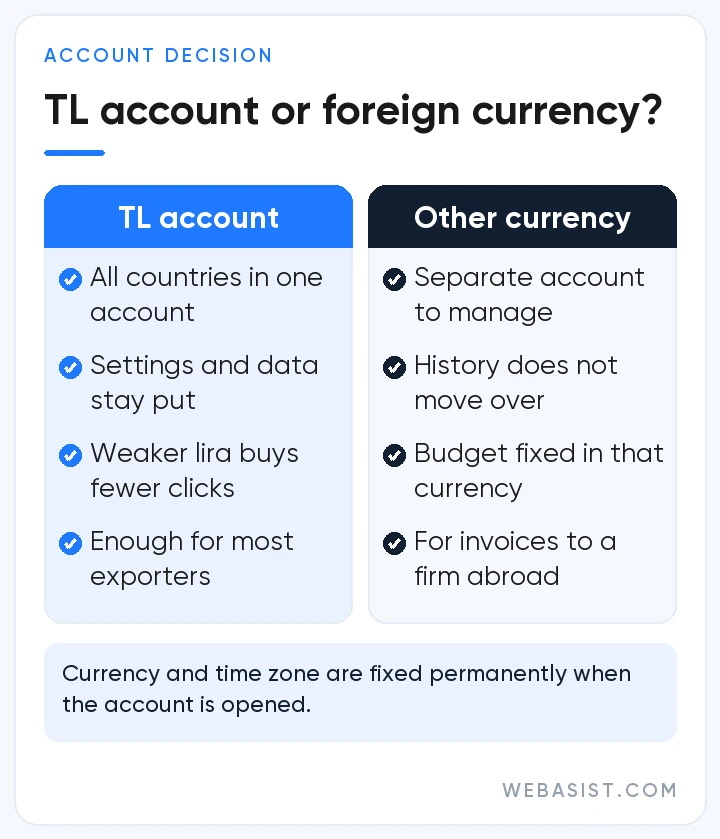
A separate account comes up in three cases: you need invoices in the name of your company abroad, your accounting requires spend in euros or dollars, or you need reports in a different time zone. An account's currency and time zone are fixed permanently when it is opened, so the answer to "how do I change my Google Ads currency" is a new account. You copy campaigns across with Google Ads Editor or a manager account, but historical data does not move.
A TL account has a hidden cost. Your competitor in Germany bids in euros; as the lira weakens, the same TL budget buys fewer clicks in that auction. That is why we do not freeze budgets in TL on international accounts; every month we check what they are worth in the target currency and adjust.
Country, language, currency: in what order do we decide?
We always follow the same order, because each decision narrows the next.
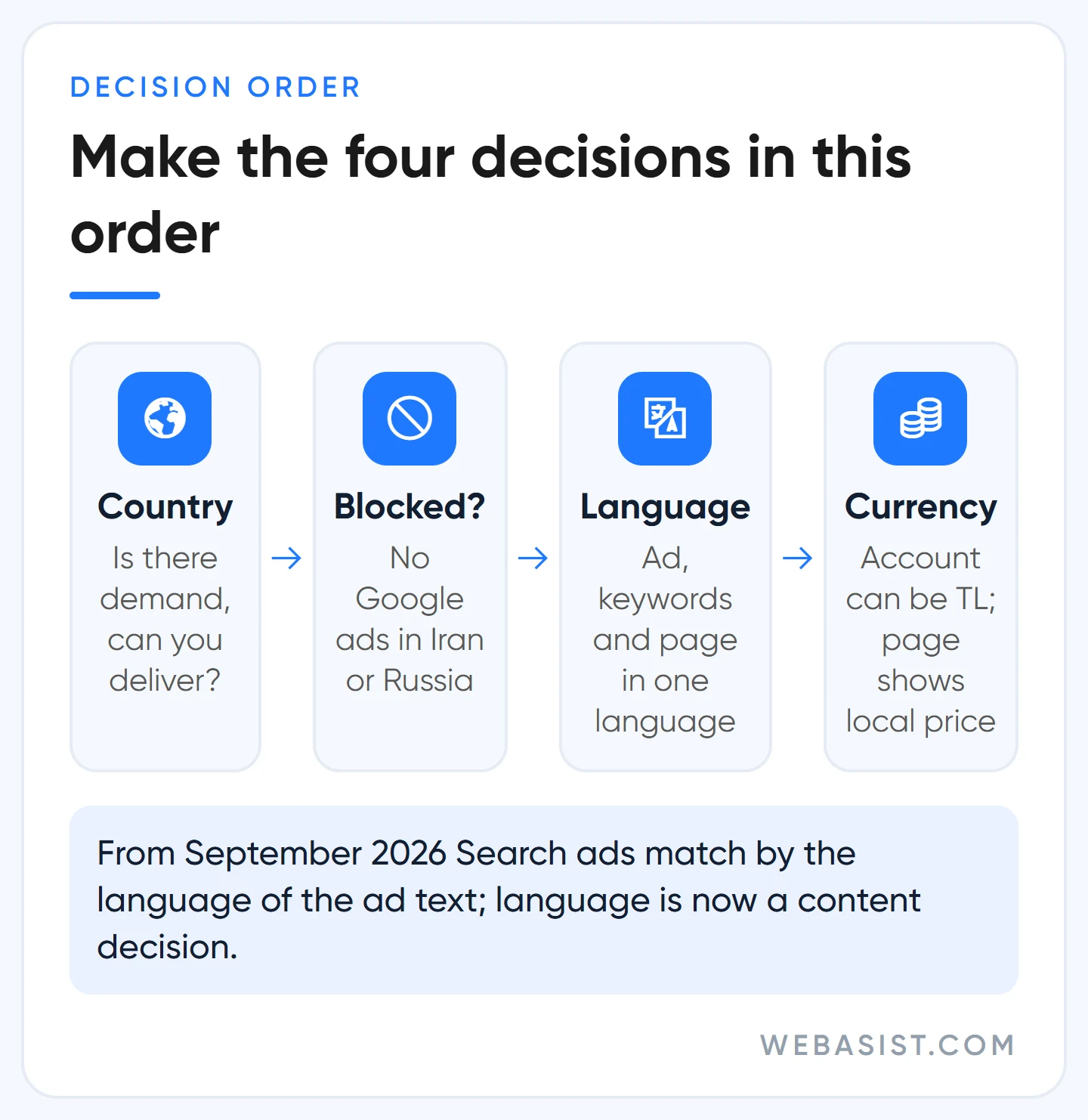
- Country: First check demand. In Keyword Planner, select the target country and language and look at monthly searches and the bid range for your product. Then check whether you can deliver: customs, shipping, after-sales support. A country with demand that you cannot ship to produces empty leads that look good in reports.
- Markets you cannot reach: Iran, Cuba, North Korea, Crimea and the so-called Donetsk and Luhansk republics cannot be targeted because of sanctions. Google has also not shown ads to users in Russia since March 2022. For an exporter selling to Iran or Russia, or a hotel expecting Russian guests, Google Ads is not a channel in those markets; do not look for budget there.
- Language: From September 2026, the campaign-level language setting is being removed from Search campaigns and ads are matched by the language they are written in. So language is no longer a setting but a content decision: German ads, German keywords and a German page for Germany. In the Gulf, check in Keyword Planner whether your buyers search in English or Arabic by looking at both.
- Currency: The account can stay in TL, but the prices on your page should not. A Dutch buyer who sees TL prices does not do the conversion; they move to a competitor quoting euros. If you do not show prices, let the buyer choose the currency on the enquiry form.
E-commerce: selling the same products in other countries
If you sell products, you can open your Merchant Center product data to new countries. Countries that share a language (such as Germany and Austria) can use the same data; a different language needs a separate data source translated into it. If your site does not show the target country's currency, prices can be shown with automatic currency conversion. Set shipping separately for each country, and switch off any redirect that changes language or currency based on the visitor's location. The full setup is in our Merchant Center and Shopping ads article.
Locations and surcharges: why we exclude Türkiye
For export campaigns our location option is "Presence". There is no point in an ad aimed at a maintenance company in Germany showing to someone in Istanbul searching for "Germany distributor". On top of that we exclude Türkiye; the difference between the options and our rule for choosing are in the campaign setup article linked above, and the rule is the same abroad.
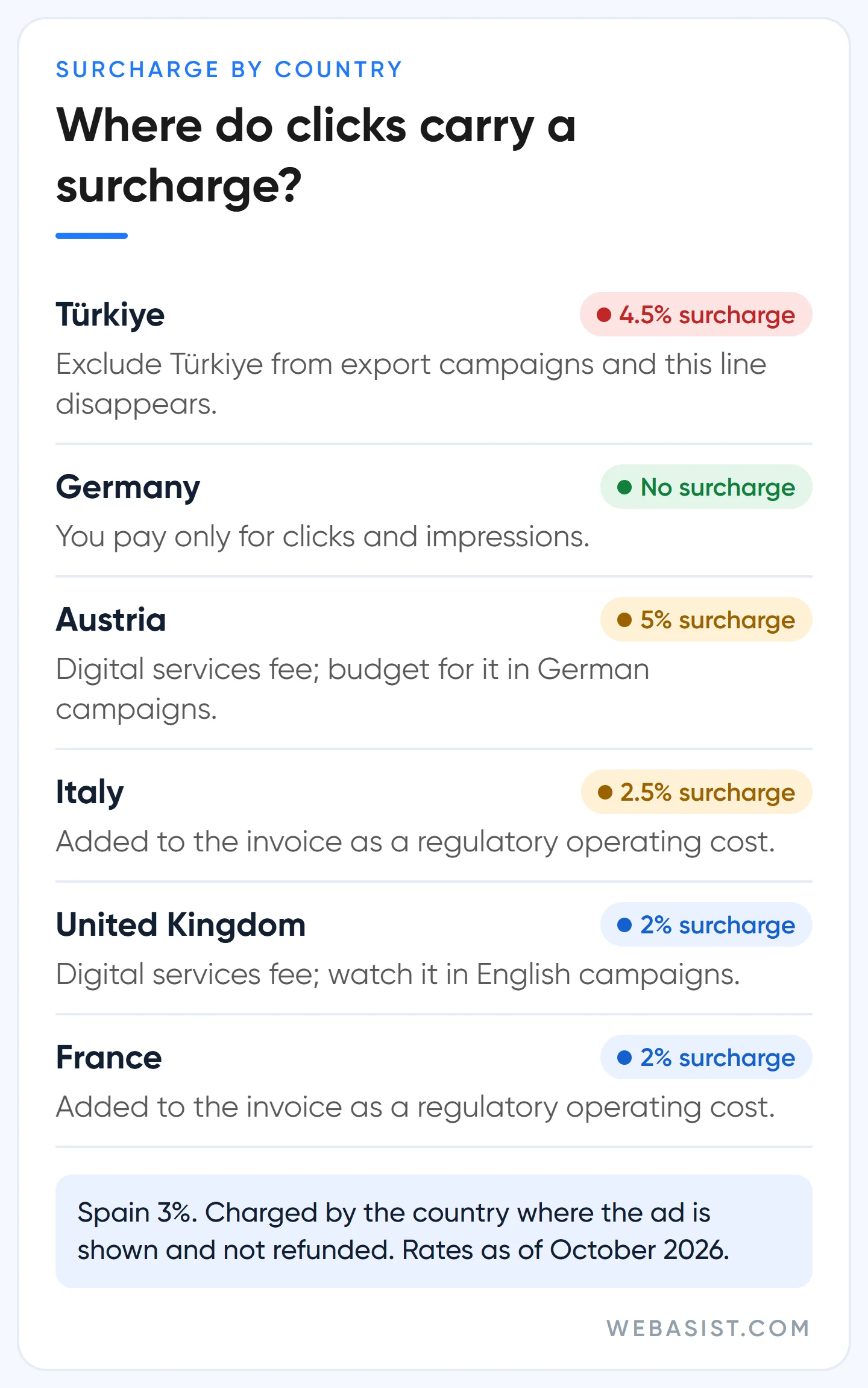
Excluding Türkiye also shows up on the invoice. The regulatory operating costs and digital services fees added to ad costs depend not on where your business is but on the country where the ad is shown. At the time of writing, ads shown in Türkiye carry 4.5%, Austria 5%, Spain 3%, Italy 2.5%, and France and the United Kingdom 2%; Germany has no such surcharge. A worked example: if your Germany campaign spends 30,400 TL a month and a wrong location option sends a tenth of the clicks from Türkiye, 3,040 TL is wasted and about 137 TL of surcharge is added on top. These fees are not refunded for ads served in line with your settings.
A week after launch, open the user location report. If you see spend from countries you did not target, the problem is the location option, not the budget. Tourism works differently, and we cover that separately below.
Keywords in the local language: translation is not enough
Translating a Turkish keyword list and loading it into a foreign campaign is the most common starting mistake we find in international accounts we take over. Buyers search for your product not by its name in your catalogue but in the language of their own trade. Even English is not one language: it is "aluminium" in the UK and "aluminum" in the US, and units and technical terms differ too. Research keywords separately for each country in Keyword Planner, and have the list read by a native speaker, ideally your distributor who knows the trade. We describe our research method in our keyword research article.
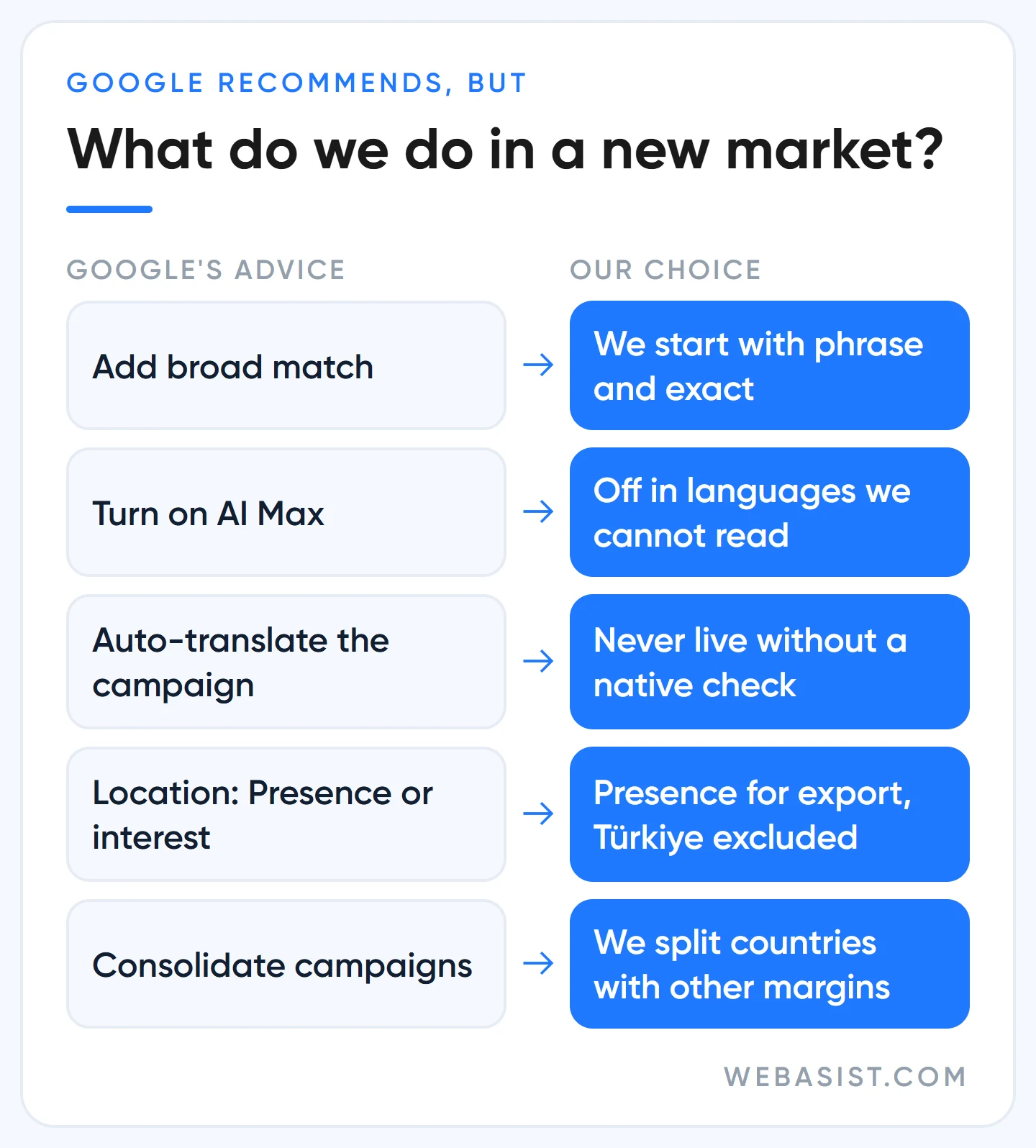
Google recommends it, but: broad match and auto-translation in a new market
When you open a campaign in a new country, every recommendation pushes reach up: broad match, AI Max, Performance Max, automatically created assets. The AI-powered localisation tool offered for Search campaigns will even translate your ads and keywords into another language and build a new campaign. In your own language you can police these tools through the search terms report. In a language you cannot read, you cannot tell which terms come from buyers and which from job seekers or students, and that is exactly where the money leaks.
So in a new market we start with phrase and exact match, keep AI Max off and never publish machine translation without a native-speaker check. We build the negative list with words from that language; in German, the words for job ads, second-hand and free each go in separately. Our routine is in the negative keywords article. We move to broad match only after reading the first months of search terms with someone who speaks the language.
Setup for exporters and B2B manufacturers: qualified enquiries, not forms
For an exporter of industrial products, raw materials or wholesale goods, what Google Ads produces is not an order but a request for a quote. That is why we measure success not by the number of forms but by the forms the sales team calls a real buyer.
- Turn the form into a filter: country, company name, product group, estimated quantity. More fields mean fewer forms but also less junk; in export work we accept that trade-off.
- Feed qualified enquiries back: send enquiries marked "qualified" in your CRM back into Google Ads with enhanced conversions for leads. The bidding system then learns to look for buyers, not forms. We explain the setup in our conversion tracking article.
- Count WhatsApp and email: foreign buyers often write rather than call. Set WhatsApp and email clicks up as conversions too.
- Plan for the time difference: the ad schedule runs on the account's time zone. Germany is 2 hours behind Türkiye in winter and 1 hour in summer; the US East Coast is 7 to 8 hours behind. If you cannot reply within the same business day, the buyer goes to the local competitor in the same search results.
- Write the page for the buyer: a product page in their language, minimum order, lead time, certificates and a contact channel that works in local hours. More in our landing page article.
International Google Ads budget: how many TL, with an example
Click prices vary widely between countries and we will not invent an average. Instead we show, with an example, the calculation you can fill in with your own numbers.
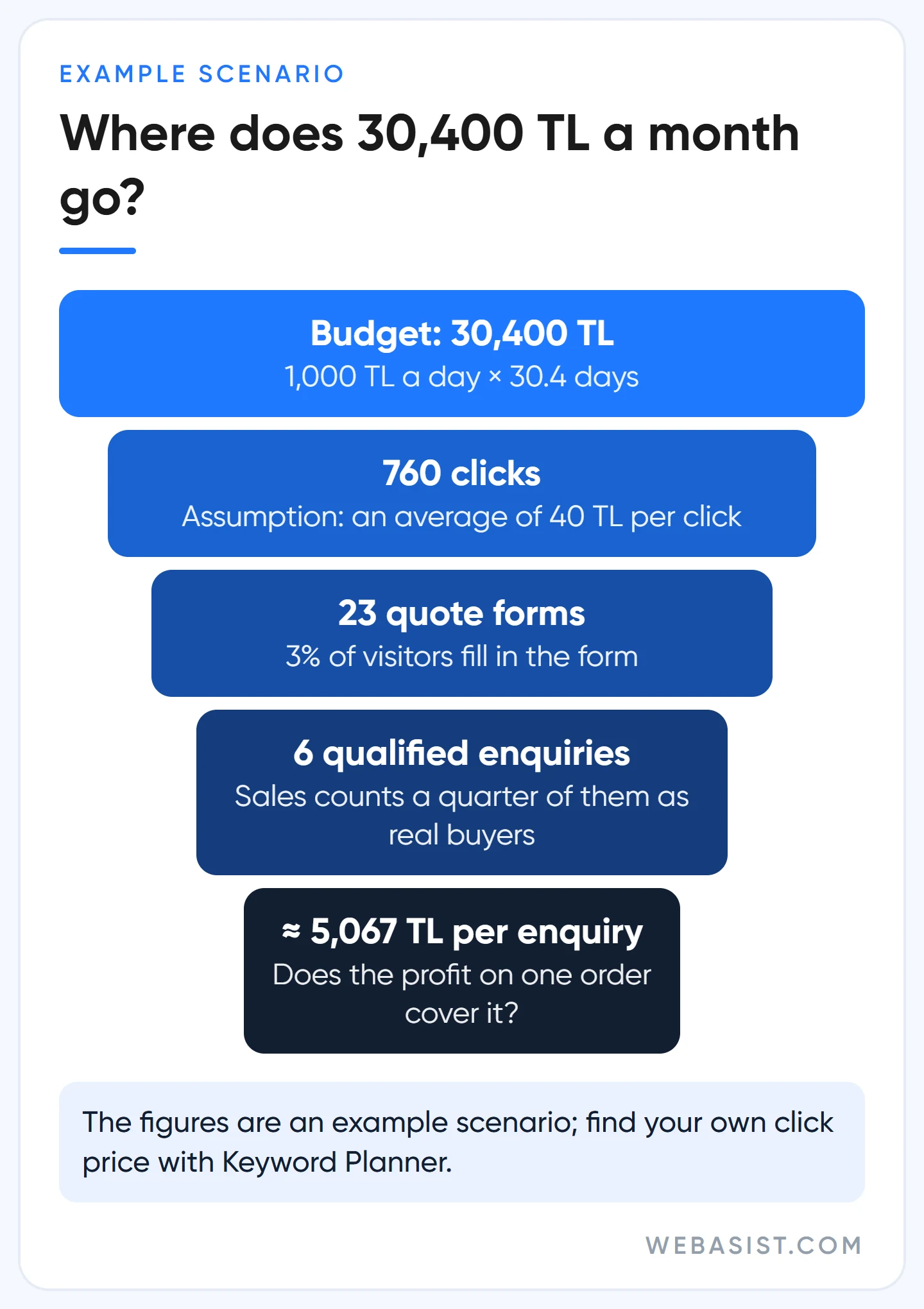
Example scenario: a manufacturer in Bursa making spare parts for industrial textile machines wants to reach maintenance companies in Germany. Say Keyword Planner's bid range for the main German keywords suggests an average of 40 TL. A daily budget of 1,000 TL comes to 1,000 × 30.4 = 30,400 TL a month; at 40 TL that is about 760 clicks. If 3% of visitors fill in the quote form, about 23 forms arrive a month. If the sales team counts a quarter of them as real buyers, 6 qualified enquiries remain: 30,400 / 6 ≈ 5,067 TL per enquiry.
Is that expensive? The answer is in your margin. Suppose an order leaves an average gross profit of 150,000 TL and one in six qualified enquiries becomes an order; a 30,400 TL month more than pays for itself. If an order arrives once every six months, it does not. Because B2B sales cycles are long, we make the first assessment at the end of month three, not on the first week's form count. The general method is in our budget planning article.
One verdict while we are at it: if you will be under 15,000 TL a month per country, do not open two countries at once. Split in two, the budget does not gather enough data to decide on either country; learn in one first, then expand.
Advertising abroad for tourism: hotels, tours and transfers
Tourism works the other way round from exporting: customers decide on a holiday in their own country, but the place they search for is your city. A hotel in Antalya that only wants foreign guests targets Germany, the UK and the Netherlands and chooses "Presence". The alternative is to target Antalya as the location and keep "Presence or interest"; then anyone interested in Antalya sees the ad, including people searching from Türkiye. That suits you if you also want domestic guests; if not, the first setup is right.
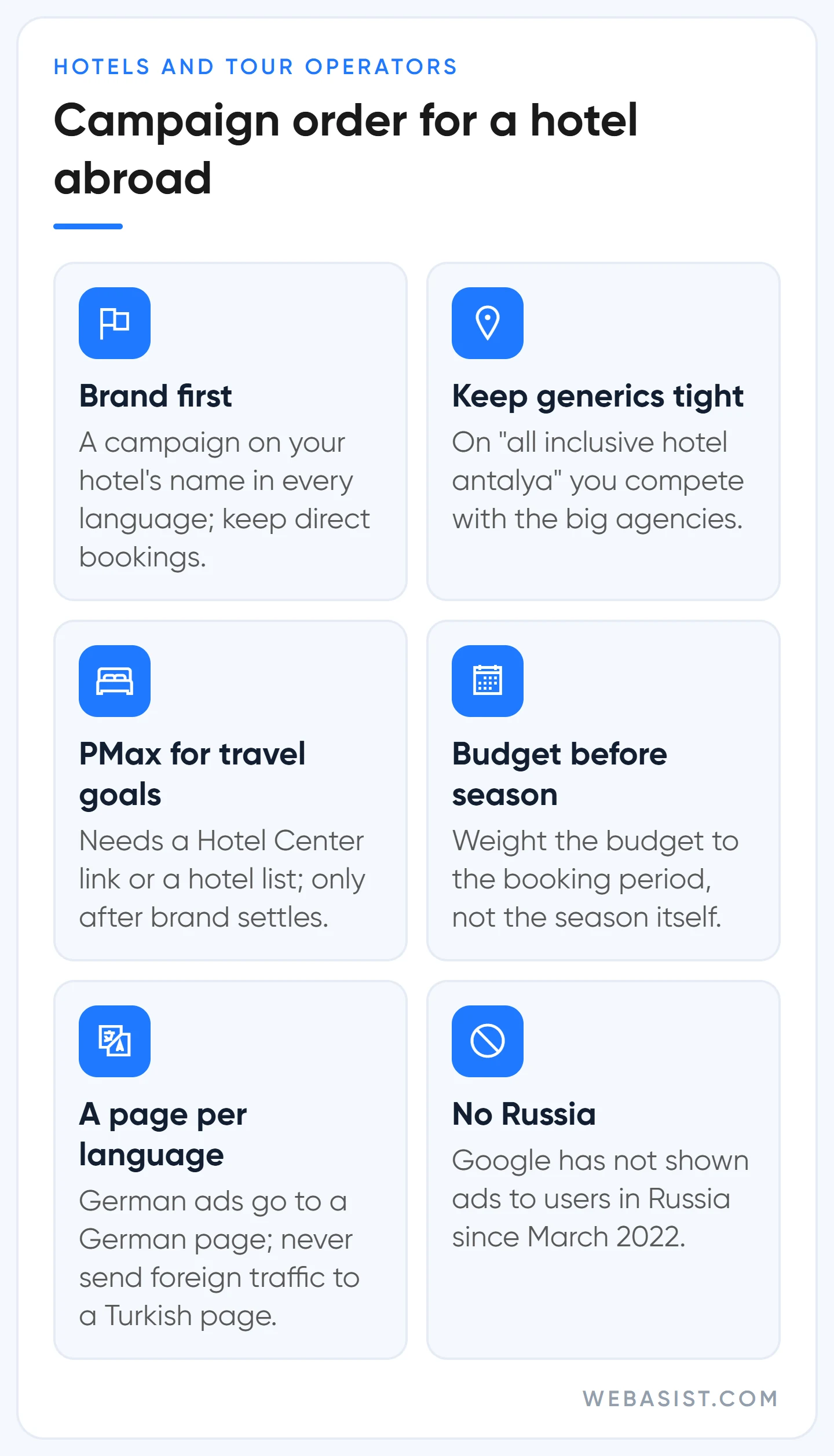
- Brand campaign first: someone searching your hotel's name is closest to booking, and online travel agencies may also advertise on that search. On international hotel accounts we open a brand campaign in every language as the first campaign; it is cheap and protects direct bookings.
- Keep generic keywords tight: on searches like "all inclusive hotel antalya" you are in the same auction as the big agencies. For a single-property hotel we give these keywords a small share.
- Performance Max for travel goals: brings your hotel prices into Google's hotel results. To set it up you link the account to Hotel Center or create a hotel list inside Google Ads. We do not move on to it until the brand and Search campaigns have settled.
- Shift budget with the season: European guests plan holidays months ahead. We put the weight of the budget on the booking period, not on the season itself.
Health tourism is outside the scope of this article: it has its own regulations. In such a campaign, exclude Türkiye without exception and take the licensing and content questions to your legal adviser.
Who should not start international Google Ads?
- Businesses with no page in the target language. An English ad that lands on a Turkish or half-translated page leaves the money at the door.
- Businesses that cannot reply to enquiries within the same business day.
- Businesses that have not solved delivery, customs and payment.
- Businesses selling to Iran or Russia; Google Ads is not available in those markets.
- Businesses wanting to open three countries at once on less than 15,000 TL a month per country. One country first.
Frequently Asked Questions
Can you change the country or currency in Google Ads?
You can change a campaign's target countries at any time. The account's currency and time zone, however, are fixed permanently when it is opened; to change them you open a new account and copy the campaigns over, without historical data.
How can I see my ad abroad from Türkiye?
Not by searching on Google, because the ad shows to users in the target country. Use the Ad Preview and Diagnosis tool with the target country as the location; we explain how in our ads not showing article.
Does Turkish export promotion support cover Google Ads?
The Ministry of Trade's export and e-export support decrees include items for promotion and digital marketing abroad. Which spend is covered and on what conditions is set out in the circulars; before launching, check the Ministry's Export Support page and your exporters' association, and keep invoices and ad records accordingly from day one.
Can you run Google ads in Russia or Iran?
No. Iran is on the sanctions list and cannot be targeted, and Google has not shown ads to users in Russia since March 2022. You will need other channels for these markets.
Can you advertise abroad on Instagram?
Yes. Meta ads also let you choose other countries as locations. If your product is visual we consider both channels together; we cover the Meta side in our Instagram ads guide.
Conclusion
Advertising abroad is a setting; making it profitable is preparation. Choose countries by demand and delivery, build language through content, exclude Türkiye and judge the budget by cost per qualified enquiry, not per click.
Write to us with your target country and the address of your page in that language; we will look at that country's demand and bid range in Keyword Planner together and discuss a per-country budget from that data. Each country and language pair needs its own campaign; so count campaigns that way when you choose a package. What each package covers is on our Google Ads packages page.














