


Google Ads vs Meta Ads: Our Verdict for Facebook, Instagram and Google
The answer to Google Ads vs Meta Ads hangs on one thing: do people search for your product on Google? If they do, start with Google Ads; if they do not, start with Facebook and Instagram ads, which means Meta. Instagram ads are bought in the same panel, Meta Ads Manager, so "Google Ads vs Instagram ads" has the same answer. Do not open both on a small budget; we give the line in lira below.
We run campaigns on both platforms and hold Google Partner and Meta Business Partner status, so we have no interest in praising one to sell the other. Our interest is where your money goes in the first month. First we show how to measure demand, then which business starts where, then what the same 30,000 TL does on each side.
The three-minute test: do people search for your product on Google?
Do not guess this; measure it. Keyword Planner in your Google Ads account shows an estimated range of monthly searches for a keyword. Type three to five phrases your customer would use: "Beylikdüzü glass balcony", "used forklift", "physiotherapy at home". If you have no account there is a rougher method: type the phrase into Google. If sponsored results appear, someone is paying for that search, so demand exists.
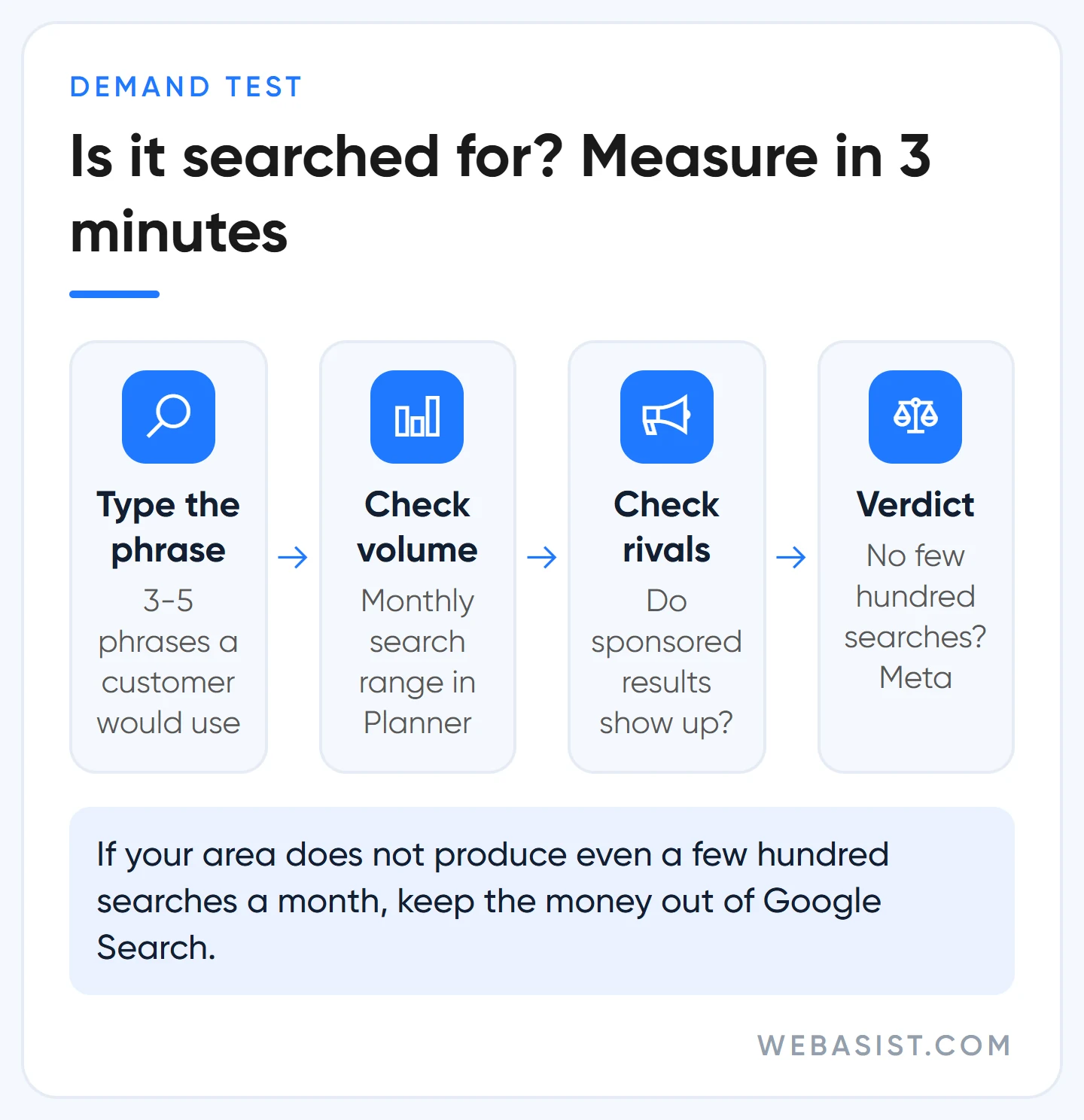
Our verdict: if searches describing your product in the area you serve do not reach a few hundred a month, do not put money into Google Search; the ad will find no impressions, and when it does, they will come from searches with the wrong intent. If demand exists, the first 10,000 TL belongs in Google Search, because that money reaches only people who have typed out their need.
The second test is for Meta: can your product be understood from a photo or a ten-second video? Glass balconies, boiler repair and accounting do not sell on visuals; handmade ceramics, clothing, home decor and a new snack do. Read the two tests together: searched for and visual (fashion e-commerce, say) means both are candidates; not searched for and not visual (a new B2B software product) means neither is the first choice, and we would talk about LinkedIn instead.
Which business starts where? Our verdicts
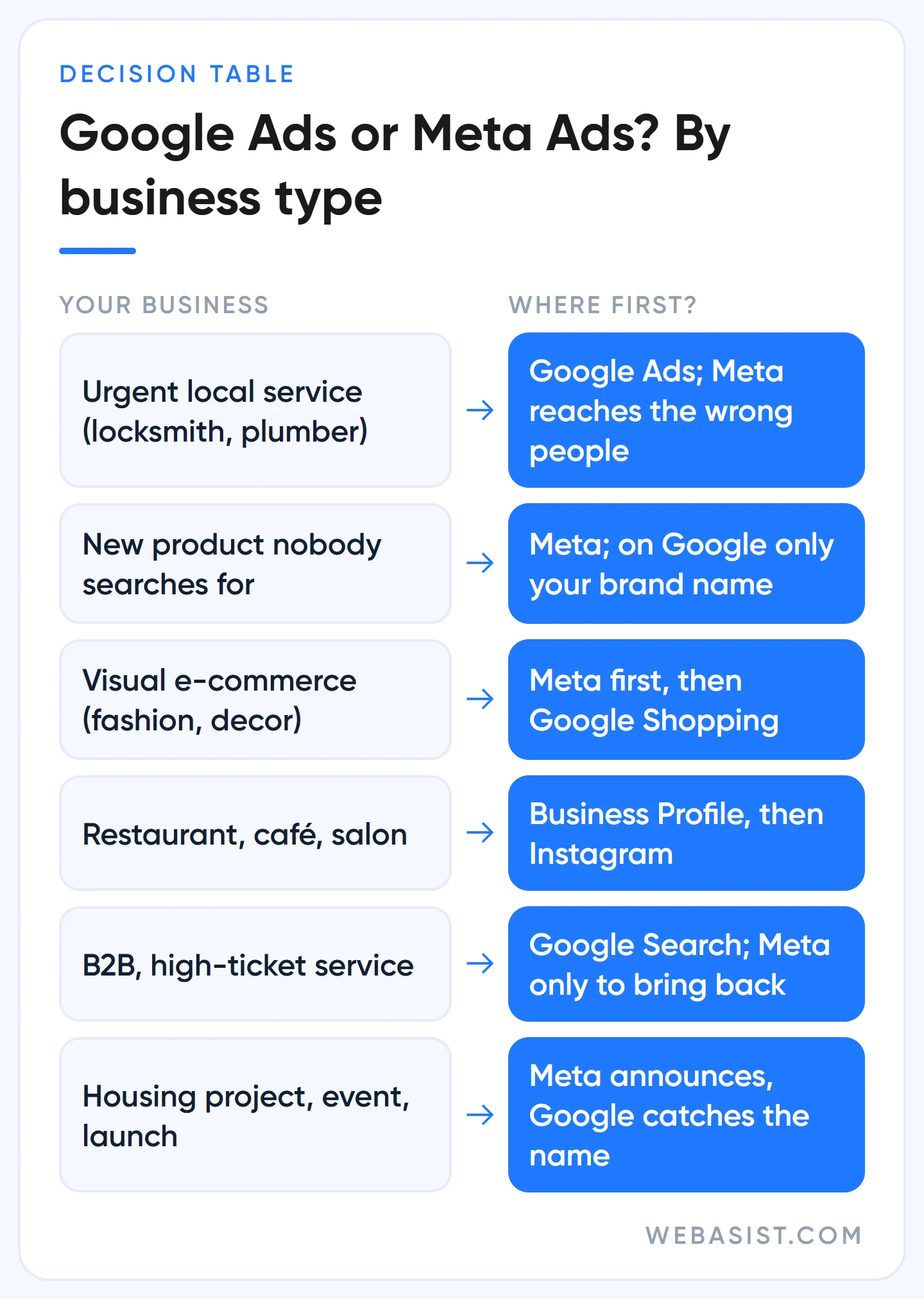
- Urgent local services (locksmith, plumbing, glass balconies, repairs): Google Ads. The customer searches the moment the problem happens; showing a "leak repair" ad to someone scrolling Instagram is shouting at people who do not need you.
- A new product nobody searches for: Meta. With no search volume you have to show the product first, and Reels and feed ads exist for that. On Google, open only a small campaign on your brand name so that people who saw you on Meta and typed your name are not lost.
- Visual e-commerce (fashion, decor, cosmetics): Start on Meta and add Google Shopping for product-name and brand searches. Your site traffic decides the order: no traffic means Meta; traffic but no sales means fix the product page first.
- Restaurants, cafés, beauty salons: The free Business Profile first, then Instagram. Maps answers "breakfast near me"; photos sell the atmosphere.
- B2B and high-ticket services: Google Search. The decision maker searches for a solution and does not stumble on it in a feed. Use Meta only to bring back people who already visited your site.
- Housing projects, events, launches: Announce on Meta, catch the project or event name on Google. Anything people must first hear about starts on Meta.
The only place in this list where we say "both" is e-commerce, and even there in sequence. For everything else: one platform, one goal, and only that in the first month.
What does the same 30,000 TL do on each platform? (example scenario)
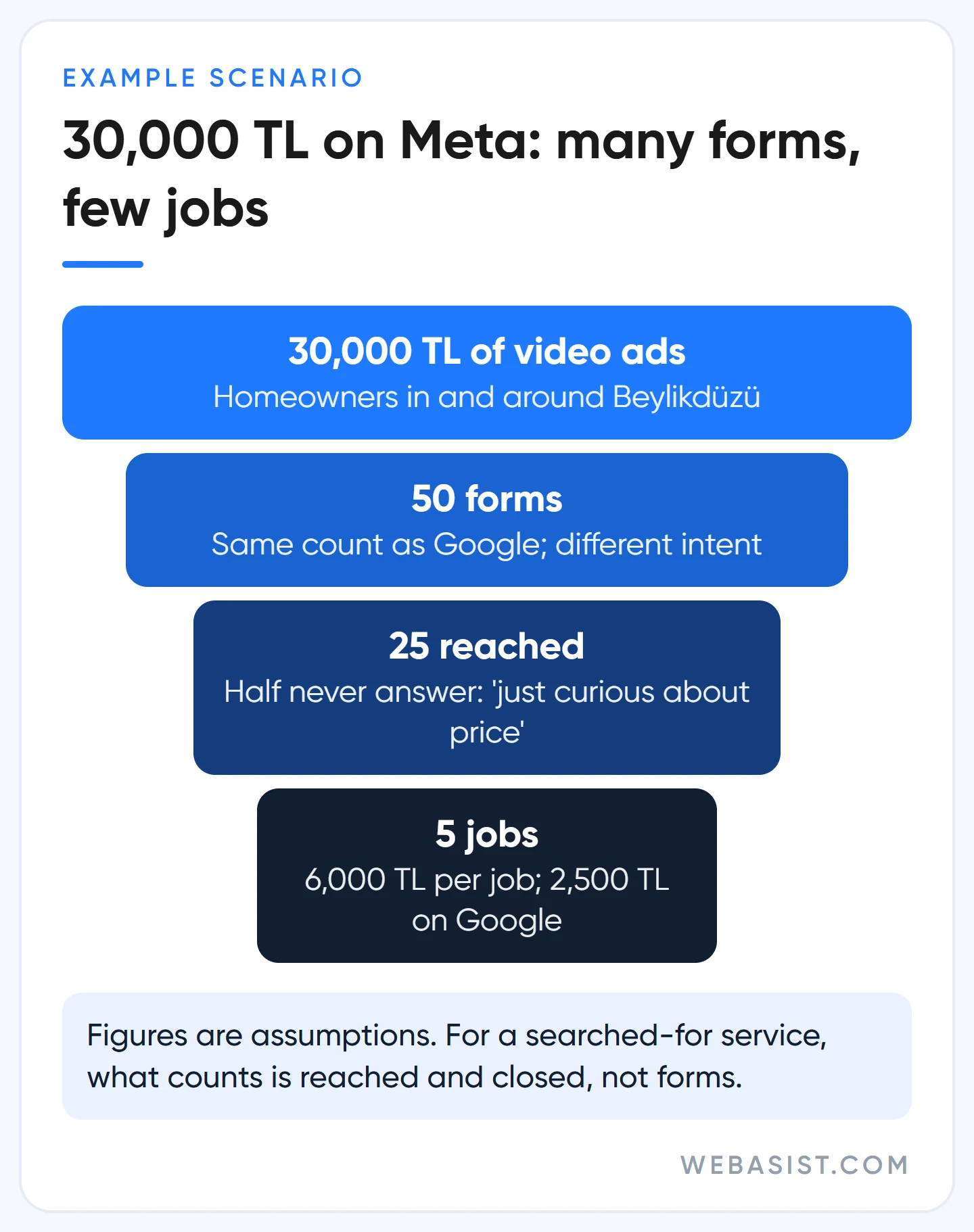
Example scenario: a glass balcony company in Beylikdüzü, Istanbul, has 30,000 TL for one month. One job leaves about 8,000 TL profit. The figures are assumptions; redo the sum with your own numbers.
Put into Google Search: at 30 TL per click on searches like "Beylikdüzü glass balcony" and "glass balcony prices", it buys 1,000 clicks. If 5% of them call or fill in a form, that is 50 enquiries at 600 TL each. All 50 are people who want a glass balcony; if a quarter become jobs, that is 12 jobs at 2,500 TL of advertising per job. With 8,000 TL profit, the sum works.
Put into Meta: the same money shows a video ad to homeowners in and around Beylikdüzü and, let us say, brings 50 forms as well; some of the people who filled them in were "just curious about the price" and never pick up the phone. This is the difference we see most in the field: on Meta the number of forms can match Google, but the number reached and turned into jobs usually does not. If 25 of the 50 are reached and 5 become jobs, a job costs 6,000 TL. Same money, same number of forms, a customer three times as expensive.
Now the reverse: a brand selling handmade ceramics. "Handmade ceramic mug" gets few searches a month; on Google it could not even find 30,000 TL worth of clicks. On Meta the same money shows the product to tens of thousands of people, and sales depend on the quality of the site and the video. For this brand we would recommend Google only for its brand name, at 50 TL a day. The logic behind budget limits is in our Google Ads budget guide.
Both platforms are sellers: when we reject their recommendations
Google shows recommendations in the panel to add Demand Gen and Performance Max campaigns; these types advertise on YouTube, Discover and Gmail, discovery surfaces that resemble Meta. Google's aim is to pull part of your search budget onto its own discovery surfaces. In accounts with a monthly ad budget under 30,000 TL we keep Google on search only; if discovery work is needed we do it on Meta, where the audience and creative tools were built for exactly that. We try Google's discovery types only after the search campaign is saturated; which type we open when is in our campaign types article.
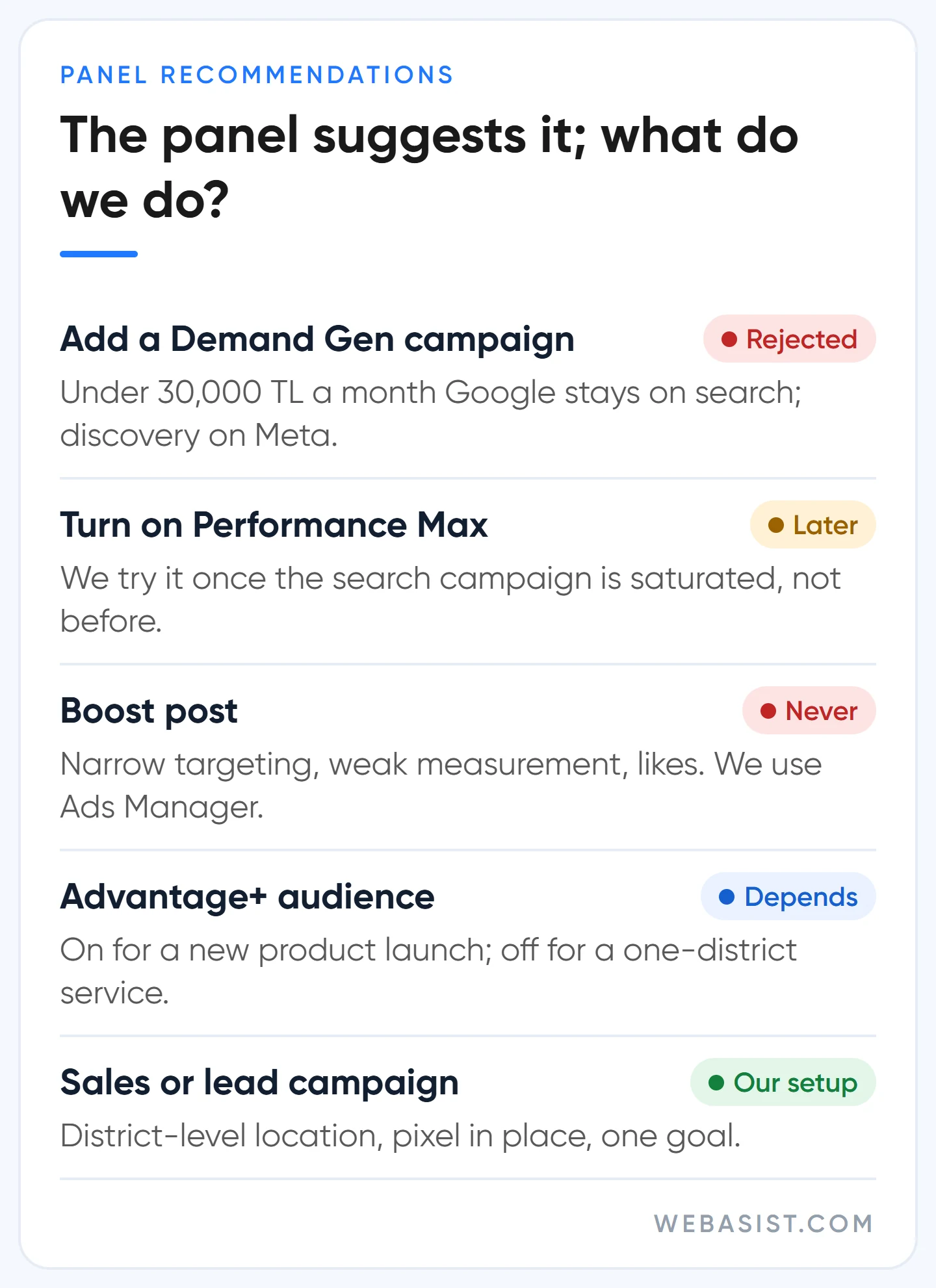
Meta is a seller too. The "Boost post" button on Instagram is the easiest way to spend money: narrow targeting options, weak measurement, likes as the result. Advantage+ audience can reach beyond the audience you chose; that helps when launching a new product and hurts when you sell glass balconies in one district. On Meta we build sales and lead campaigns in Ads Manager and keep location at district level; the setup is in our Facebook ads guide and Instagram ads guide.
Using both: Meta introduces, Google catches
For a business whose budget can carry both platforms, the question becomes "in which order" rather than "which one". Someone who sees your product on Meta usually types your brand or product name into Google before buying. If you are not there at that moment, the interest Meta created clicks on a competitor's ad. That is why, in every period we promote on Meta, we keep a brand and product-name campaign running on Google; why brand searches are cheap and why they are essential is in our competitor brand bidding article.
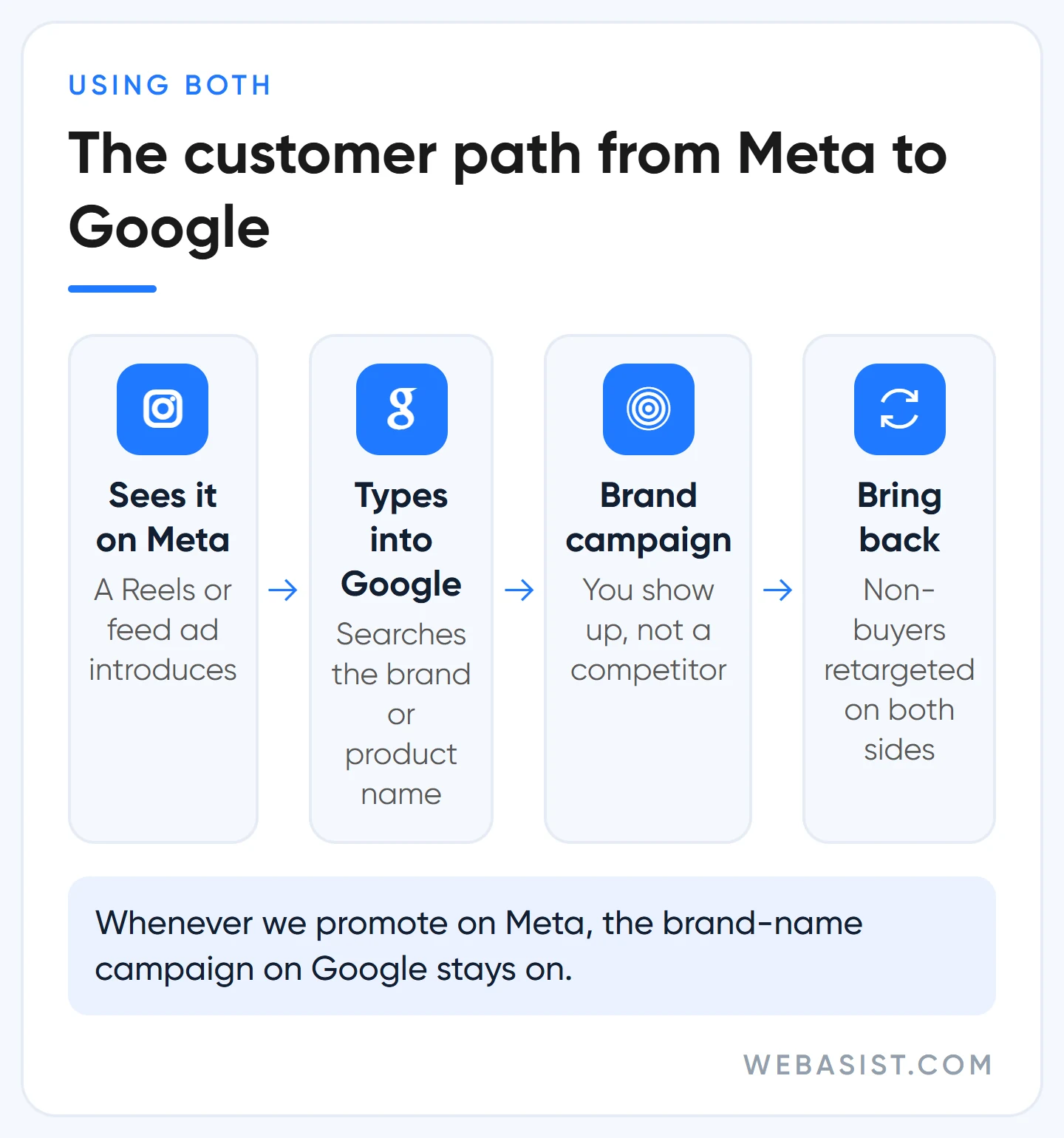
The flow works in reverse too. Visitors who arrive from Google and leave without buying can be retargeted on Meta; the website visitor audience built with the Meta Pixel exists for that. On the Google side the same job is done with remarketing. Add the second platform with a limited budget only once the first produces stable data; leaving both in the learning phase in month one starves both.
Measurement: do not trust the sum of two dashboards
Google Ads and Meta each count conversions in their own panel by their own rules, and the same sale can appear in both. On Google the default click-through conversion window is 30 days; on Meta, standard attribution gives 7 days for clicks and 1 day for views. A business that adds up the two panels believes it sold more than it did and raises the wrong budget.
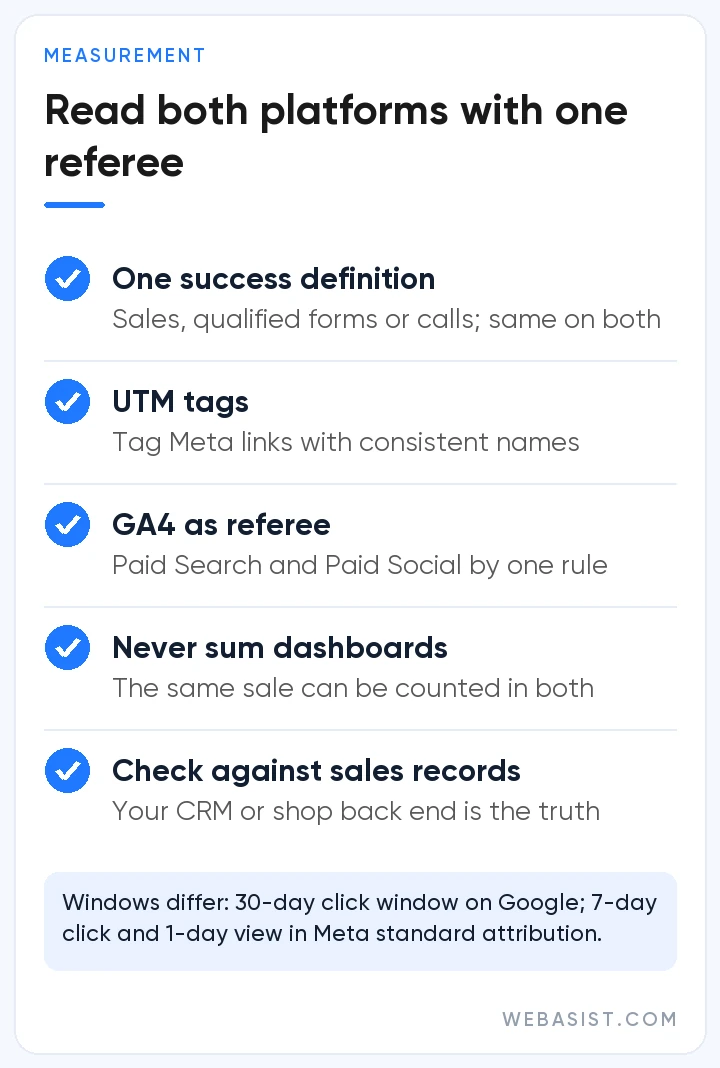
Our referee is Google Analytics 4 together with your own sales records. We add UTM tags to Meta links, link Google Ads to GA4 and read both channels by the same rule, then compare against real sales in your CRM or shop back end at month end. The Google side of the measurement setup is in our conversion tracking guide, step by step. "Meta worked better" without measurement in place is a guess.
Who should not run both, and who should run neither?
- Do not run both if your monthly ad budget is under 10,000 TL. That money is borderline for meaningful data on even one platform; split in two, learning never finishes on either side. One platform, one campaign.
- Do not go on Meta if you cannot produce new images and video every month. The same ad wears out after a few weeks, frequency rises and costs climb. With nobody to make creative, a Meta budget drains away after two months.
- Do not go on Google Search if nobody searches for your product. No impressions means the problem is channel choice, not Google; you cannot capture demand before creating it. The difference between ads and organic results is in our Google Ads vs SEO article.
- Run neither if nobody will answer the phone or reply to a form within the hour. Meta leads go cold especially fast; a business that replies at noon to a form sent the evening before has spent that money on its competitor.
Frequently Asked Questions
Which is better, Google Ads or Instagram ads?
Instagram ads are bought through Meta Ads Manager, so this is the same question as Google Ads vs Meta Ads. If the product sells on visuals and is not searched for yet, Instagram; if it is searched for, Google. Ready buyers end up typing into Google, so while you promote on Instagram do not leave your brand name uncovered on Google.
Which is cheaper, Google ads or Facebook ads?
Do not compare by click or impression price; a click on Meta often looks cheaper, but the person clicking has a different intent. Look at what one customer costs in lira over the same period with the same definition. Both platforms add a country-specific fee on top of the budget for ads shown in Turkey; on Google that rate is 4.5%.
Which should a small business start with?
If you sell a service people search for, a small Google Search campaign focused on one district; if you sell a visual product nobody searches for yet, Meta with three to five creatives. Not both.
Do Meta ads appear in Google search results?
No. A Meta ad only appears on Facebook, Instagram, Messenger, WhatsApp, Threads and partner apps in Audience Network. Appearing on Google's results page takes Google Ads or organic work.
Conclusion
Searched for: Google Ads. Not searched for: Meta. Able to carry both: let Meta introduce and Google catch. If the budget is under 10,000 TL, take one decision from this article and do only that.
Send us your product name and the district you serve; we will pull the search volume from Keyword Planner and give you the "Google or Meta" answer in one line, with the reason. If you want to hand the accounts over to us, the scope is on our Google Ads package and social media advertising package pages, and ad spend is not included in either.














