


Competitor Brand Bidding: What to Do When a Rival Bids on Your Name

You typed your own brand name into Google and a competitor's ad came up first. The short answer: if the competitor is only using your name as a keyword, Google allows it and a complaint will not stop it. A complaint works only when your trademark appears in the ad text itself, or when the ad pretends to be you. Your real defence is a small brand campaign on your own name.
Competitor brand bidding raises three questions that our clients ask us again and again, and this article answers all three plainly. A competitor is bidding on my brand, what do I do? Should I pay for ads on my own brand name? Should I bid on their name in return?
Our answers, in order: work out which situation you are in, yes if a competitor shows up, and no for most small businesses.
One note before we start: take the legal side to a trademark attorney once, because we do not give legal opinions. What we cover here is what to do inside the ad account and where your money goes. The examples are in Turkish lira because that is the market we manage accounts in.
A competitor is bidding on my brand name: what should I do?
First, stop searching for your own name over and over. If your own ad shows each time, you pile up impressions with no clicks, and if you click the competitor's ad you are committing click fraud yourself. We explain what happens when a rival does that to you in our guide to fake clicks in Google Ads.
The first job is to document what is going on. We look in three places:
- Ad Preview and Diagnosis tool: it sits in the Tools menu of Google Ads. Type your brand name and you see the results page without adding impressions.
- Auction insights: if you already run a brand campaign, this report lists the domains that enter the same auctions on your name and how often they appear above you.
- Ads Transparency Center: this is where you read the competitor's live ad copy. We show how in our Ads Transparency Center guide.
Save a screenshot, the date and the search term. Then answer one question: does your trademark appear in the competitor's ad text? Every step after this depends on that answer.
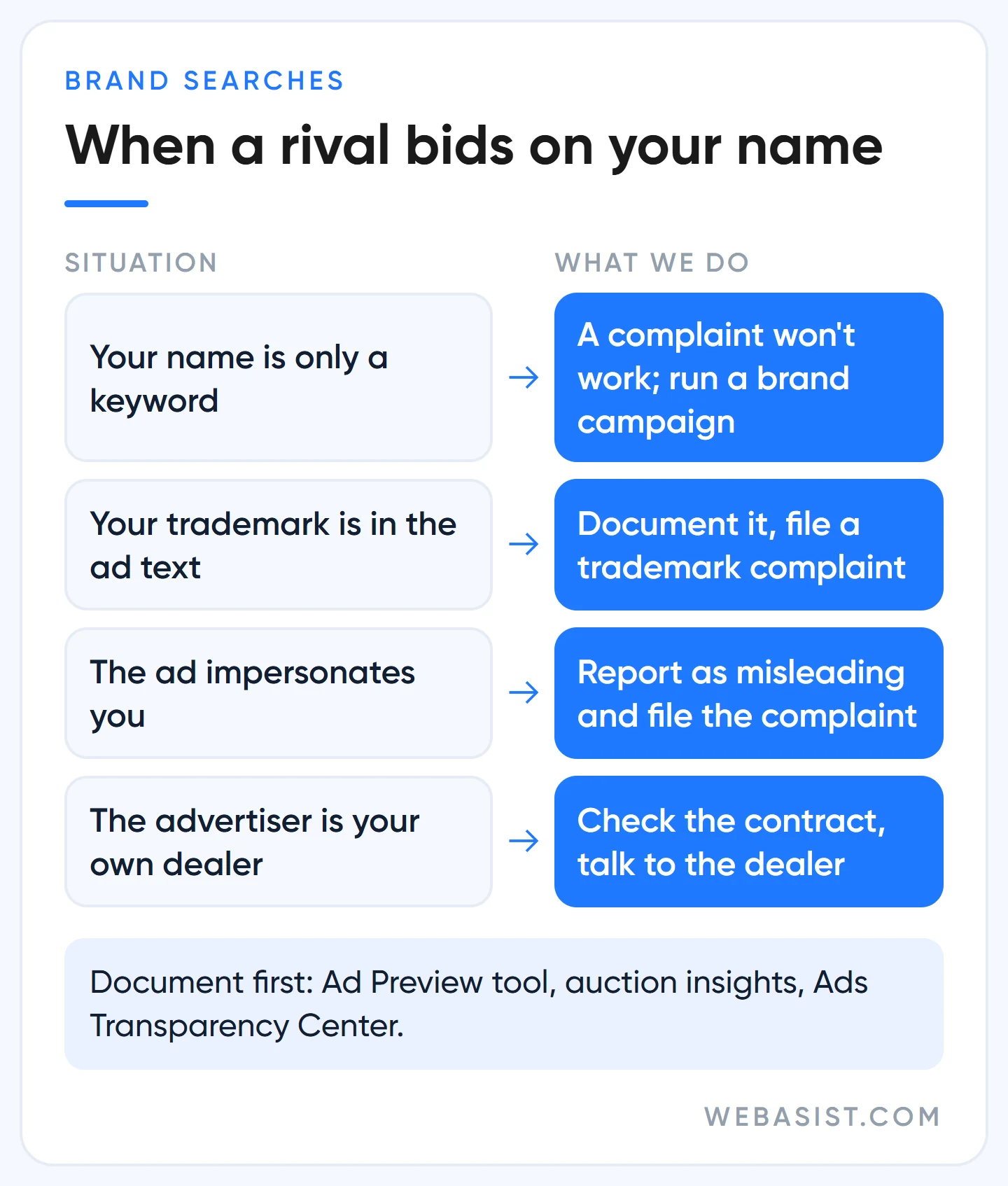
| What you see | Will a complaint work? | What we do |
|---|---|---|
| Competitor uses your name as a keyword but writes its own name in the ad | No | Launch or strengthen the brand campaign |
| Your registered trademark appears in their headline or description | Yes | Document it and file a trademark complaint |
| The ad poses as your official site, dealer or branch | Yes, through two channels | Report the ad as misleading and file the trademark complaint too |
| The advertiser is your own dealer or reseller | Usually not | Check the contract first and talk to the dealer |
The first row is the one we see most, and it is the hardest for clients to accept: Google is happy to sell someone else's brand as a keyword. The reason is simple, it earns from that click as well. The person searching your name is demand you built, yet the auction is open to everyone. Working out what it costs to stay on top of that search pays better than being angry about it.
If the ad is impersonating you
When a competitor presents itself as your authorised service, official site or branch, that is a separate and more serious violation than trademark use. Google treats it as misrepresentation. Report the ad from its card in the Ads Transparency Center or from the menu next to the ad, and open the trademark complaint as well. The two reports go to different teams, so one does not replace the other.
How do you file a trademark complaint with Google?
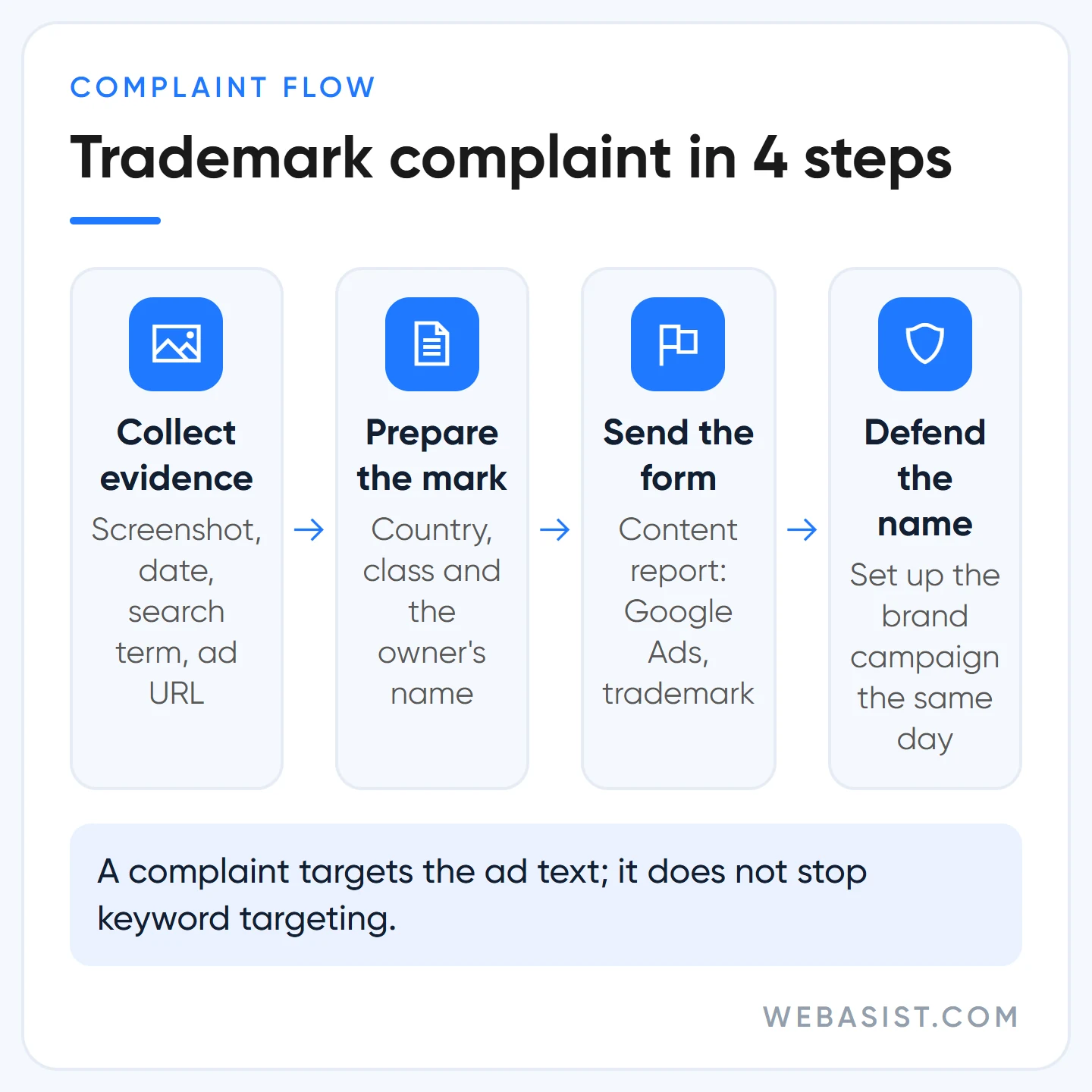
The complaint has to come from the trademark owner or someone the owner has authorised in writing. The route: follow the complaint link on the Trademarks policy page into Google's content reporting flow, choose Google Ads as the product and trademark as the issue type.
Have these ready before you open the form:
- Your trademark registration details: which country, which class, in whose name.
- A screenshot of the ad, the date, the search term and the address the ad leads to.
- If your agency or attorney is filing for you, a letter of authorisation from the trademark owner.
Knowing the scope sets the right expectation. Google accepts complaints against a specific advertiser identified by its URL, not against everyone in your industry. It considers them only for the countries and industries where you can show trademark rights. If it decides to restrict, the restriction stays on every ad leading to that domain, but when another competitor does the same thing tomorrow you need a new complaint.
What a complaint cannot do is just as clear: it does not stop the competitor from targeting your name as a keyword. Your trademark leaves the ad text and the ad keeps running. That is why we never sell a complaint to a client as the whole solution. We file it and set up the brand campaign on the same day.
Google makes no promise on timing and reviews requests in the order received. We tell clients to be ready for a wait measured in weeks, not days. Keep the confirmation email, because replying to it is how you send extra information.
If you are a reseller, or have resellers
Trademark owners used to authorise each reseller with Google one by one. That is no longer needed, because restrictions now apply only to the advertiser named in a complaint. If you are a reseller using the brand name in your ads, your landing page has to actually sell that brand's products, show prices and a way to buy, and the ad has to make clear you are a reseller.
If you own the brand, look at it from the other side. When your dealer bids on your name and competes with your own campaign in the same search, both of you pay more per click. You fix that with an advertising clause in the dealer contract, not with a complaint to Google.
If you are the one who got the complaint
An ad limited for trademark reasons usually does not stop completely, it just stops showing on some searches. The fastest way out is to remove the trademark from headlines, descriptions and sitelinks and resubmit. If you really are a reseller of that brand, appeal, but bring your landing page in line with the reseller conditions first. Our disapproved ads guide explains how appeals work.
Should I advertise on my own brand name?
Our answer depends on two things you can check in five minutes. If another ad appears above you when you search your brand, yes, run it. If nobody appears and you rank first organically, you usually do not need it, so put that money into keywords that bring new customers.
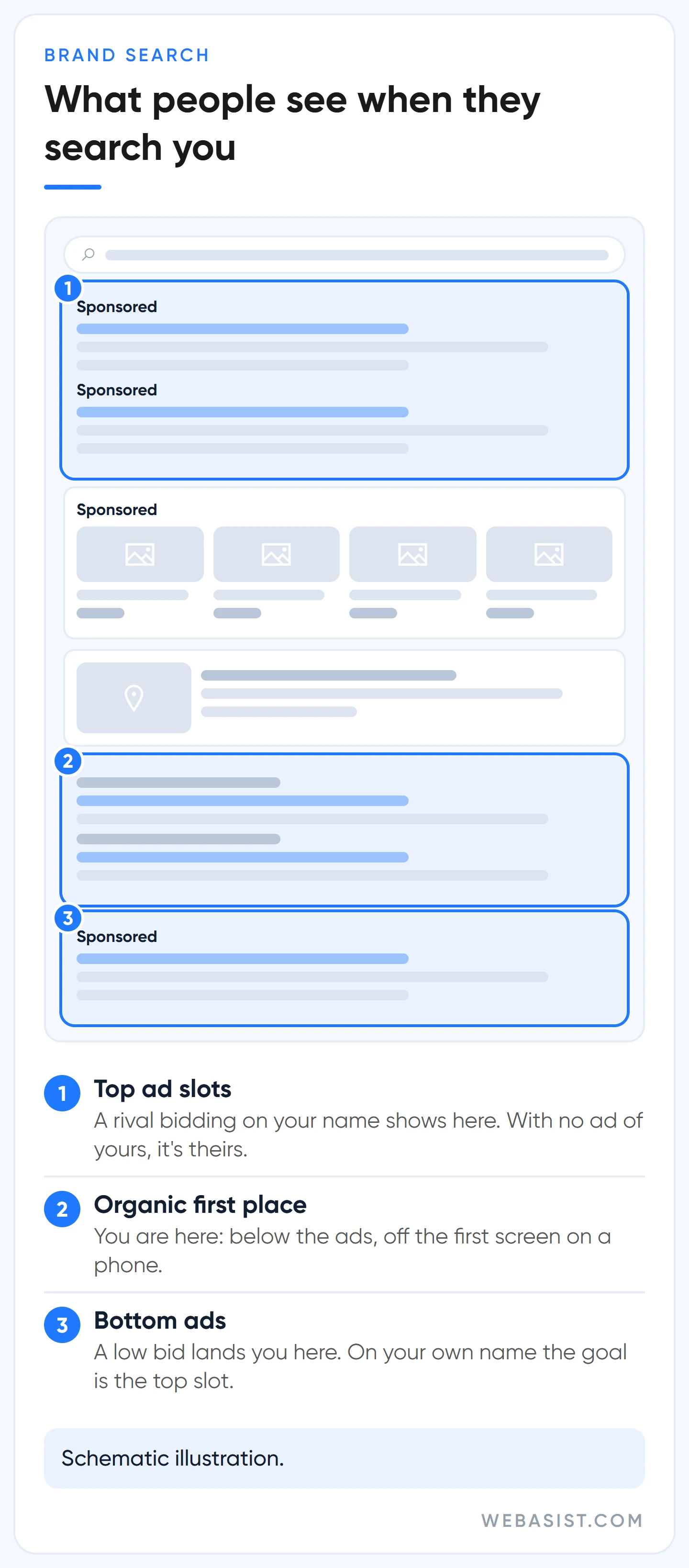
The objection "I already rank first, why pay?" is fair but incomplete. Ads sit above the organic results. When a competitor bids on your name, your first organic position ends up below that ad, and on a phone it may not even fit on the first screen. People click the first thing they see, and that may be your competitor's ad promising same-day delivery.
Let us put numbers on it. The figures below are not from a real account, they are an example scenario to show the calculation:
- 1,000 people search your brand name each month and 300 click your ad.
- Brand clicks are cheap because yours is the most relevant ad. Say 3 TL a click: 300 × 3 = 900 TL.
- If the competitor wins just 4 of your customers a month from those searches, and one customer leaves you 2,500 TL in profit, you lose 4 × 2,500 = 10,000 TL.
A 900 TL insurance policy is cheap next to a 10,000 TL loss. But with no competitor in sight, most of that 900 TL goes to people who were coming to you anyway. The way to tell the two apart is a test, not a guess.
A two-week on and off test
Link Search Console to Google Ads. The "Paid and organic" report in the report editor then shows ad clicks, organic clicks and the combined total for your brand searches side by side. Pause the brand campaign for two weeks in a quiet period and watch total clicks and brand-driven sales. If the total barely moves, the campaign is adding nothing, so leave it off.
Be sceptical of any agency that says brand ads are a must, and of any consultant who says they are pointless, if neither has run this test. We discuss why ads do not affect your organic ranking and how the two work together in our Google Ads vs SEO article.
Do not let the brand report fool you
The brand campaign is the best-looking row in any account: cheap clicks, high conversion rate. That is not the ad being brilliant, it is people who were already looking for you. Keep brand and non-brand keywords in one campaign and the average cost per conversion looks low while the true cost of a new customer stays hidden. In accounts we take over, this is the first thing we separate.
How we set up a brand campaign
Technically it is an ordinary Search campaign. The difference lies in what you let in and what you keep out. Our setup order:
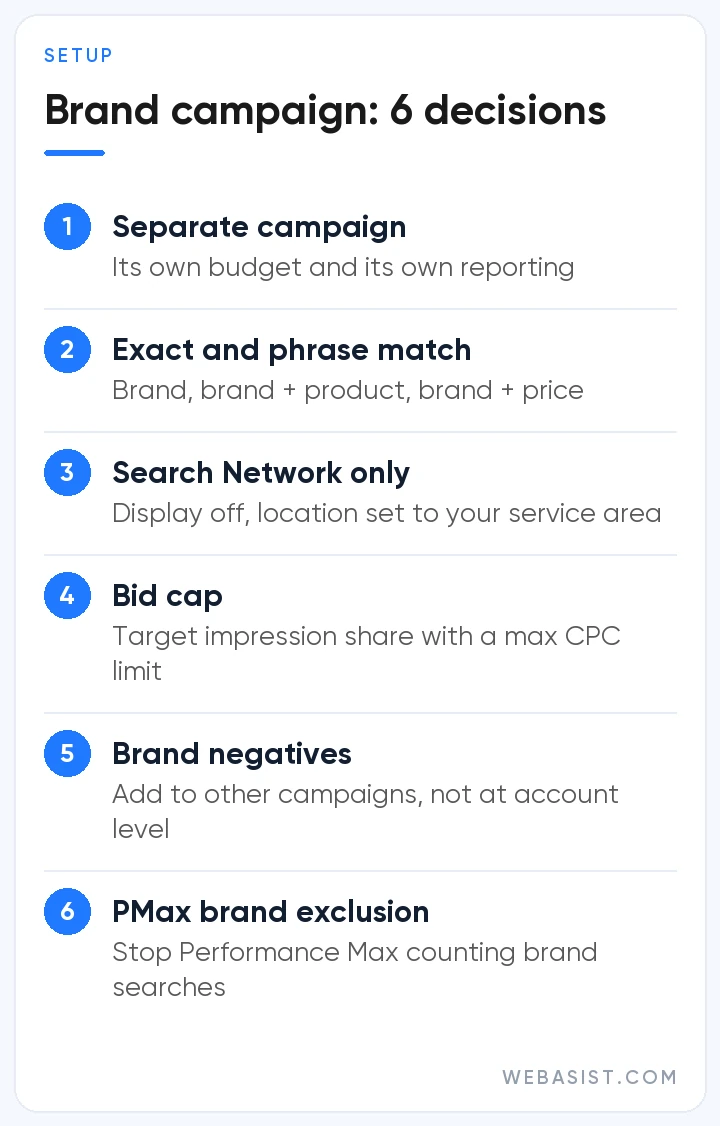
- A separate campaign. Put "Brand" in the name and give it its own budget and reporting.
- Exact and phrase match. Brand name, brand + product, brand + price, brand + contact. Add the one-word spelling, the abbreviation and any former name.
- Search Network only. Untick the Display Network box and limit location to people who are actually in your service area.
- Target impression share with a bid cap. The goal is to stay on top of your own name. Without a maximum CPC limit, you raise your bid every time the competitor does, without noticing. See our bidding strategies guide for how the strategy works.
- A full ad. "Official site" in the headline, your current offer in the description, sitelinks to your four most searched pages.
- Brand negatives in the other campaigns. Add your brand name as a negative keyword to your other Search campaigns so brand clicks are not credited there.
One accident we see often at that last step: adding the brand negative to the account-level list. That list applies to the whole account, so your own brand campaign stops serving too. Apply the list campaign by campaign. Our negative keywords guide covers how negatives match.
What Google recommends here, and why we decline
The Recommendations tab will ask you to switch your brand campaign to broad match and fence it in with the "brand inclusions" setting. Apply it and the keywords in the campaign become broad match. We do not do this in brand campaigns: exact match already catches the searches we want, while broad match opens the door to queries only loosely tied to the brand and spoils the cheap clicks.
The second issue is Performance Max. Because it serves across every Google channel, it picks up your brand searches on its own and polishes its report with them. Google sees no problem, a sale is a sale.
For you, the campaign you believe is finding new customers may be counting people who were already searching for you. Add a brand list containing your own brand under brand exclusions in the campaign settings. If you sell products, you can tick the box that keeps Shopping ads running on brand searches. Details are in our Performance Max guide.
Can you bid on a competitor's name, and does it work?
You can. Google does not restrict targeting a competitor's trademark as a keyword. What it restricts, if the owner complains, is using that name in your ad text. So the question is not whether it is allowed but whether it is worth it, and our answer for most small businesses is no.
Here is why. Someone typing your competitor's name is looking for the competitor, not for you. Your ad does not contain the name they typed, and it should not.
So click-through rate stays low, ad relevance looks weak and Quality Score drops. With low quality, your actual click price can approach your maximum bid even when nobody else bids on that keyword. We unpack the mechanism in our Quality Score guide.
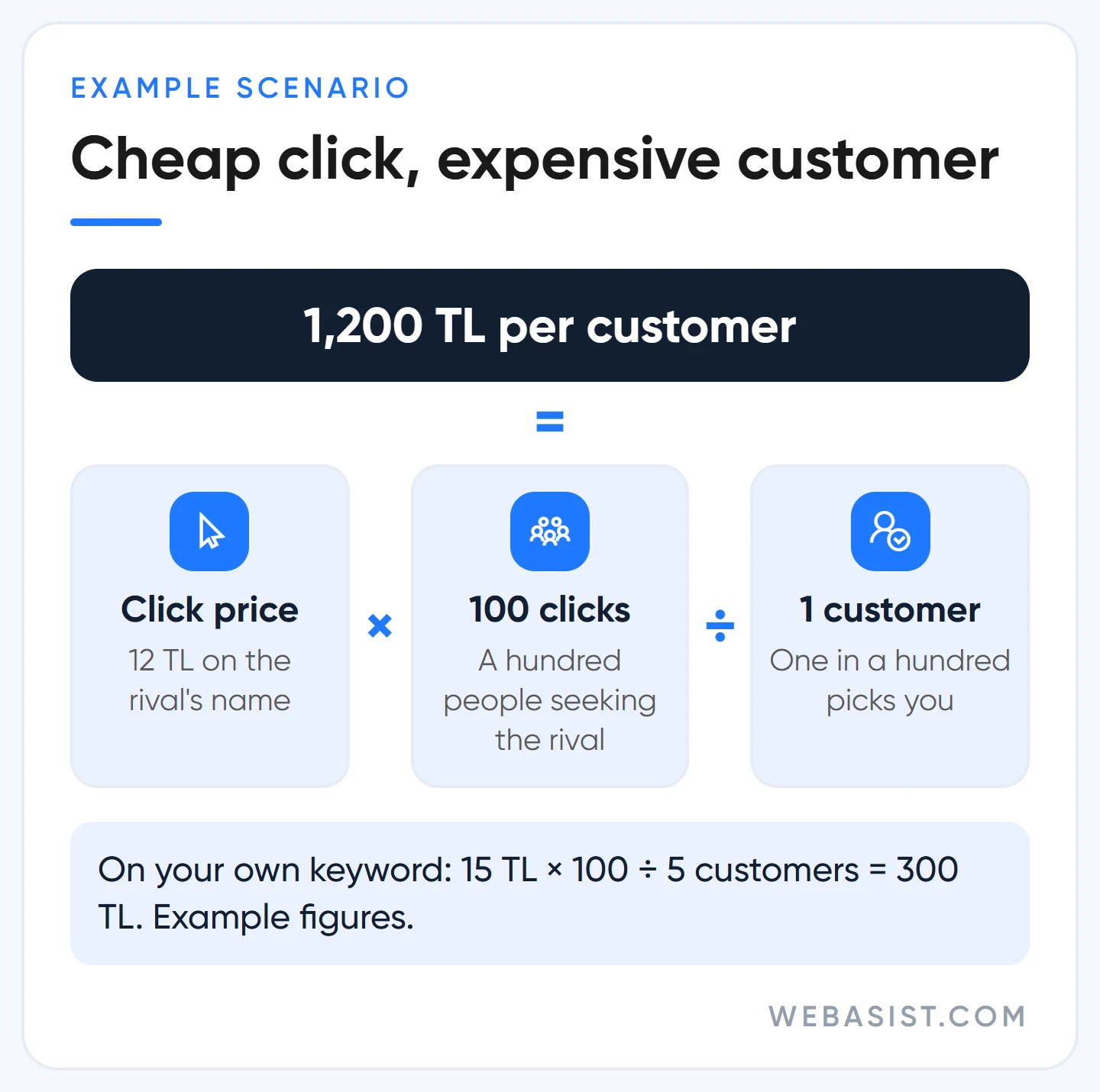
Another example scenario. On a keyword describing your own service a click costs 15 TL and 5 out of 100 clicks become customers: cost per customer is 15 × 100 ÷ 5 = 300 TL.
On the competitor's name a click costs 12 TL, which looks cheaper. But only 1 in 100 becomes a customer: 12 × 100 ÷ 1 = 1,200 TL. The cheaper click produces a customer four times as expensive.
Then there is retaliation. When you bid on a competitor's name they see it in auction insights and usually do the same to you. After that both sides pay more to defend their own names.
The only party that comes out ahead is the one selling the ads. In small industries where everyone knows each other, it also damages business relationships.
Two situations where it is worth a try
- Switching is easy and your difference fits in one sentence. Subscriptions, software, shipping, rentals: businesses a customer can change in a day, and where you have a real edge such as "no setup fee" or "same-day delivery".
- The competitor is in trouble. It raised prices, its service slipped, it closed a branch. During that period some of the people searching for it really are looking for an alternative.
If you do run a competitor campaign: our setup rules
If we are going to test it, we build the campaign isolated enough to switch off at any moment. Nearly all the trouble comes from the competitor's name leaking into ad text, not from the keyword.
- Separate campaign, one ad group per competitor. Its own small daily budget. You can pause a competitor that is not paying off without touching the rest.
- Exact and phrase match. Broad match drifts into searches unrelated to the competitor's name.
- Filter out the competitor's existing customers. Make "competitor + login", "competitor + customer service", "competitor + tracking" and "competitor + jobs" negatives. Those people will not convert for you.
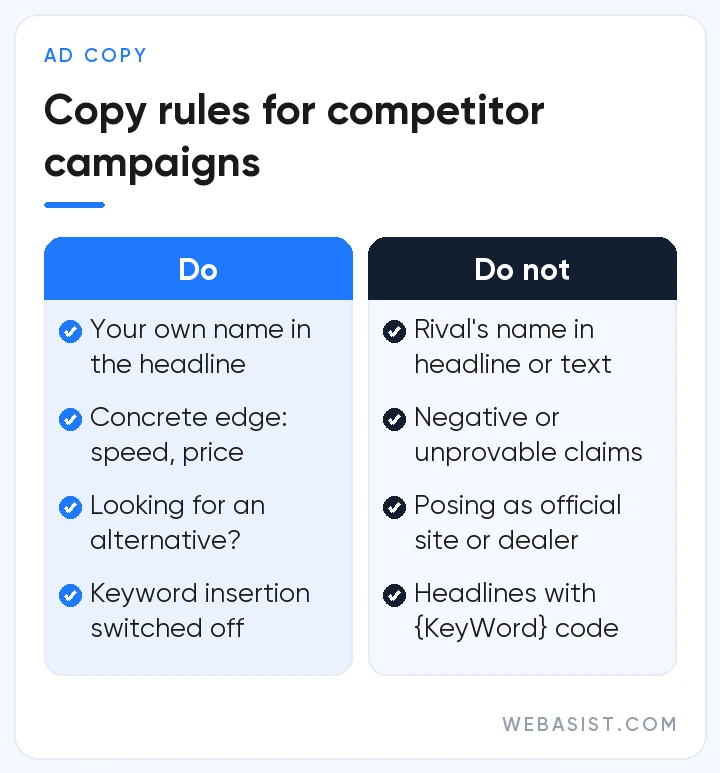
- Keyword insertion off. With {KeyWord:...} in a headline, Google writes the searched term into it. If the keyword is the competitor's name, their trademark shows in your ad and a complaint follows.
- Read every copied asset. Sitelinks and callouts copied from another campaign can carry competitor names.
- An honest comparison page. The visitor was looking for someone else and landed on you. Tell them on the first screen, with facts you can prove, why you deserve a look.
| Do in the ad text | Do not |
|---|---|
| Show your own name clearly in the headline | Put the competitor's name in a headline, description or path field |
| State a concrete difference: turnaround, pricing model, support hours | Make negative or unprovable claims about the competitor |
| Use a general frame such as "Looking for an alternative?" | Suggest you are the competitor's official site, dealer or partner |
Do not judge the campaign by click-through rate, which will be low regardless. The measure is cost per customer. Set a period and a ceiling up front: for example four weeks, and twice the customer cost you see on your own keywords. If it goes over, switch it off and move on.
If you show up on competitor names without meaning to
You may find competitor names in your search terms report even though you never added them. Broad match, AI Max and Performance Max show your ad on searches the system considers relevant, and that includes searches with competitor names. Check first what a customer from those searches costs you. If it is expensive, add the competitor names as negative keywords or apply a brand list containing those competitors as an exclusion.
Who should stay out of this altogether?
We advise against bidding on competitor names in the cases below, and when a client insists we try to talk them out of it first:
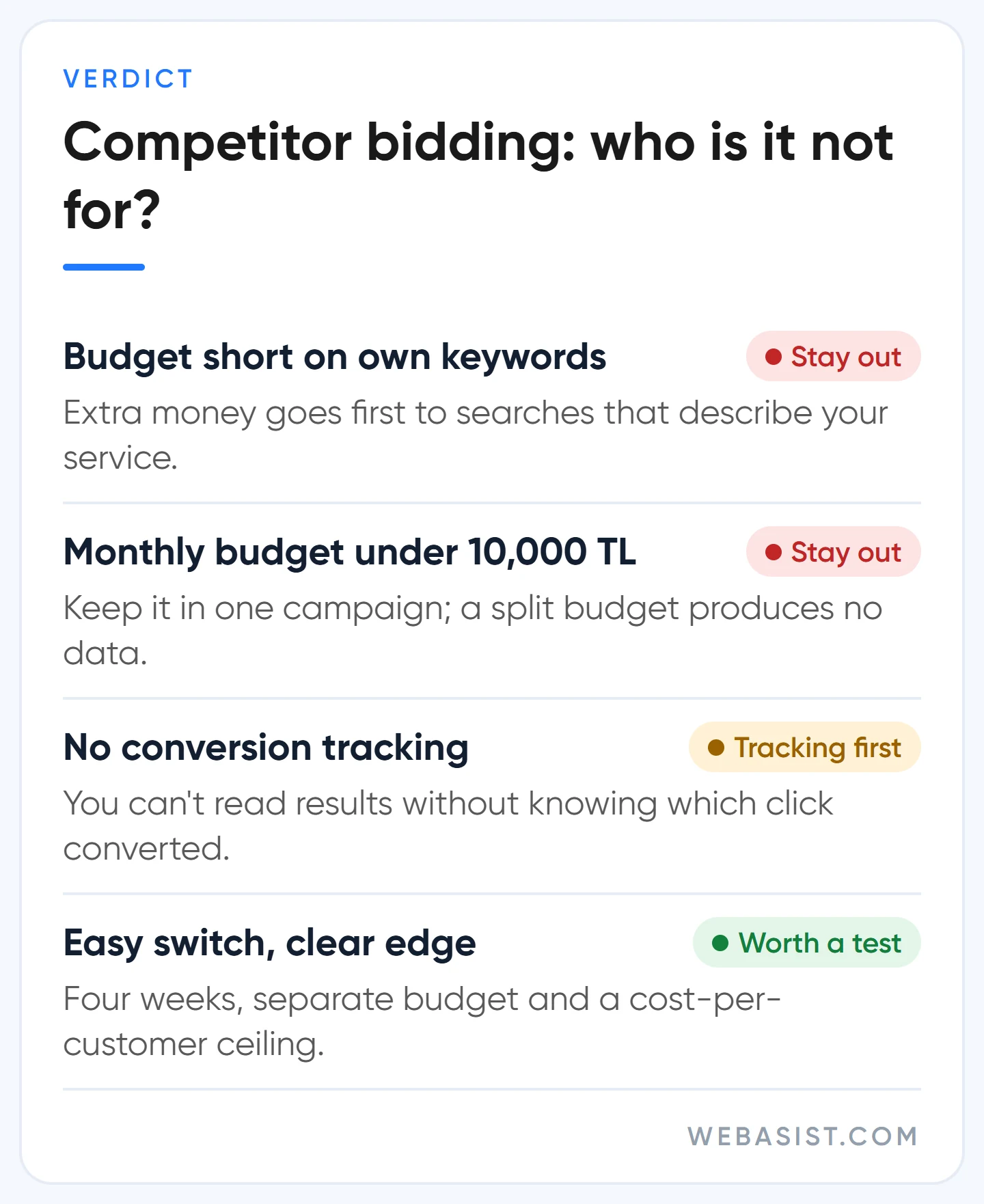
- Your budget runs out on your own keywords. If your ads stop before the day ends on searches that describe your service, that is where extra money belongs.
- Your monthly ad budget is under 10,000 TL. We keep a budget of that size in a single campaign. Split that money in two and both campaigns starve for data.
- You have no conversion tracking. If you cannot tell which click became a customer, you will never learn whether the competitor campaign worked.
- The competitor is also your supplier, dealer or partner. A handful of clicks is not worth the relationship.
- Customers rarely switch. In long-contract, hard-to-install businesses the person searching for the competitor is most likely an existing customer looking for the support line.
There is a "do not" for your own brand as well: if only a few people a month search your name and no competitor appears above you, the campaign produces no data and Google parks the keyword as low search volume. At that stage your job is not brand ads but the keywords that get you known. This is also why our Google Ads packages cap the number of campaigns by budget.
Frequently Asked Questions
How do I know if a competitor is bidding on my brand?
If you run a brand campaign, the auction insights report lists the domains you meet on searches for your name. If you do not, search your brand in the Ad Preview and Diagnosis tool. You can read the competitor's ad copy by searching its domain in the Ads Transparency Center.
If my complaint is accepted, does the competitor's ad disappear?
No. The restriction stops your trademark being used in the ad text. The competitor can rewrite the ad, keep targeting your name as a keyword and keep appearing on the same search.
My brand is not registered. Can I still complain?
Google considers complaints for the countries and industries where you can show trademark rights, so an unregistered name rarely gets a result. Talk to a trademark attorney about registration. Meanwhile, you do not need a registration to run a brand campaign.
Will Google suspend my account for bidding on a competitor's name?
Not for targeting it as a keyword. If you use the competitor's trademark in ad text and a complaint arrives, the ad gets restricted. A trademark violation does not close an account overnight, a warning comes at least 7 days before any suspension. An ad that impersonates the competitor is a separate and serious violation.
How much budget does a brand campaign need?
Enough to appear on all of your brand searches and no more. At campaign level, impression share lost to budget should be close to zero. Because brand clicks are cheap, in most accounts this is a small slice of total spend.
Conclusion
If a competitor is bidding on your name, a complaint helps only when your trademark is in the ad text, and your own brand campaign handles the rest. Advertise on your own name when a competitor shows up, and decide with a two-week test when none does. Bidding on a competitor's name without a real edge and proper tracking is burning money.
Send us your brand name and the two competitors you run into most. We will go through your auction insights and those competitors' live ads together, and tell you in the same call whether you need a brand campaign and how many lira it will cost.














