


Google Ads vs SEO: Which Is Better and Which to Fund First
We are not going to answer Google Ads vs SEO with "it depends". If your business is new and you need customers within three months, the answer is Google Ads; SEO will not make your phone ring in that time. If you have been in the market for two years and every customer comes from ads, you are late to SEO; start today, without switching the ads off. We are an agency that works mostly on Google Ads, and that is what we tell the second kind of client too.
Below we give the verdict for four business types first, then show the difference between Google Ads and SEO on a single results page, and then work out what the same 60,000 TL does over six months in ads and in SEO. At the end you will find who should put money into neither.
The short answer: which comes first? Four businesses, four verdicts
The decision rests on two questions: are your customers searching for you on Google today, and how soon do you need them? Demand plus a short deadline means ads; demand plus a long horizon means both; no demand means neither. Most businesses that answer these two questions fall into one of four pictures.
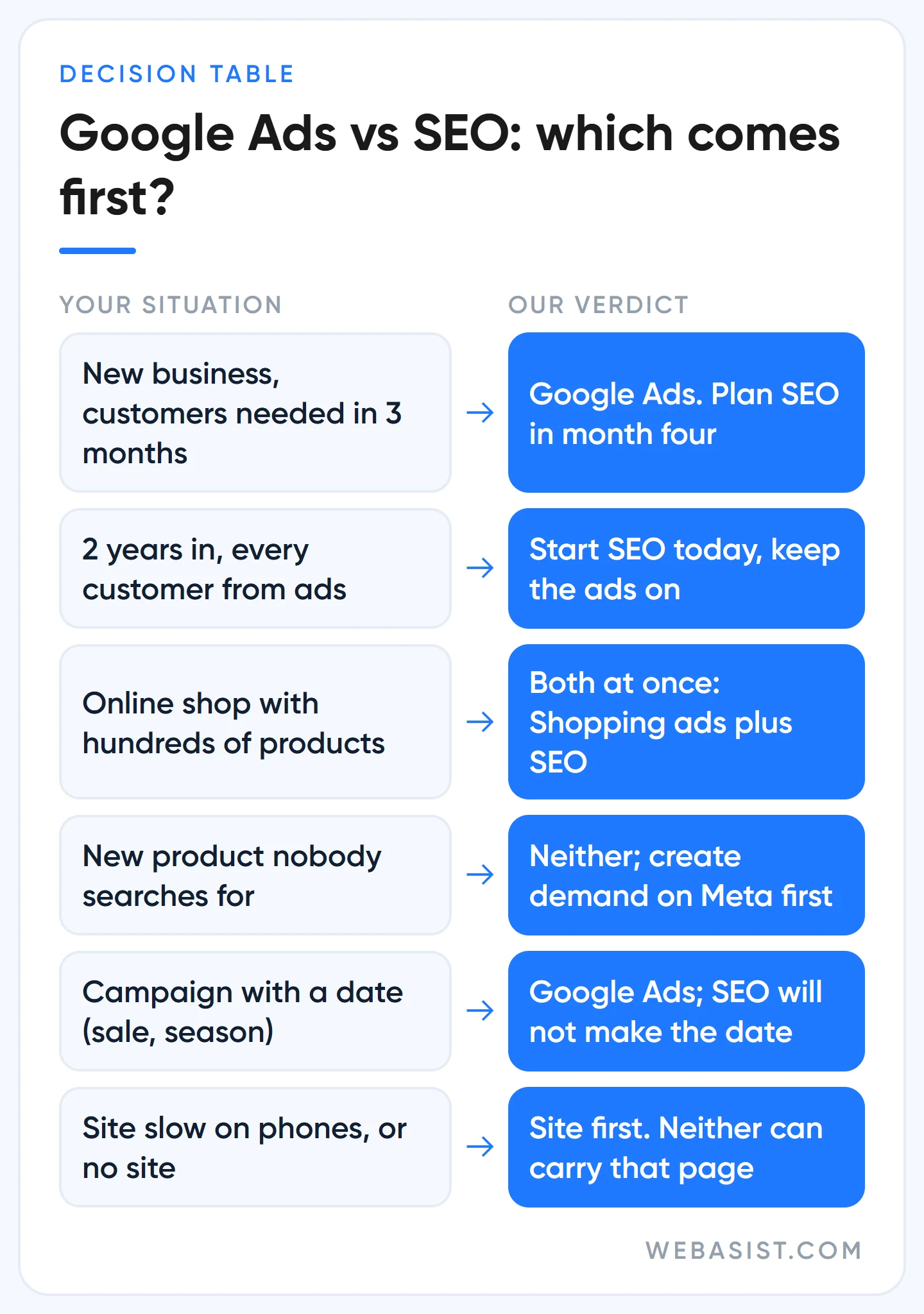
- A newly opened service business (boiler repair, clinic, movers): Google Ads first. A site with no organic history stays invisible for months; an ad shows the same day it is approved. Plan SEO not in the first three months but in month four, once the ads have shown which searches make money.
- Two years in the market, every customer from ads: Start SEO today and keep the ads running. A business that pays for a click for every customer goes to zero the day it cuts the budget, and organic pages are the only way out of that dependence. Had you started three years ago, you would not be reading this.
- An online shop with hundreds of products: Both, from day one. Sales data comes from ads, while product and category pages are far too many to carry on anything but organic traffic. We cover the ads side in our Shopping ads article.
- A new product nobody searches for: Neither. No ad and no organic result appears for a keyword nobody types. You need to create demand first, and that is a job for Meta ads.
There is one more case where we say "not yet" to both: your site does not open within three seconds on a phone, or you have no page that answers the search. Ads would carry expensive clicks to that page and SEO cannot rank it. The site comes first. In some of the accounts we take over, ads have been running for months while the visitor hunts for a phone number on the homepage; in those accounts our first job is the page, not the campaign.
Google Ads vs SEO: two different jobs on the same page
When you search, two systems run on the results page. The "Sponsored" results at the top and bottom are filled by an auction; you pay per click and disappear when the budget runs out. The organic results in the middle are ranked by Google's search systems; you cannot pay your way in, and you do not pay to stay.
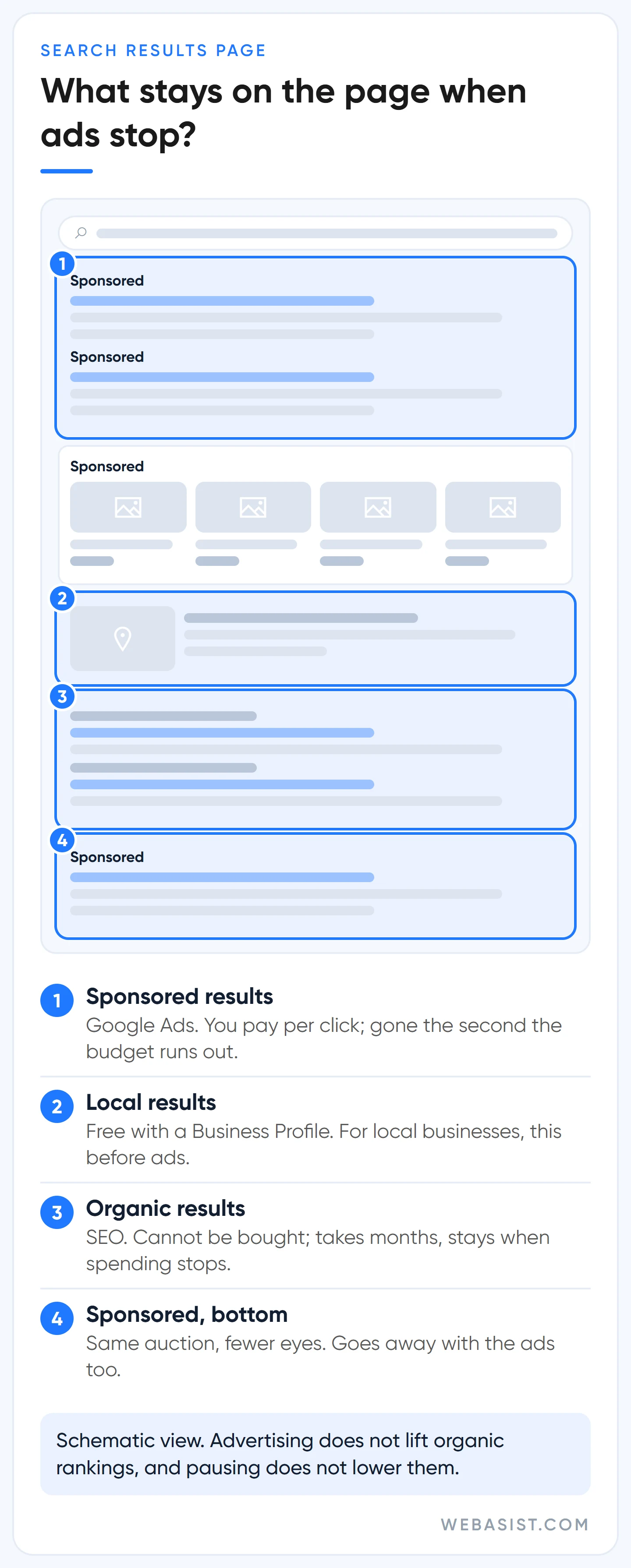
Advertising does not affect your organic ranking; Google says so, and on this point Google is right. Spending more on ads does not lift your organic position, and pausing them does not lower it. The only bridge between the two is data: what the ads teach you, you use in SEO, as we explain below.
The difference shows most clearly when you stop. Ads are a tap: open it and traffic flows, close it and it stops that second. SEO is infrastructure: it takes months to lay, but once laid it does not charge you for each visit. Infrastructure needs maintenance too; when a competitor writes a better page or Google updates its ranking, positions erode.
If you are a local business there is a third area on the page: Maps and local results. Appearing there takes a complete Business Profile rather than ads; we cover that in our article on free visibility on Google.
The same 60,000 TL, the same 6 months: ads or SEO? (example scenario)
Example scenario: an air-conditioning installation and repair business in Ümraniye, Istanbul, has set aside 60,000 TL for six months. One job leaves about 1,200 TL profit. The figures are assumptions; the logic applies to your business too.
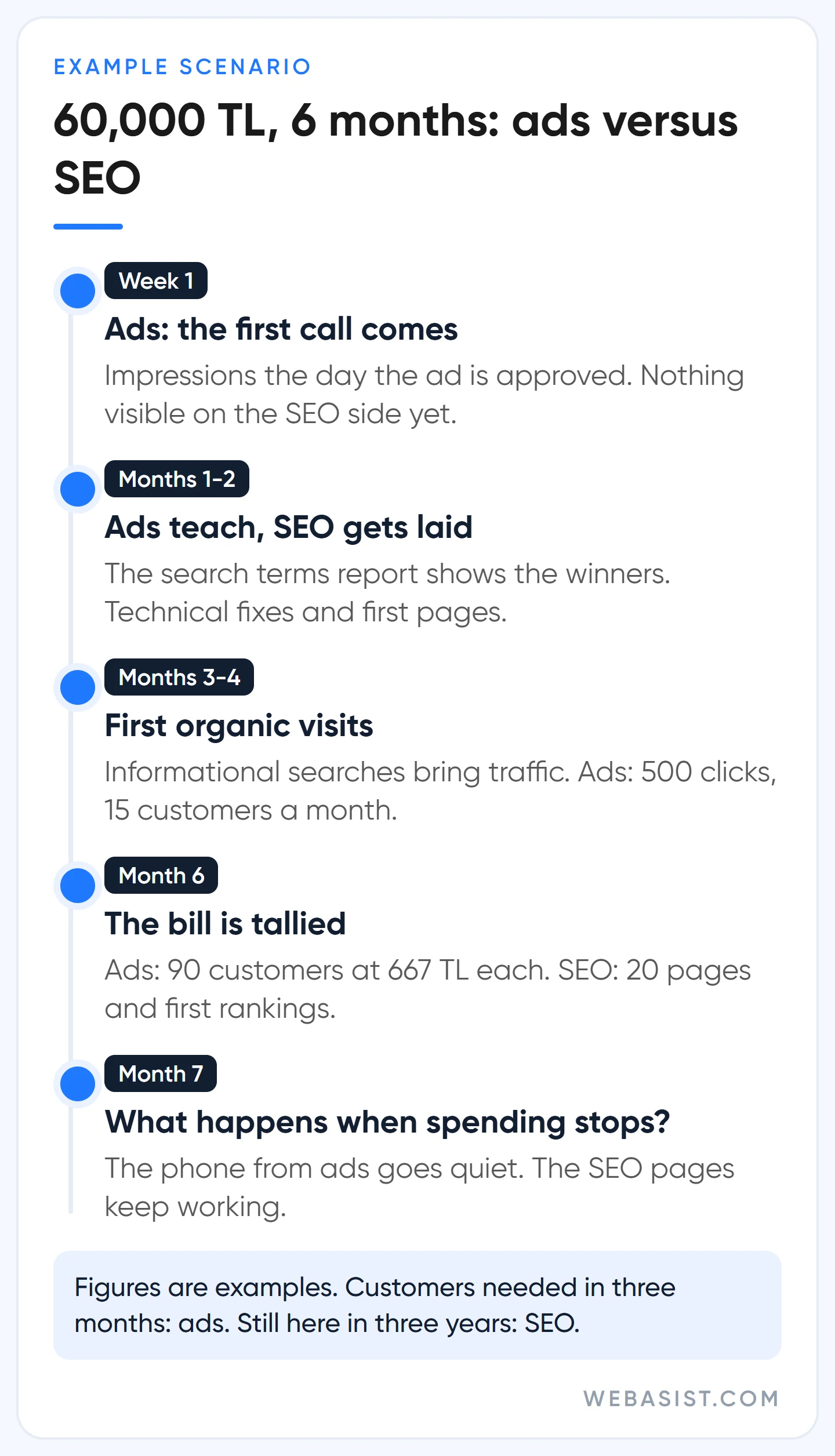
If the money goes into ads: it buys 10,000 TL of clicks a month. If a click on searches like "Ümraniye air conditioning repair" costs 20 TL (assumption), that is 500 clicks a month and 3,000 in six months. If 6% of clicks turn into calls and half of the calls become jobs, six months bring 90 customers at 667 TL each. With 1,200 TL profit per job the campaign pays; the first call comes in week one, and if the budget stops in month seven, so does the phone.
If the money goes into SEO: the same 60,000 TL pays for technical fixes and roughly 20 service and district pages over six months. The phone does not ring in the first two months; Google says some changes take effect in hours and others in months, and that matches what we see. From month four, visits start arriving from informational searches such as "when should air conditioning be serviced". When the six months end the spending stops, but the pages stay, and in month seven they keep working.
How many organic clicks arrive by month six is something neither we nor anyone else can tell you; anyone who does is selling. What we can say is this: if the business has to find 45 customers in three months, it has no option other than ads. If it will still be in the same district three years from now, it should start SEO no later than year two, because ads keep it a tenant at 10,000 TL a month. You will find the click-ceiling calculation for your own keyword in our Google Ads pricing article.
When to start SEO: the point where you know you depend on ads
If all three of these show up in your ad account, the time to start SEO has already passed: the monthly budget keeps rising while the number of customers stands still; you are paying for clicks on "what is, how to, which is better" searches; and you have to advertise even to people typing your brand name, because you are not first in the organic results. All three are jobs for organic pages, not ads.
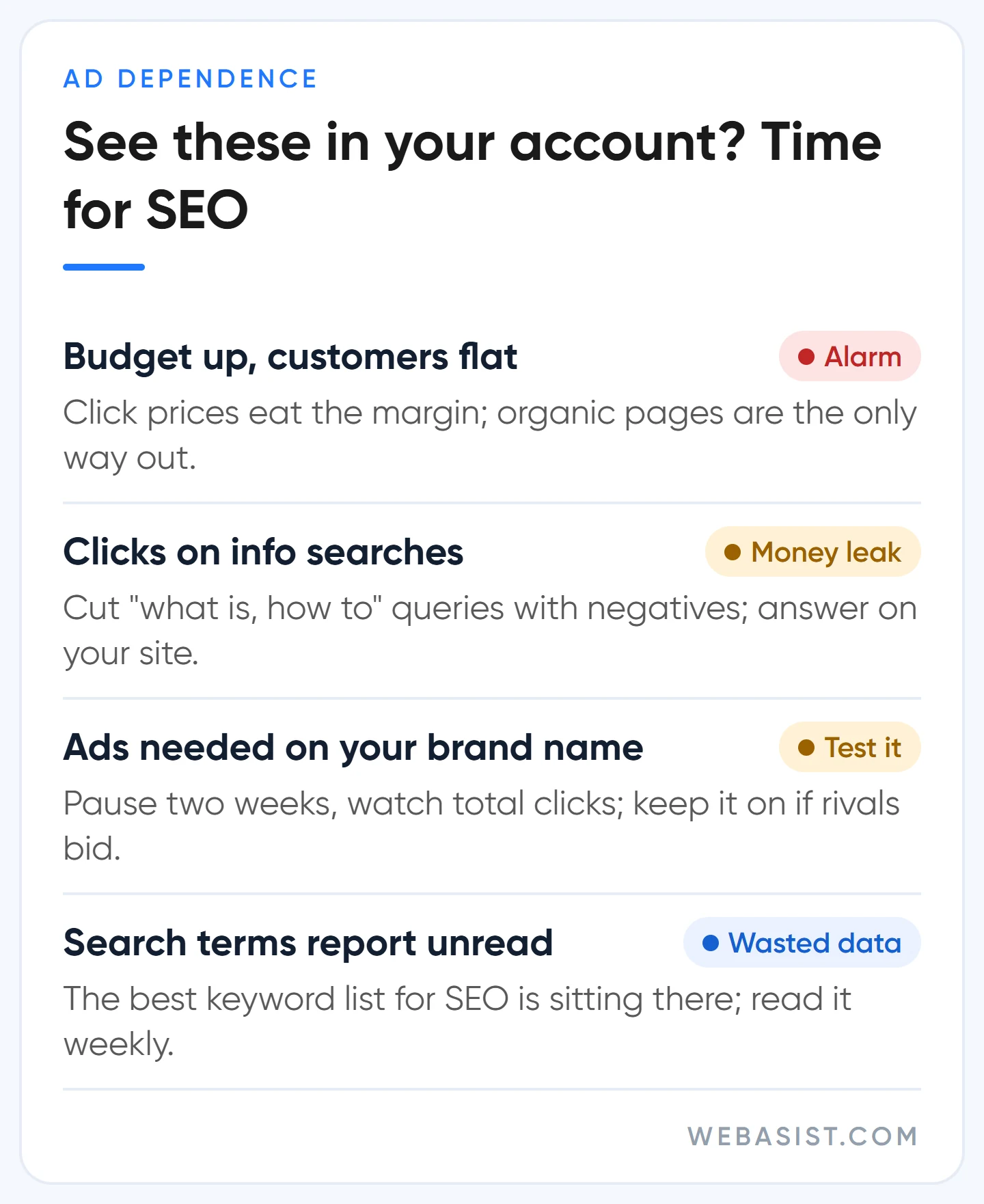
This is a point where we part ways with Google. Google recommends broad match and AI Max so that your ad also appears for searches beyond the keywords you wrote; that means the "air conditioning repair" budget also goes to "how many BTU do I need" searches. For Google that is more impressions; for you it is paying for a click from someone looking for information. We take informational searches out of the ad budget with negative keywords and have the answers written on organic pages; which accounts we switch AI Max on and off in is covered in our article on AI in Google Ads.
Brand searches are a separate argument. The only way to answer "would organic clicks grow if I paused the ad" is a test: pause the ad on your brand keyword for two weeks and see how much of the total clicks you lose. If competitors advertise on your brand, the answer is usually "keep it on"; the details are in our competitor brand bidding article.
Using both: aim SEO with the data from your ads
If the two channels are not run by the same team, the most valuable thing gets lost: knowing which search makes money. The search terms report in your ad account shows within a few weeks which words bring the clicks that make the phone ring. That list is the list of which page to write first in SEO; we build the content plan from it, not from guesswork.
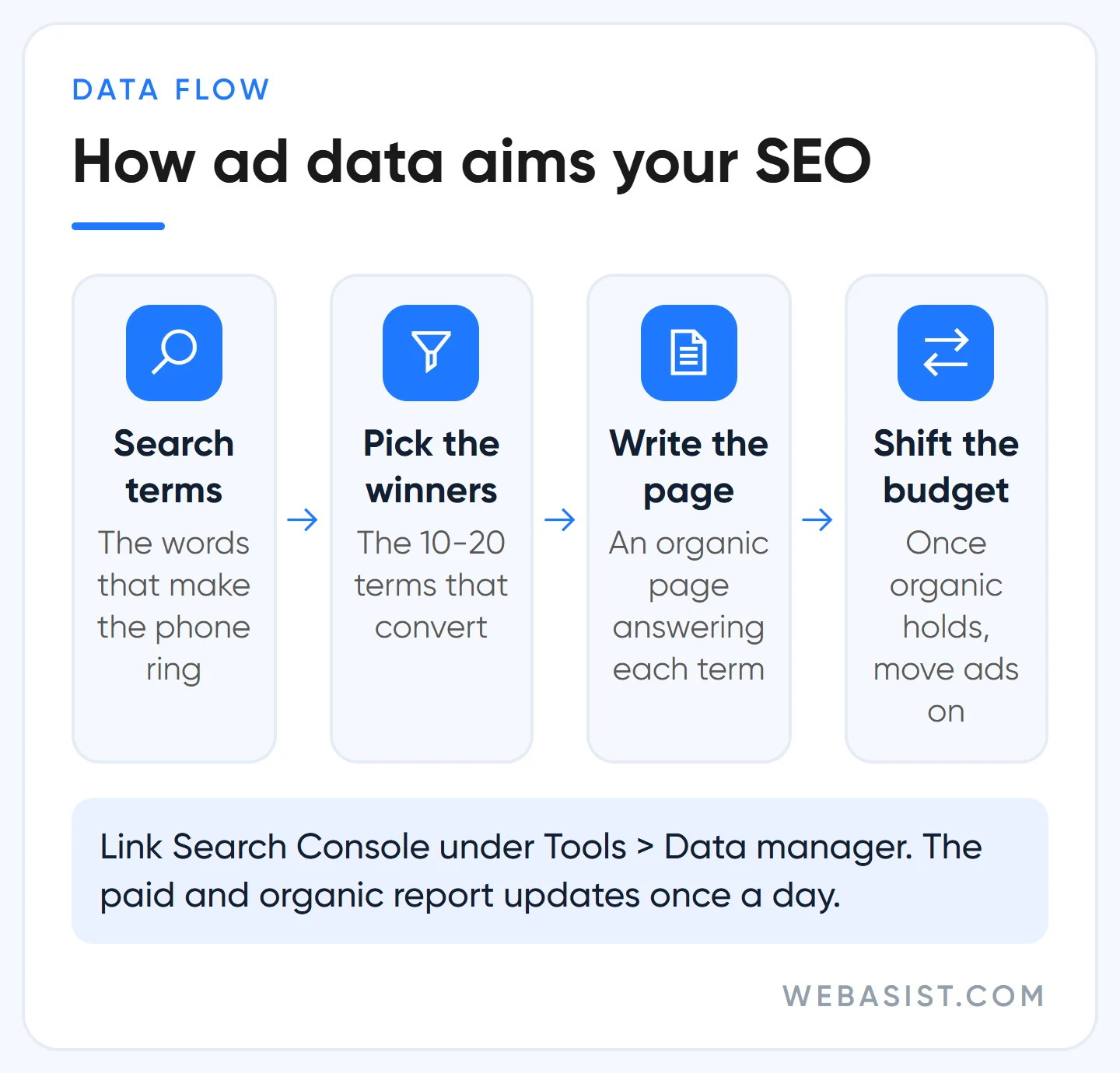
It works the other way too. Queries where Search Console shows you organically but you run no ads are candidates for the campaign, and topics that attract organic visits but never convert are where you do not put ad money. Google Ads has a report that puts both sets of data in one table: link Search Console under Tools > Data manager, and the report opens in the Report editor under the "Basic" tab. It counts text ads only and updates once a day.
The third thing the channels share is the landing page. A page that loads fast and answers the search clearly means cheaper clicks in ads and better positions in organic results; one fix helps both. Where the site cannot carry that job, we fix the page before running ads; what we look at is in our landing page article.
Who should not put money into SEO, and who should not into ads?
- Not SEO if you have a dated campaign. SEO started in August for a November sale may not arrive in time; any goal with a date belongs to ads.
- Not SEO if you are thinking in less than six months. A three-month SEO budget is a half-finished building: the money goes, the traffic does not come. If you cannot commit six months, put the money into ads or hold it.
- Neither if you have no website or it does not load on a phone. Build the site first; our web design packages include Search Console registration and the technical SEO basics from the start.
- Never anyone who "guarantees first place". Nobody can guarantee the top spot on Google, and Google's own guide warns against services that guarantee rankings or claim a "special relationship" with Google. The same goes for anyone selling ad management as "first page for 500 TL".
- Not ads if the click costs more than your margin. A business paying 2,000 TL per customer on 800 TL of profit gets revenue from ads, not profit. Do not enter either channel before doing this sum; we set up the measurement in our conversion tracking guide.
Frequently Asked Questions
Does Google Ads affect SEO rankings?
No. Ads and organic results are decided by separate systems; ad spend neither lifts nor lowers your organic position. When you pause ads, what drops is the clicks from ads, not your organic ranking.
Which is cheaper, SEO or Google Ads?
Measure them in the same unit: how many lira one customer costs you. In ads that figure comes from click costs and the management fee; in SEO it comes from content and technical work. In a six-month window ads almost always look cheaper; SEO only becomes cheap once the pages hold, and we do not call any SEO sum shorter than 12 months cheap.
Are Google Ads and SEO the same thing?
No. Google Ads is the advertising system where you pay per click to enter the sponsored area of the results page; SEO is the technical and content work on your site to earn positions in the organic results. The term "SEM" is sometimes used for both together; it does not change the decision.
How long does it take to reach the top of Google?
With ads, as soon as your ad is reviewed and approved; most ads are reviewed within one business day and show in the sponsored area the same day. Organically, changes take anywhere from hours to months to show. On a new site, what we see is meaningful organic traffic starting after a few months, with the first page on a competitive keyword taking longer.
Conclusion
If you need customers in three months, ads; if you will still be in the same business in three years, SEO starting today; if you can do both, aim SEO with the data from your ads. The business that asks "which first" rather than "which is better" is the one that makes money from this.
Give us read-only access to your Google Ads and Search Console accounts and we will put in writing the first ten keywords to move from the search terms report into SEO, and the informational searches to cut from the ads. The scope of our ad management is on our Google Ads package page; we do not sell SEO as a package on the site and quote it by scope instead.














