


Google Ads Quality Score: How to Improve It (and Why Not to Chase It)

Google Ads Quality Score is a diagnostic number from 1 to 10 shown next to each keyword in a Search campaign. It summarises how relevant your ad and landing page look compared with other advertisers on the same searches, and it is not a direct input to the auction. A keyword with a score of 4 tells you something is wrong; it doesn't tell you what.
When people come to us saying "my Quality Score is low", the problem is almost never the score itself. We find mixed ad groups, ads that all land on the homepage, broad match pulling in unrelated searches, and slow mobile pages. Fix those and both the score and the costs improve. Treat the score as a goal on its own and you lose money; below we show why, in lira.
What Google Ads Quality Score is, and what it isn't
Quality Score comes from three components: expected clickthrough rate, ad relevance and landing page experience. Each is compared with other advertisers whose ads showed for exactly the same search in the last 90 days. Google doesn't publish the weights, so ignore any online claim that "half the score comes from X".
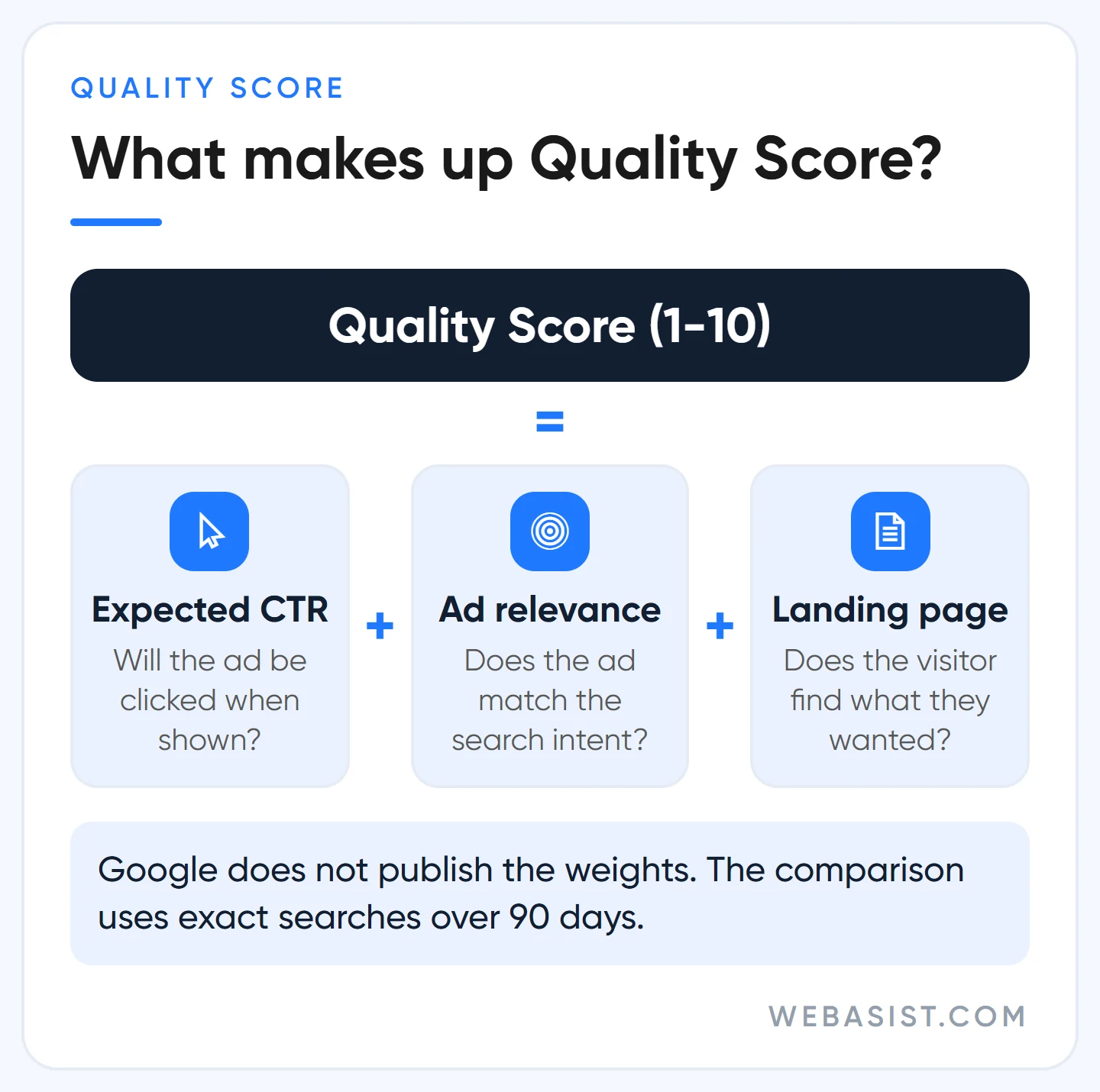
The score isn't in the default table. On the Keywords page, add Quality Score and its three components from Columns > Quality Score; the "(hist.)" columns show the value for the date range you pick. Looking at the score without the component columns is like reading only the total of a blood test.
Two limits are worth knowing. First, factors like device, time of day and location may not be reflected in the score; your quality on an evening mobile search gets lost inside one number. Second, the score only looks at searches that exactly match your keyword. A bit further down we explain why that second limit matters.
The real problem in accounts stuck on Quality Score
In accounts we take over, a low score usually hides one of four things. What they share is that the cost hits your invoice before it shows in the score:
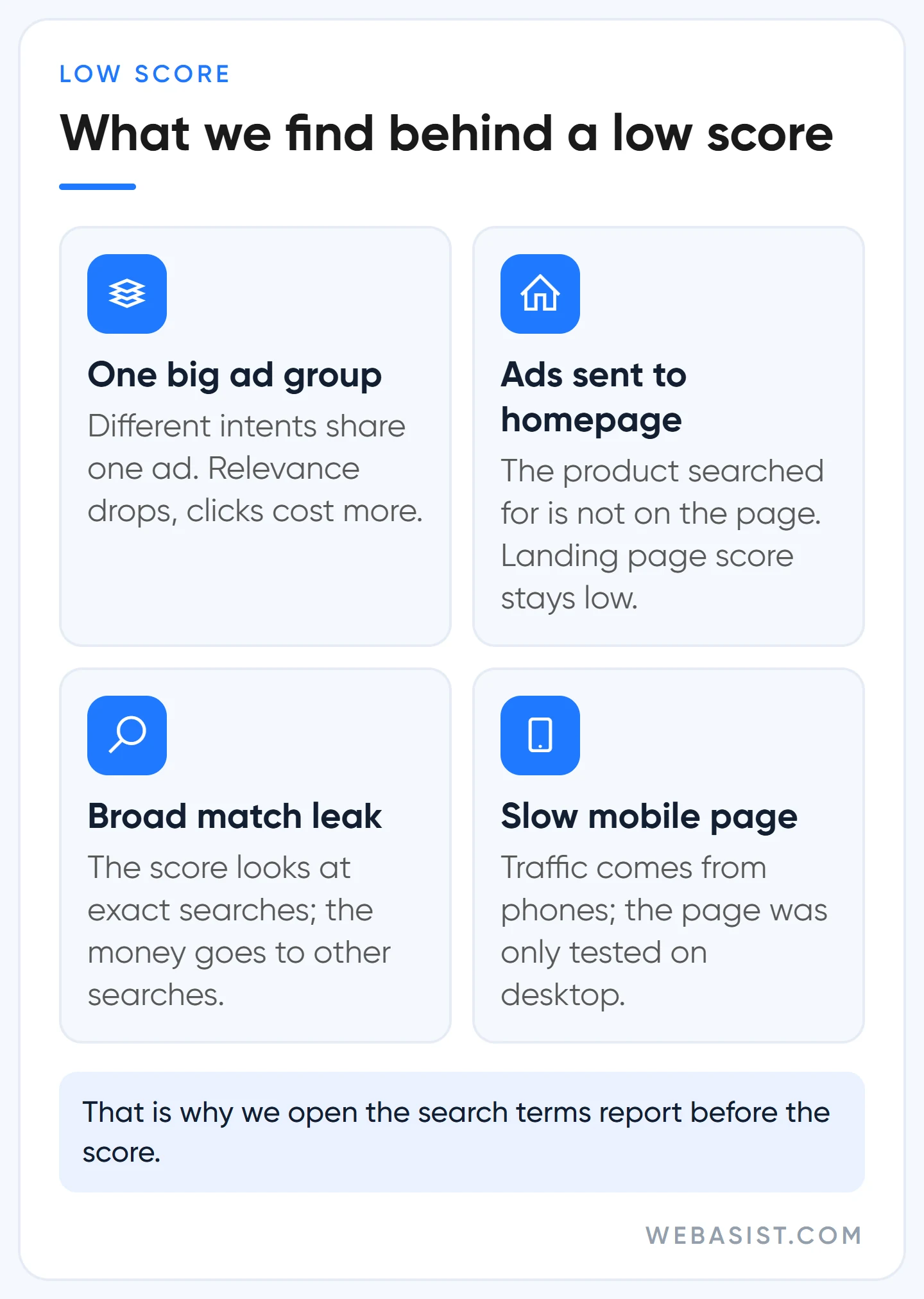
- Everything in one ad group. If "boiler service", "boiler prices" and "radiator flushing" sit in the same group, one ad can't answer all three well. Relevance drops and clicks get more expensive. The fix is splitting the group by intent; how to group keywords is in our keyword research guide.
- Every ad goes to the homepage. Someone searching "steel door models" looks for doors on the homepage, can't find them and leaves. Landing page experience stays "Below average".
- Broad match spends half the money on other searches. The score looks at exact searches while the budget may be going to queries like "how does a boiler work". The score shows 7 and the money is wasted.
- The page is slow or broken on phones. Pages tested on desktop and left alone, while most traffic is mobile, are the usual cause.
So when we see a low score, the first report we open is the search terms report, not the score column. Reading Quality Score without knowing which searches trigger your ad gives you half the picture.
Above average, Average, Below average: what the components tell you
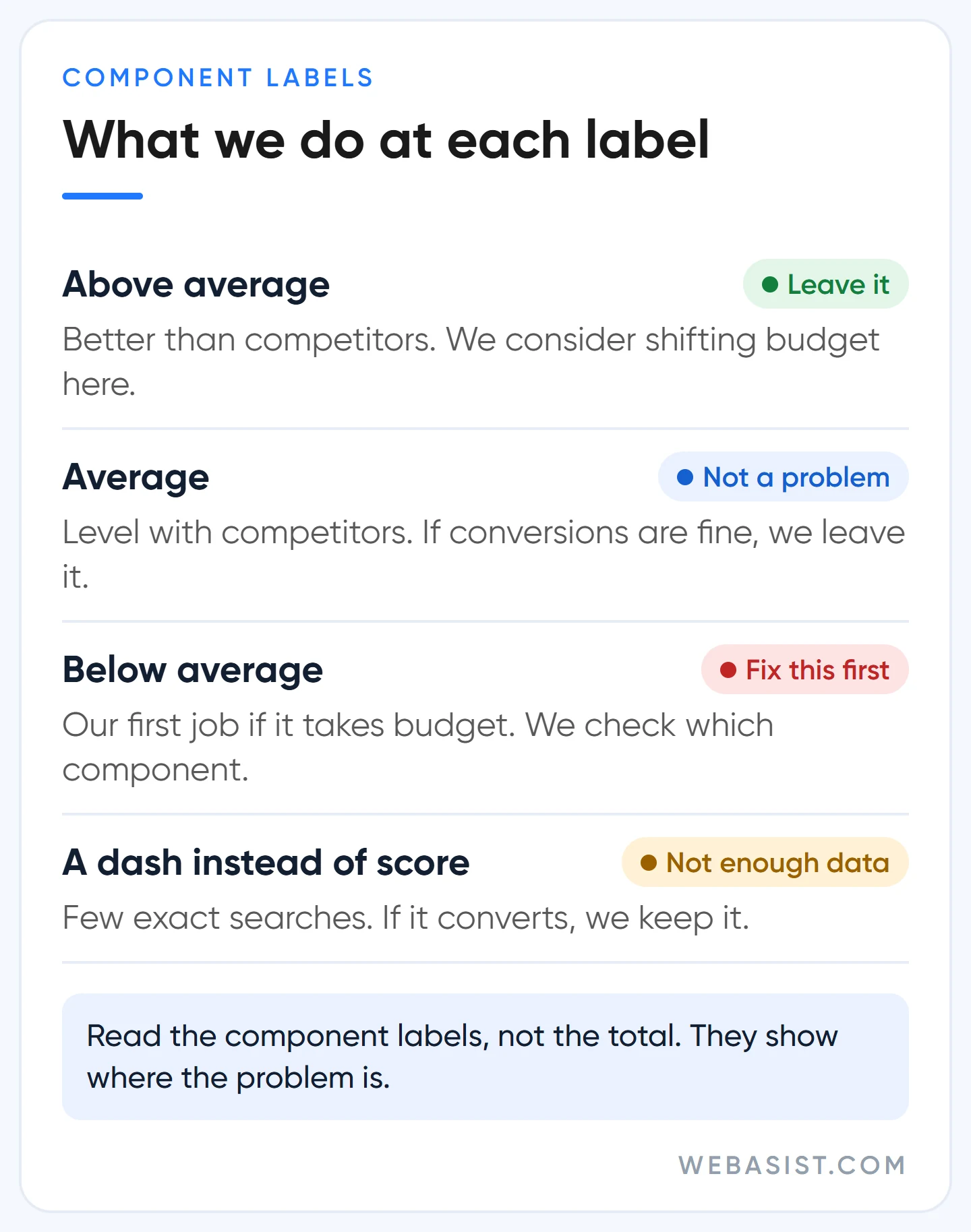
Each component gets one of three labels: "Above average", "Average" or "Below average". Look at these labels instead of the total, because only they tell you where the problem is.
- Expected clickthrough rate: the chance your ad gets clicked when shown. The effect of position and assets is removed from this estimate, so raising your bid to move up won't fix it. The lever is the ad copy.
- Ad relevance: how closely the ad matches the intent behind the keyword. When it's low, the problem is usually structure, meaning the ad group.
- Landing page experience: whether the person who clicks finds what they wanted. Content, consistency with the ad, mobile usability and speed all count here.
We read these labels not keyword by keyword but in a table sorted by spend. If landing page experience is "Below average" on the ten keywords that take most of the budget, the problem is the page, not the keywords; fixing one page lifts all ten. If the label shows on only a few keywords, the problem sits in their ad group.
"Average" is not a problem. It means you are level with competitors, and plenty of keywords make good money there. Our priority is keywords marked "Below average" that take a real share of the budget.
How to improve Quality Score: what we do for each component
How you improve Quality Score depends on which component is weak. Our first move for each:
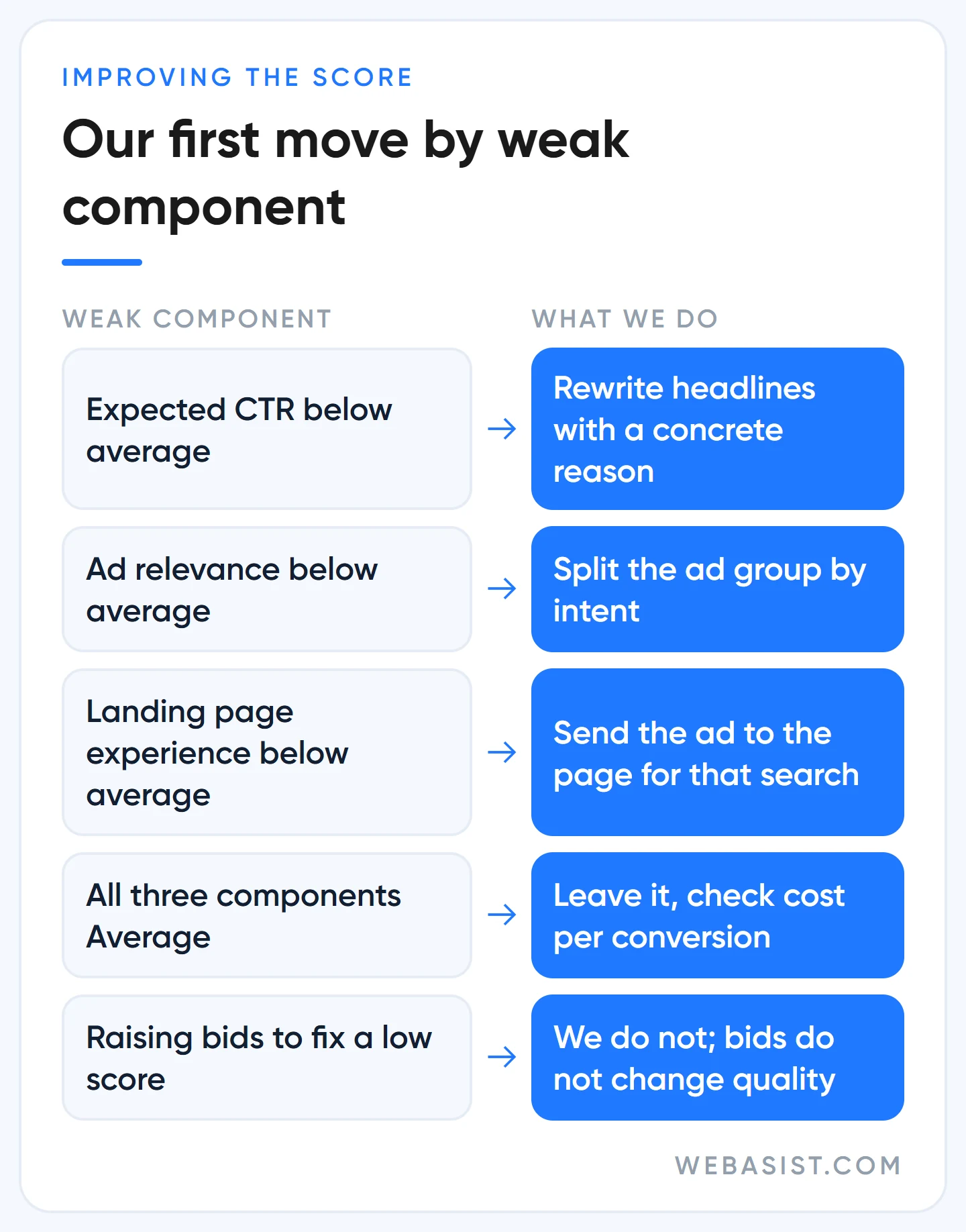
- Expected CTR below average: we rewrite the headlines. The search term goes in the first headlines with a concrete reason next to it: speed, warranty, price. How we write them is in our ad copy guide.
- Ad relevance below average: we split the ad group. We sort search terms by intent and give each intent its own group with ads written in its language. Moving a keyword to a new group with new ads can change its quality; moving a group with the same ads to another campaign doesn't.
- Landing page experience below average: we send the ad to the page about the thing searched for, and if that page doesn't exist we build it. The page side is covered in our landing page guide.
- All three "Average": we leave it alone and check whether spend and conversions are where they should be.
Two things we don't do. A higher bid can change your ranking but not how your ad's quality is judged, so we never raise bids for the score. And we don't write ads that repeat the keyword five times; relevance may tick up but the ad stops persuading anyone.
How much does Quality Score cost you per click?
Quality hits the money side directly. Your ad's position is decided by your bid together with ad and page quality, and a high-quality ad reaches the same spot for a lower cost per click. If your quality is low, even on a search with little competition you'll find yourself paying close to your maximum bid. With manual bidding you never pay more than that limit, but you pay right up against it.
Example scenario: a boiler service in Umraniye bids at most 40 TL and gets 400 clicks a month. With good quality, clicks average 27 TL, or 10,800 TL a month. With ads sent to the homepage and everything in one group, the same position costs 38 TL a click, or 15,200 TL a month. The 4,400 TL difference goes every month without bringing a single extra customer (figures are illustrative).
We read this gap not from the score but from how the average cost per click moves over time on the same keyword. If the bid stays the same and the average cost climbs, either competition grew or your quality fell; the auction insights report shows which. Other things that drive click prices are covered, with lira calculations, in our Google Ads pricing guide.
Why chasing the score loses money
Google itself says Quality Score isn't a number to optimise for. We agree. The problem in practice is that the score becomes a success metric in reports. "Our average Quality Score went from 6 to 8" sounds good but tells you nothing about how many customers you got and at what cost.
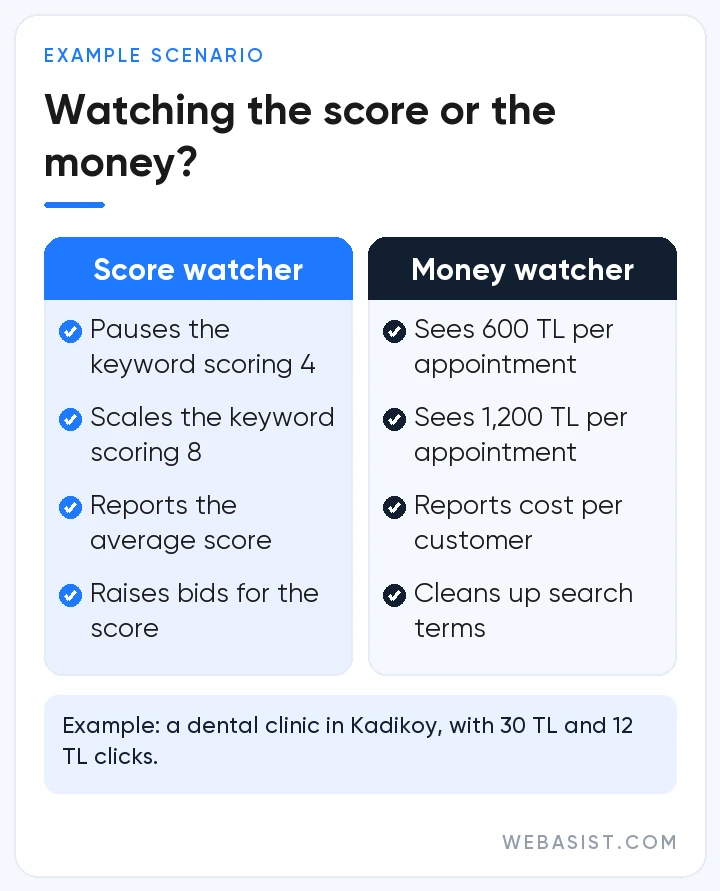
Example scenario, a dental clinic in Kadikoy. The keyword "dental clinic Kadikoy" has a score of 4 and costs 30 TL a click; 100 clicks bring 5 appointments, 600 TL per appointment. "Teeth whitening" has a score of 8 and costs 12 TL a click; 100 clicks bring 1 appointment, 1,200 TL per appointment.
Someone watching the score pauses the first keyword; someone watching the money pauses the second. We watch the money.
Google's own recommendations show a similar tension. The interface suggests adding new keywords as broad match. Because the score only looks at exact searches, a broad match keyword can show a nice score while much of the budget goes to searches that never matched it exactly.
In accounts with fewer than 20 to 30 conversions a month we don't switch on broad match. Whatever the score says, the search terms report and the cost per conversion make the call.
Why did Quality Score drop, or why does it show a dash?
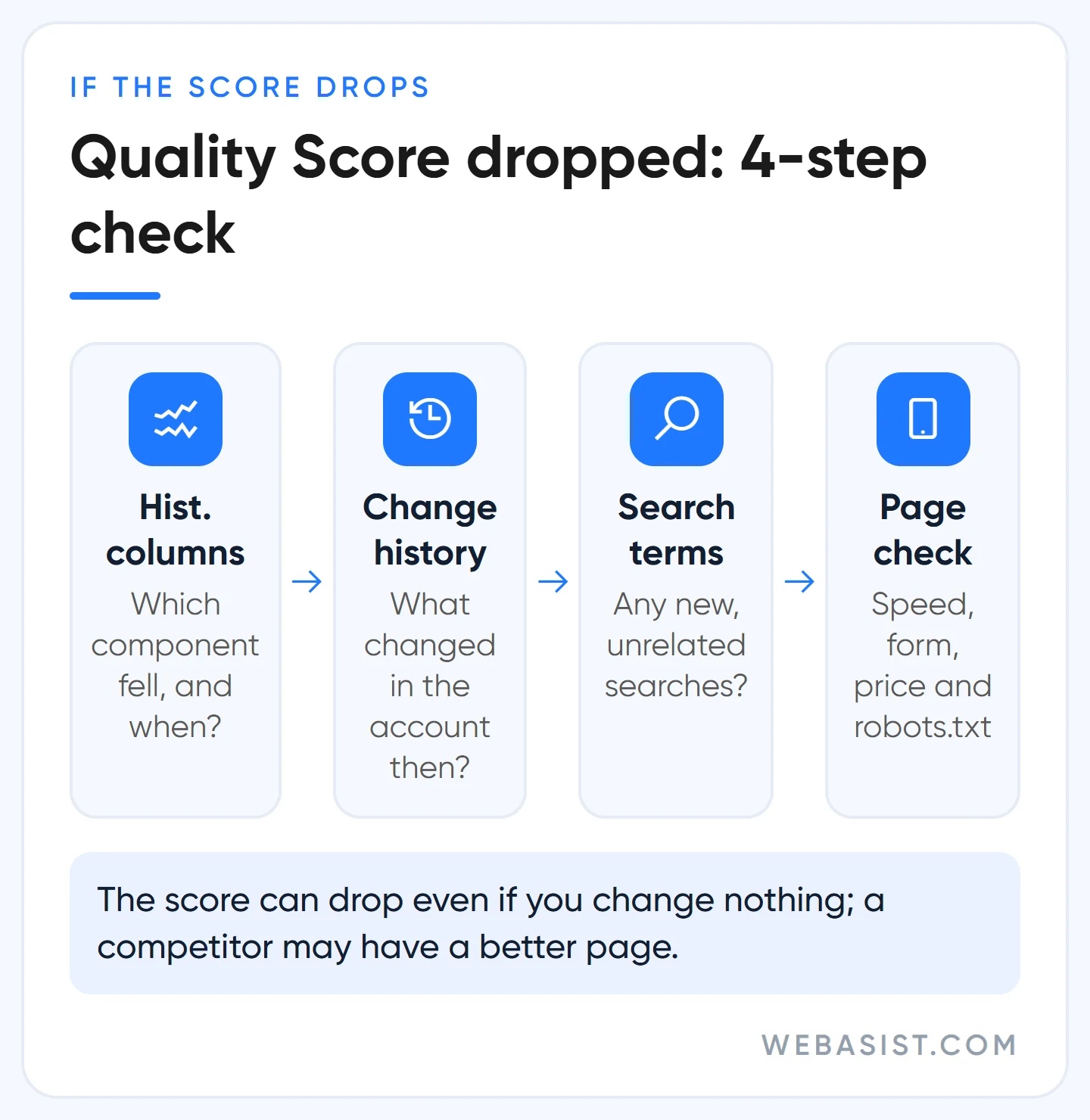
The score is relative to competitors and based on 90 days of history, so it can change even if you touch nothing. A competitor arrives with a better page and your score falls. When we see a drop we check, in order: which component fell and when in the "(hist.)" columns, what changed in the account on those dates in Change history, whether anything new appeared in search terms, and whether the page still loads fast.
The causes we find most often are a redesigned site with ads still pointing to old URLs, a price or form removed from the landing page, and ad copy rewritten in a way that drifts away from the keyword. If a site update blocked Google's ad crawler (AdsBot-Google) in robots.txt, the page can't be assessed; we check that too.
A dash (-) instead of a score means the keyword doesn't have enough exactly matching searches. That's normal for new and low-volume keywords and isn't a performance problem. Don't bulk-delete these keywords; if they convert, keep them.
Who shouldn't spend time on Quality Score at all?
Quality Score isn't worth the time in every account. In these cases we put other work first:
- You have no conversion tracking. Fixing scores without knowing which keyword brings customers is steering without knowing where you're going. Set up conversion tracking first.
- Each keyword gets a few clicks a month. Most will show a dash instead of a score, or a score that jumps around weekly. Concentrate the budget on fewer keywords first.
- You only run Performance Max or Shopping. Quality Score is reported for keywords in Search campaigns; in Shopping, product data quality matters and there is no score.
- The ad gets no impressions at all. The problem is bigger than the score; start with why your ad isn't showing.
Frequently Asked Questions
What is a good Quality Score in Google Ads?
Google doesn't set a target number. Our rule: no "Below average" component on keywords that take a share of the budget. We've seen plenty of keywords profit at 6 or 7; don't break them chasing a 10.
Will raising my bid improve Quality Score?
No. Your bid affects your ad's position but not how its quality is assessed. The score is driven by ad copy, ad group structure and the landing page.
Is Ad Strength the same as Quality Score?
No. Ad Strength is feedback on how many and how varied your headlines and descriptions are, and it isn't used in the auction. Quality Score summarises the user experience at keyword level compared with competitors.
How long does Quality Score take to change?
Google doesn't give a timeframe. What we see is that on keywords with decent volume, the effect of a change shows in the "(hist.)" columns within a few weeks; on low-volume keywords it takes longer. That's why we note the date of every change and compare before and after.
Conclusion
Quality Score is a thermometer: it shows the fever, not the illness. On a low-score keyword, check search terms first and the weak component second, and never pause a profitable keyword because of its score.
Export your keyword report with Quality Score and the three component columns and send it to us. We'll mark which component is burning money on your 20 biggest-spending keywords and list the first three fixes. For a wider check, our method is in the account audit guide; ongoing management is in our Google Ads packages.














