


Google Ads Pricing in Turkey 2026: What Does It Really Cost?
Google Ads pricing has no rate card, but we are not going to leave you without numbers. There is no flat fee to Google: you set a daily budget and money only leaves your account when someone clicks. A business that sets 350 TL a day spends at most 10,640 TL a month on ads, plus a 4.5% regulatory operating cost for ads shown in Turkey, plus VAT. If an agency runs the account, its management fee is paid separately on top.
The real question is not "how much does Google Ads cost in Turkey" but "what will one customer cost me, and is there profit left". We work both out in lira below: clicks, monthly budget and the extras on the invoice, plus how agency fees are set. We deliberately left out the "average cost per click by industry" tables you find online. Those figures know nothing about your keyword, your district or your website.
How much does Google Ads cost in Turkey? The short answer in four lines
What leaves your pocket at month end is made up of four items. The first three are the Google side; the last one only exists if you work with an agency.
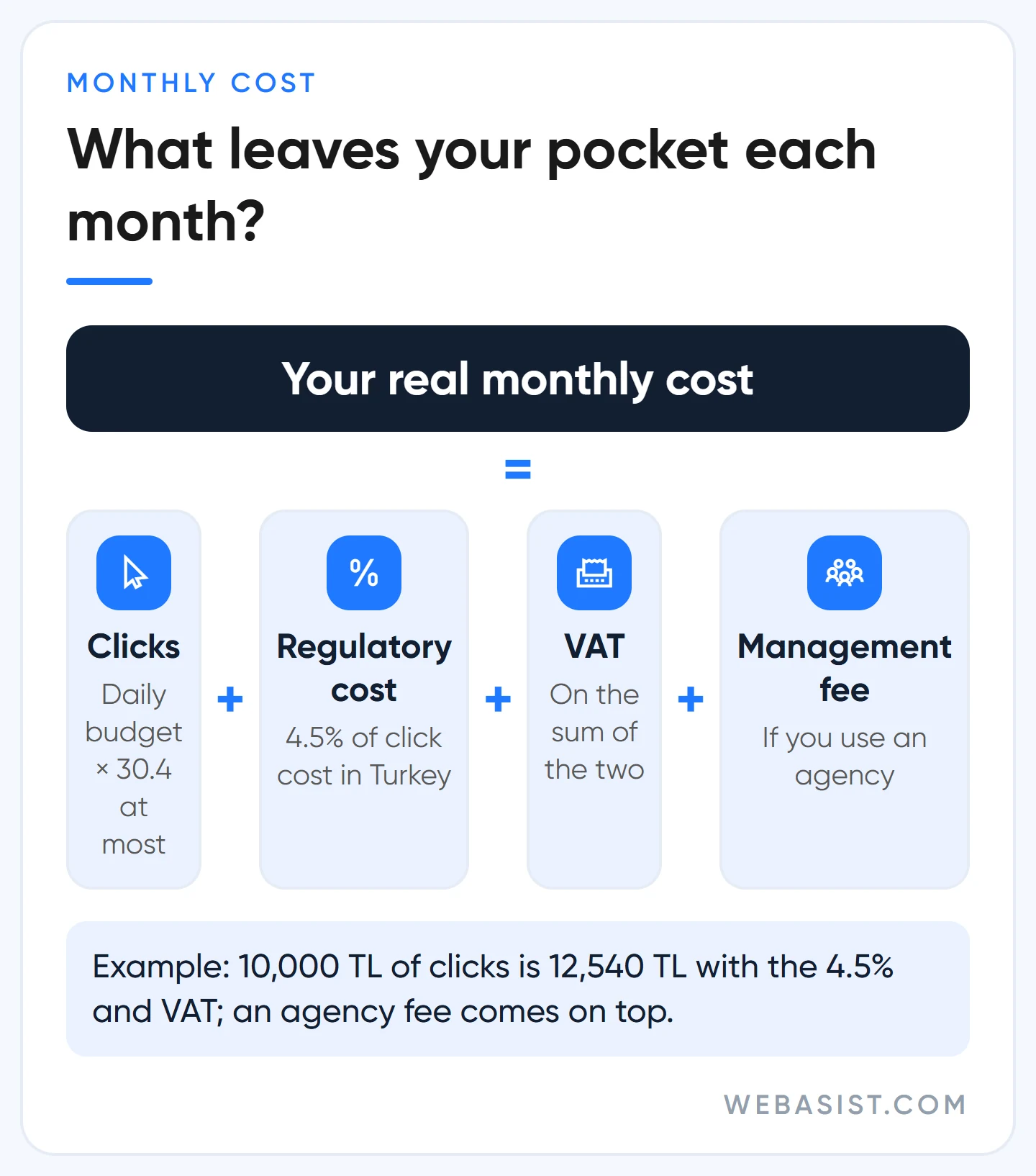
| Item | Paid to | How much? |
|---|---|---|
| Ad budget (clicks) | You decide. 350 TL a day means at most 10,640 TL a month | |
| Regulatory operating cost | 4.5% of the cost of ads served in Turkey. 450 TL on 10,000 TL | |
| VAT | On the invoice or self-assessed | At 20% VAT, 2,090 TL on 10,450 TL |
| Management fee | Agency (if any) | Depends on the agency's fee model; VAT is added on top |
Example scenario: a business buys 10,000 TL of clicks in a month. The Google side is 10,000 + 450 = 10,450 TL, or 12,540 TL with VAT. If an agency runs the account, its management fee and the VAT on that fee come on top of this figure.
To turn a daily budget into a monthly figure, multiply by 30.4. Google may spend up to twice your daily budget on a busy day but cannot exceed that monthly cap. The detail of that rule, and how to work a budget back from a target, is in our Google Ads budget guide. The invoice lines and the accounting side are covered in the Google Ads billing guide.
What does one click cost, and why does the price keep changing?
In search ads, being shown is free and the click is what you pay for. Google does not set the price; the businesses competing with you on that keyword do. Every search runs a small auction, and you pay just enough to beat the advertiser right below you. That is why a click you were willing to pay 40 TL for usually costs less than 40 TL.
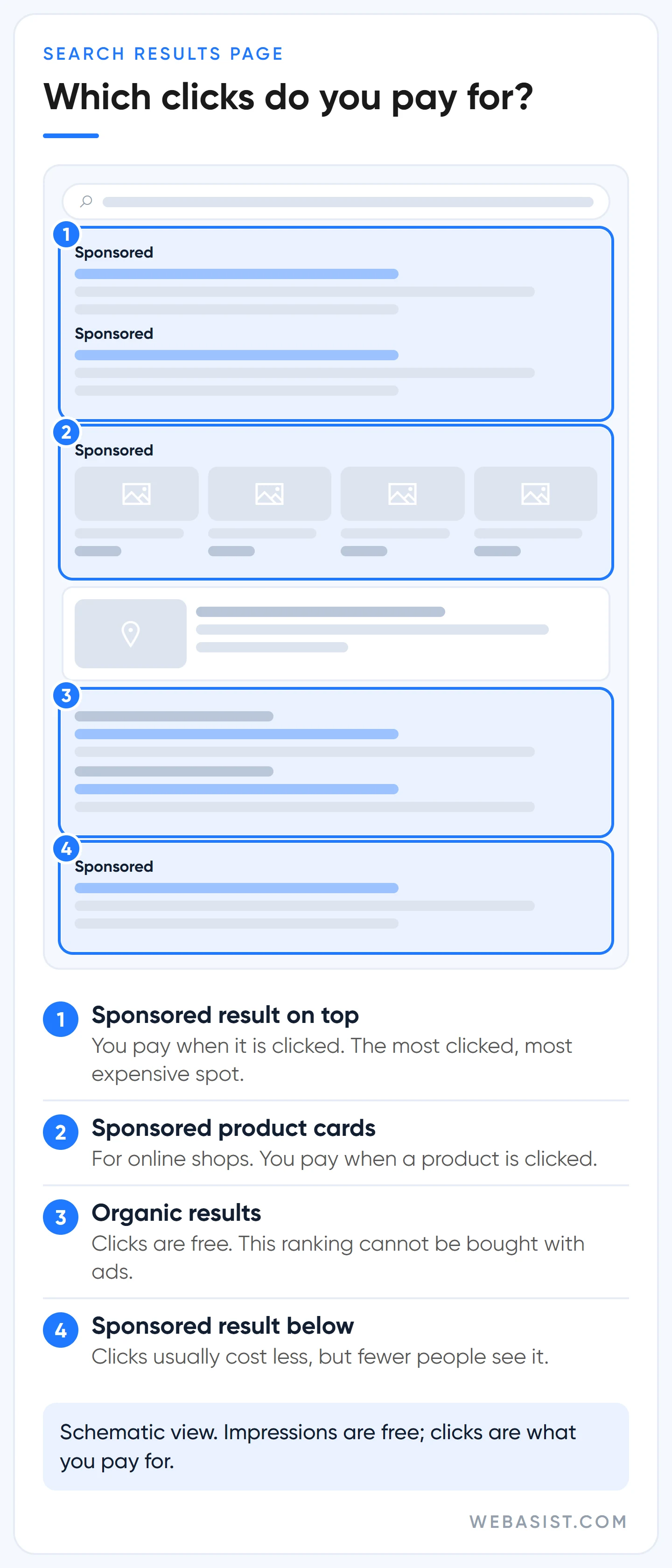
The same keyword costs two businesses different amounts, because the auction also weighs how well the ad and the page match the search. For someone searching "Kadıköy boiler repair", an ad that says "Same-day boiler repair in Kadıköy" reaches the top for less than a generic "technical service" ad. In most accounts that come to us complaining about expensive clicks, the bid is not the problem: every keyword sits in one ad group and every ad points to the homepage. We explain how that scoring works in our Quality Score article.
Which businesses pay the most per click? The rule is simple: the more a customer is worth and the more urgent the decision, the more the click costs. Lawyers, dental and aesthetic clinics, movers, locksmiths and boiler repair sit at the expensive end; niche B2B products and neighbourhood retail sit at the cheap end. We are not quoting figures because even within one industry, Şişli and Beylikdüzü are priced differently.
Outside search, the unit changes: on YouTube you pay per view or per thousand impressions, on the Display Network per click or per thousand impressions. Clicks there look cheap, but buying intent is lower too. Do not confuse a cheap click with a cheap customer.
How to check keyword prices before you spend anything: a 3-minute method
Google's free Keyword Planner shows, in lira, the bid range of ads that reached the top of the page for a keyword. All you need is a Google Ads account with billing details entered; you do not have to run a campaign. The path is one line: Tools > Keyword Planner > Discover new keywords.
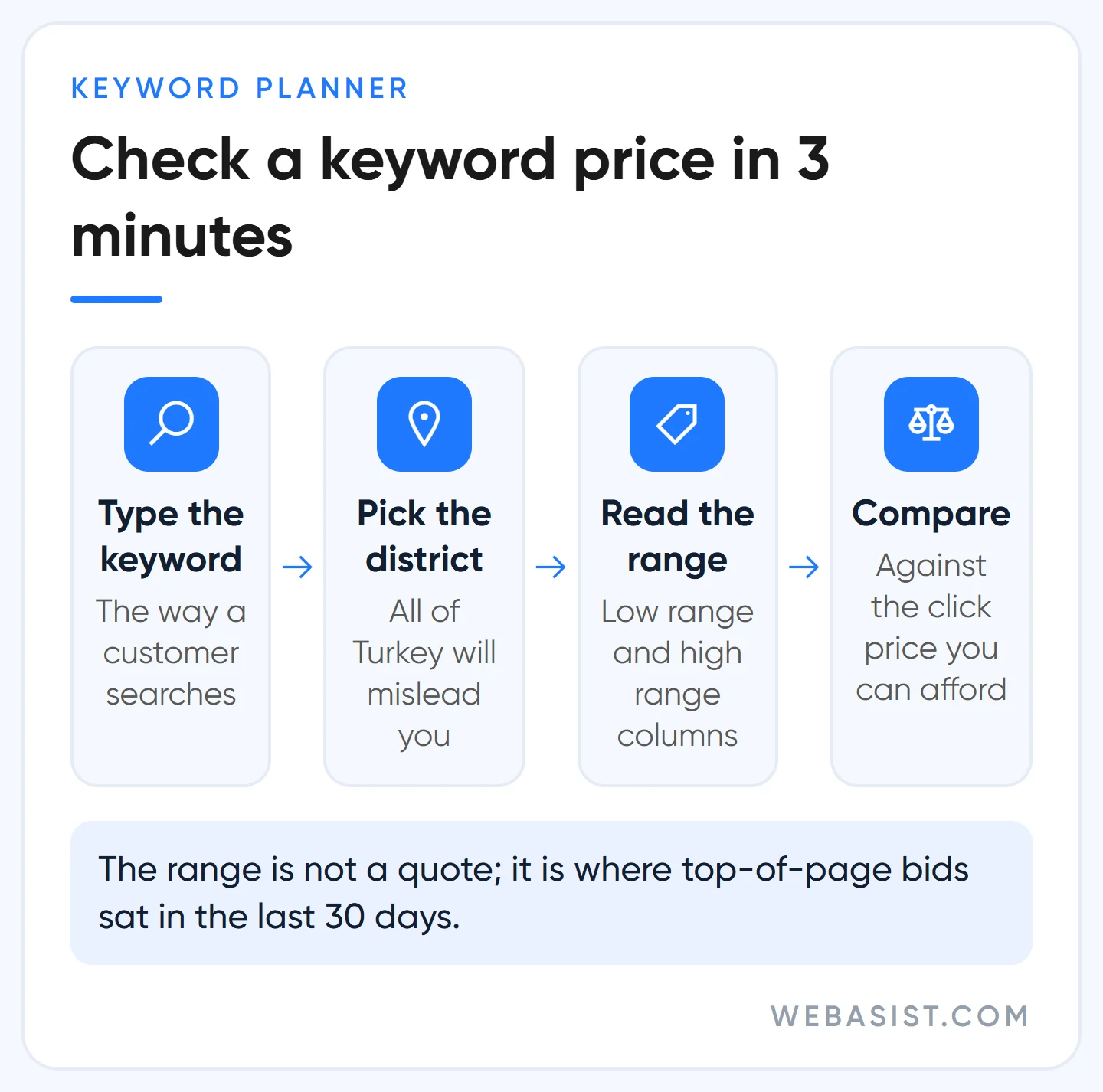
- Type the keyword the way a customer would: "implant prices", "Ataşehir house movers".
- Do not leave the location on Turkey; pick the province or district you actually serve. The range changes with location.
- Read the "Top of page bid (low range)" and "Top of page bid (high range)" columns.
Those two columns are not a quote; they are the lower and upper band of bids that made it to the top over the last 30 days. If you see 12 TL in the low range and 38 TL in the high range (an example), a well-built account buys clicks in the lower half of that band and a badly built one overshoots the top. The mistake we see most often is entering the high range straight in as the bid. Choosing the right keywords is covered step by step in our keyword research guide.
Is this click too expensive for me? Work out the most you can pay
Whether a click is expensive depends on your profit, not on the market. The sum needs three numbers: the profit one customer leaves, how many leads turn into customers, and how well your site turns clicks into leads.
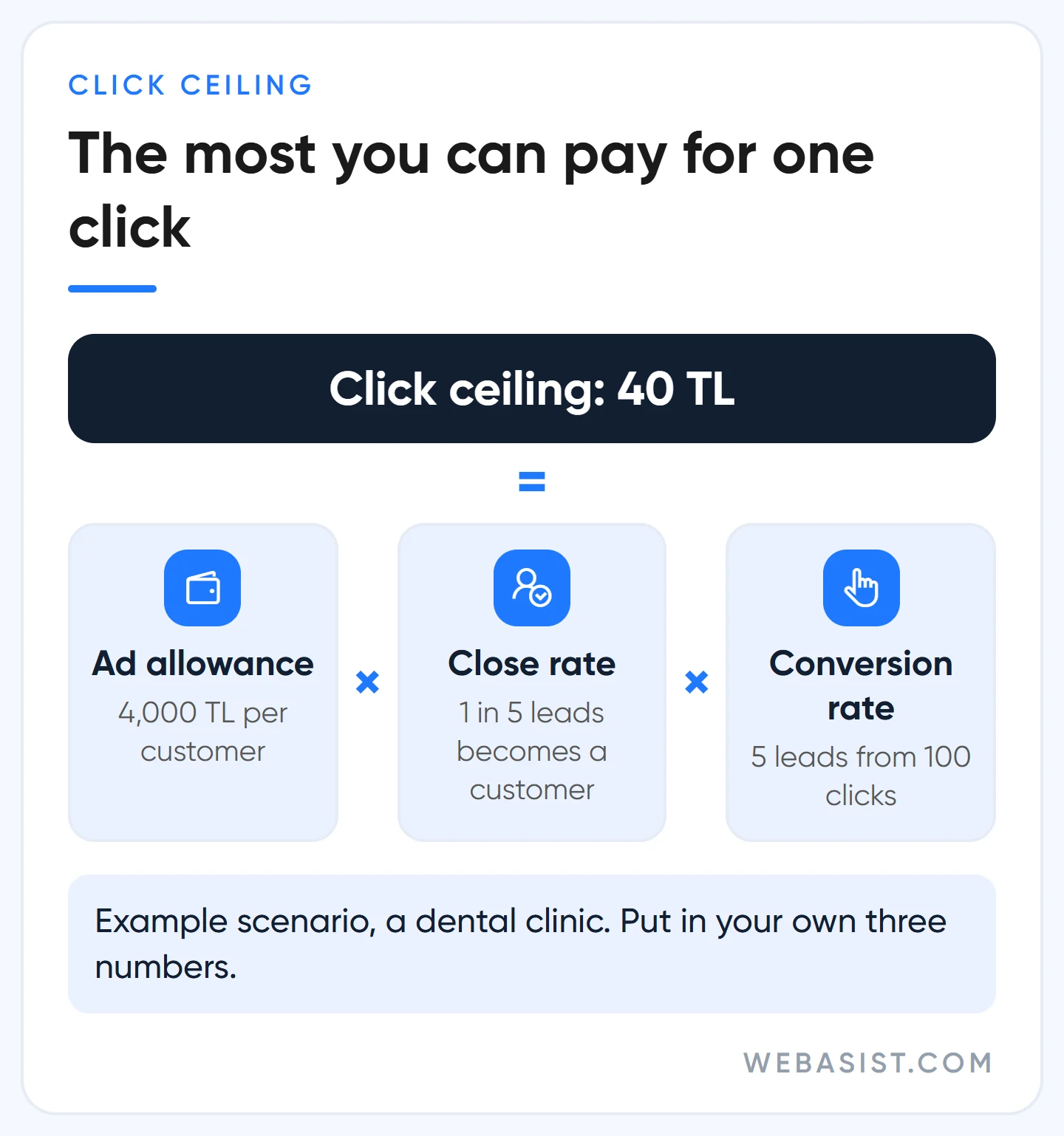
Example scenario, a dental clinic: one implant patient leaves 20,000 TL gross profit and the clinic is willing to give 20% of that, 4,000 TL, to advertising. One in five people who ask for an appointment starts treatment, so a lead can cost at most 800 TL. On the site, 5 out of 100 clicks become a form or a call. The click ceiling is 800 × 0.05 = 40 TL.
If Keyword Planner shows a range of 25 to 60 TL for that keyword, the clinic is playing on the edge: it wins when it buys clicks at the bottom of the range and loses at the top. If the range were 90 to 150 TL our answer would be blunt: stay out of that keyword. Find a narrower one or raise the site's conversion rate first; a bigger budget does not fix this sum.
How much per month? What budget should you start with?
There is no technical minimum; you can enter 50 TL a day. Our own minimum comes from somewhere else: to say whether a campaign works, we want to see around 250 clicks a month. With fewer we cannot call it a failure or a success.
| Click price (example) | Monthly budget for 250 clicks | Per day |
|---|---|---|
| 10 TL | 2,500 TL | About 82 TL |
| 25 TL | 6,250 TL | About 206 TL |
| 50 TL | 12,500 TL | About 411 TL |
| 80 TL | 20,000 TL | About 658 TL |
Our verdict: do not start with 3,000 TL a month on a keyword where a click costs 50 TL. You will get 60 clicks, see 3 leads at a 5% conversion rate and conclude that Google Ads does not work, when it was the budget that did not work. In that position, narrow down to one district and your three to five highest-intent keywords, or save up and come in two months later with the right budget.
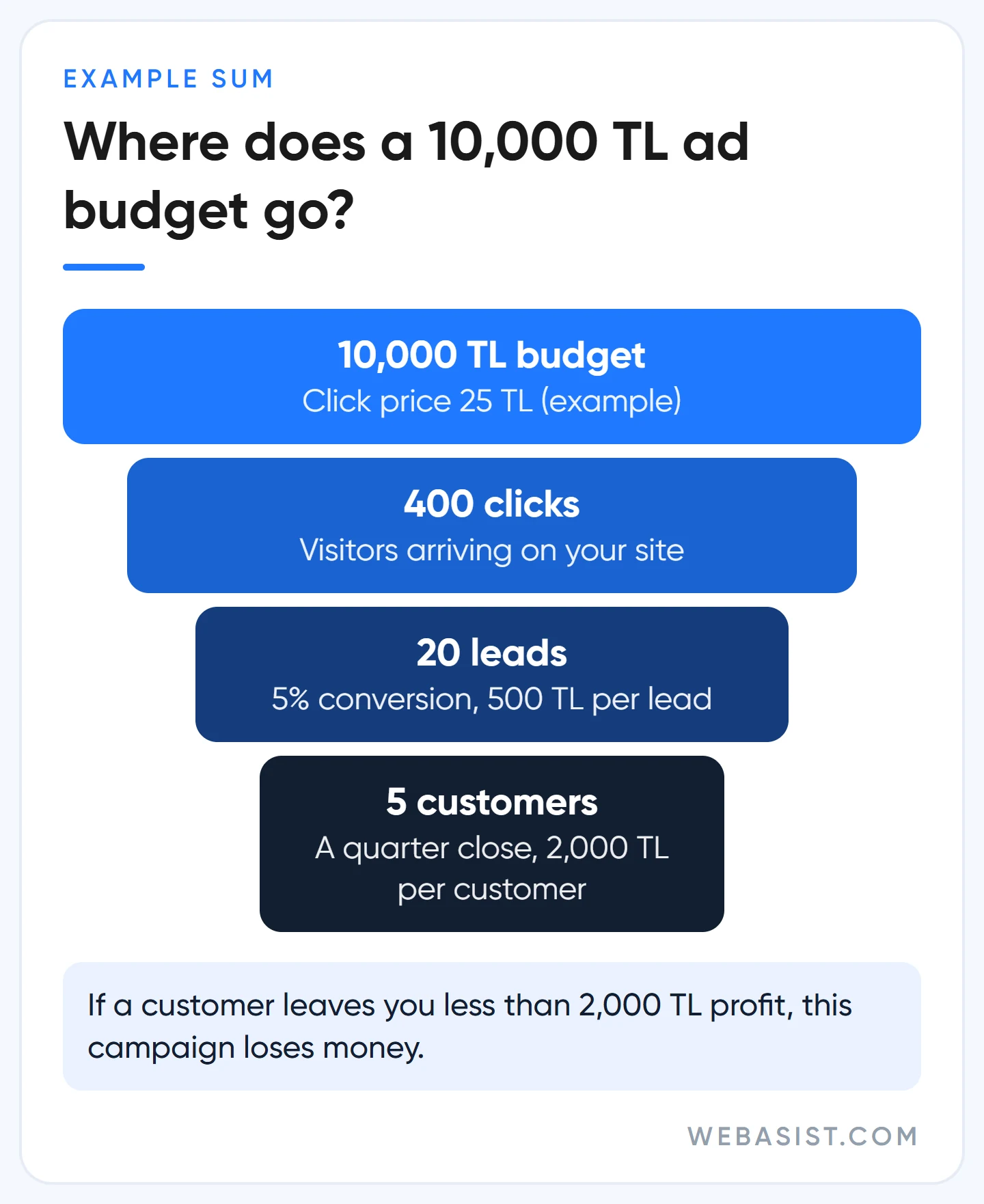
Work out how the budget turns into customers before you start. With a 10,000 TL budget and a 25 TL click you get 400 clicks; at 5% that is 20 leads, and if a quarter of them close you have 5 customers. You have paid 2,000 TL per customer. If a customer leaves you less profit than that, the campaign brings revenue, not profit.
If you are opening a new account, factor in the ad credit Google offers on first spend. Current amounts and the traps around them are in our Google Ads promo code article.
Google Ads management fees: how agencies charge
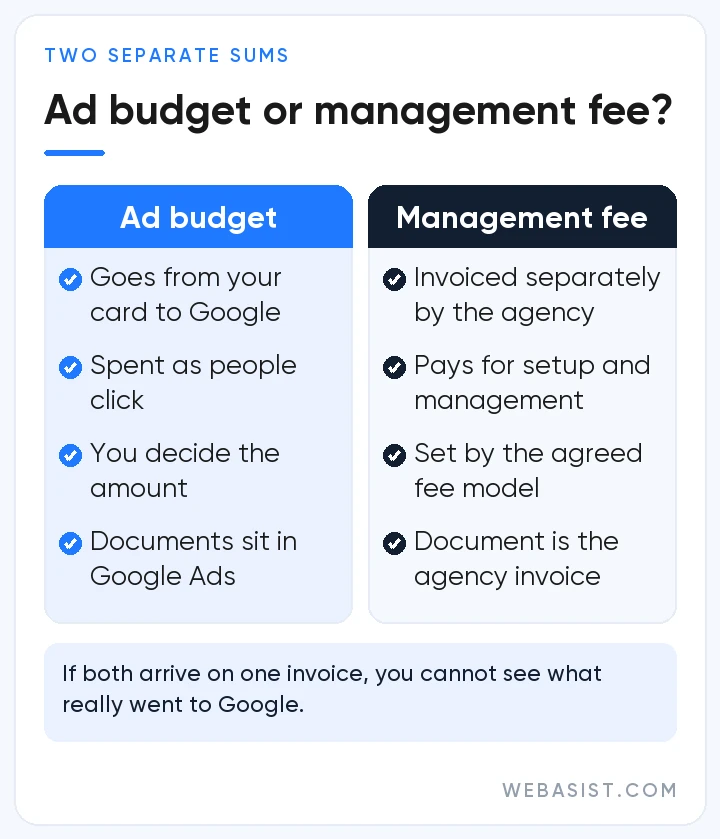
Ad budget and agency fee are two separate sums of money. There are three fee models on the market, and you should not compare quotes before you know which one you are looking at.
- Flat monthly fee: The fee stays the same when your budget grows. Campaign count and scope should be in writing.
- Percentage of spend: The agency's income grows with your budget. Each time you hear "let's raise the budget" you have to ask who benefits.
- One invoice including ad spend: The riskiest model. You cannot see how many lira actually went to Google.
We work on a flat fee and take no commission on your ad budget. Ad payments go from your card straight to Google, the account is opened in your name and you watch the spend in the panel yourself. Our packages include industry and keyword analysis, search term and negative keyword optimisation, ad copywriting and a performance call by phone; the ad budget is not included in the fee. If you would like us to take the account over, our Google Ads advertising packages page shows what is included.
One sentence against our own interest: if your monthly ad budget is smaller than an agency's monthly fee, do not hire us or any other agency. You would pay more for management than for ads; you are better off adding it to the budget and running the account yourself. How to test agency quotes is covered in choosing a Google Ads agency.
When Google says "spend more": the default settings that inflate cost
Google sells ad space. The panel's defaults and its recommendations both lean towards more impressions and more spend. Nothing surprising there; a seller wants to sell. But you are the one paying, so these are the first places we look in every account we take over:
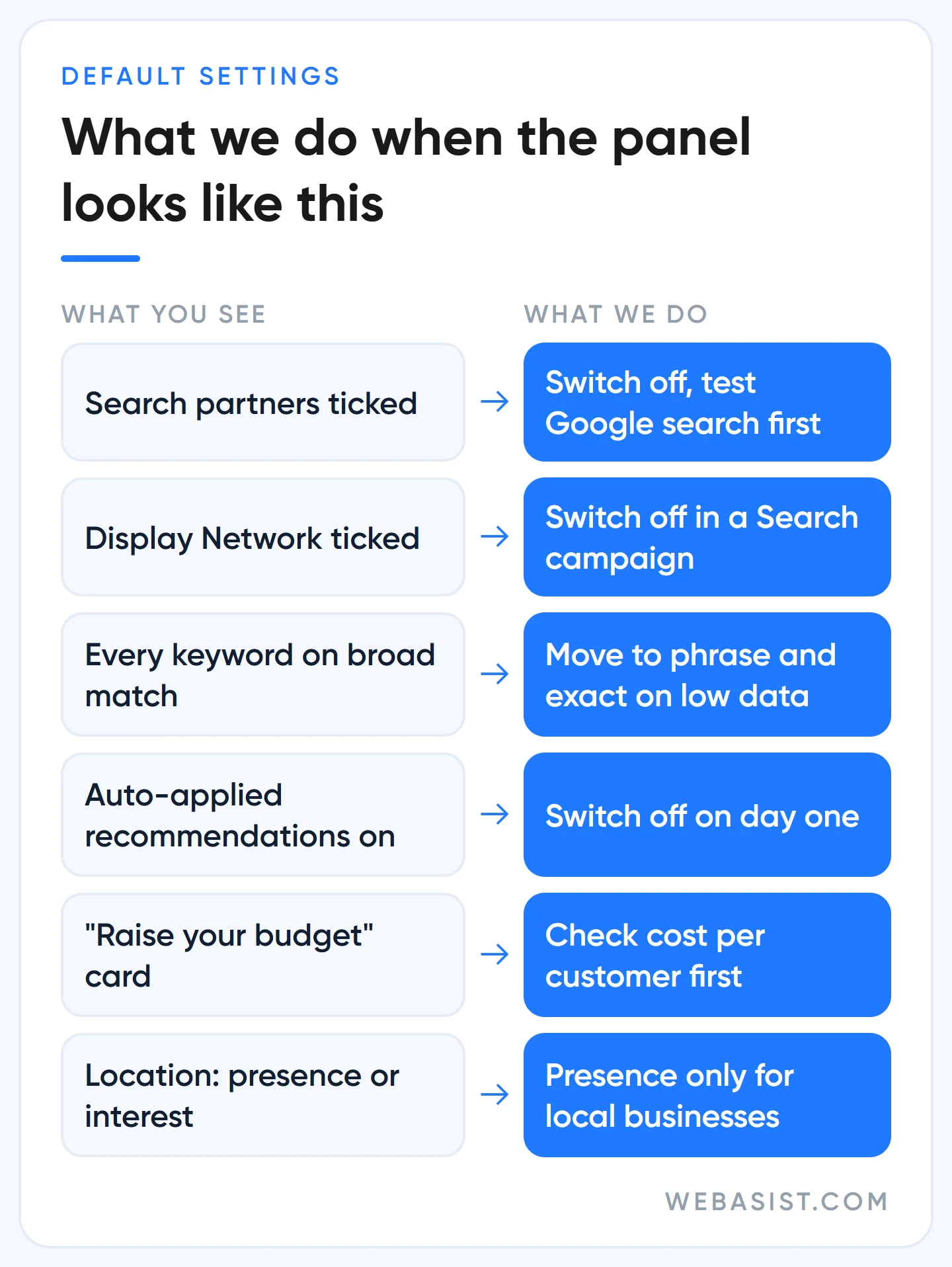
- Search partners and Display Network boxes: Both come ticked in a new Search campaign. We start with both off, so the budget is spent on Google search itself first.
- Broad match: Google recommends adding new keywords as broad match. In an account that does not see 20 to 30 conversions a month, that means paying "boiler repair" money for "how does a boiler work" searches. On a small budget we start with phrase and exact match and build the negative keyword list from week one.
- Auto-applied recommendations: Left on, the system adds keywords and changes bid strategies on your behalf. We switch them off on day one.
- The "raise your budget" card and optimisation score: The score does not measure your profit; it measures how closely you follow recommendations. Dismissing a recommendation raises the score too, so you do not need to raise the budget for the sake of the score.
- Location option: The default targets people in your area and also people "interested in" it. Someone in Ankara searching "Istanbul movers" clicks your ad. For a local business we switch this to "Presence".
Fixing these five settings saves more money than cutting bids. Cut the bid and your ad drops down the page; cut the wasted clicks and the same money gets you in front of more customers.
Who should not put money into Google Ads?
We do not tell every business to advertise. If one of these describes you, keep the money in your pocket for now:
- Nobody searches for your product. Search ads capture demand that already exists; they do not create it. For a new category or an unknown brand, Meta ads are the better starting point.
- Your margin cannot carry the click. On a product that leaves 150 TL profit, a 15 TL click and a 2% conversion rate mean 750 TL per customer.
- Nobody will pick up the phone. In a business that answers forms the next day, the most expensive click is the missed call.
- Conversion tracking is not set up. Every lira spent without seeing which keyword brings customers is a guess; set up conversion tracking first.
Frequently Asked Questions
How much does one Google ad cost?
There is no fee per ad. Writing and showing an ad is free; money leaves when it is clicked. Write ten ads and the invoice stays the same. The invoice is driven by the number of clicks and the price of each one.
How much do 1,000 views cost on Google Ads?
With video ads you pay per view or per thousand impressions, and the price is set in an auction that depends on the audience you target. You find your own figure by dividing spend by views: if you spent 2,000 TL and got 20,000 views, 1,000 views cost you 100 TL (an example calculation).
Are "sponsored ad" prices on Google different from Google Ads prices?
They are the same thing. Results labelled "Sponsored" in search are Google Ads ads; there is no separate sponsored-ad price list. If someone sells you "first place on Google" for a fixed price, what they are selling is either their own management fee or a promise they cannot keep.
Do you pay for Google Ads upfront?
In most accounts you spend first; Google charges your card when costs hit certain thresholds and at the start of the month. You can also work on prepay by loading a balance.
Conclusion
The price of Google Ads is not set by Google; it is set by your keyword, your district and your website. Your job is to know the most you can pay for one click. Do not talk budget before you know that number, and do not let anyone else talk budget to you either.
Send us your keyword, the district you serve and the profit one customer leaves you. We will pull the Keyword Planner range and work out your click ceiling together, and if the numbers do not add up we will not hesitate to say "stay out of this keyword".
Sources
- Jurisdiction-specific surcharges: the basis for the 4.5% rate in Turkey.
- About spending limits: the twice-daily and 30.4-times monthly rule.
- About Keyword Planner forecasts: top of page bid ranges.
- Actual cost-per-click (CPC): Definition: why you pay less than your bid.














